


A harvest of more than 175 kilograms was an early milestone in the development of saffron in Lorestan. The surviving article did not give that figure a year or a source, so it cannot be presented as the province’s current output. A later official agricultural report gives a clearer dated picture: in 2019, Lorestan had 381 hectares of saffron and reported 1,047 kilograms of production.
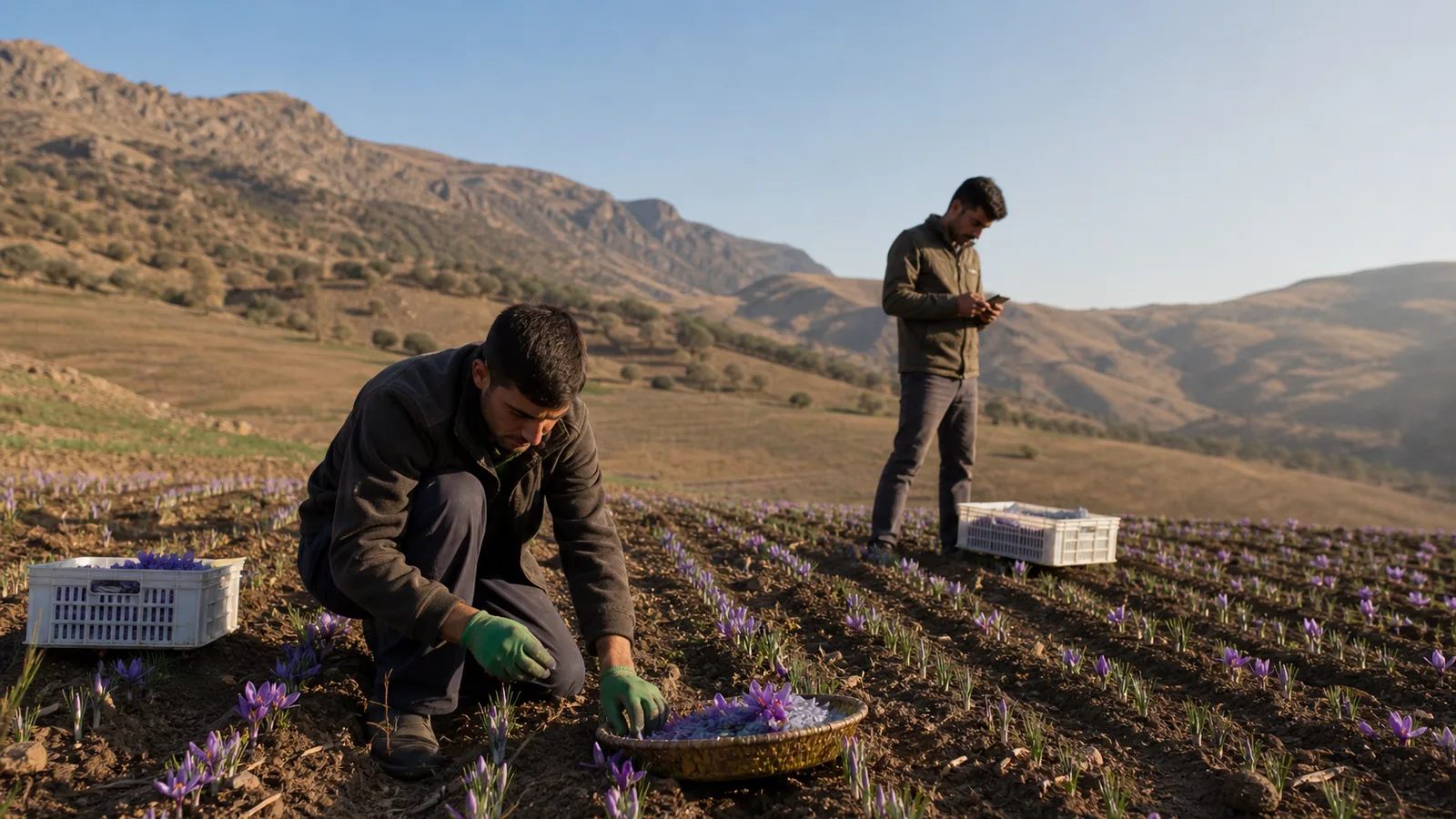
That growth is the real story behind harvesting more than 175 kg of saffron in Lorestan. The province moved beyond a small trial crop and began building a wider production chain, but planted area alone does not guarantee a strong return. Mature fields, healthy corms, skilled picking, prompt drying and a market that recognises the product all matter.
From 175 kilograms to more than one tonne
The 175-kilogram figure belongs to an undated historical report. It is still useful as a marker of the crop’s earlier scale, but the absence of a stated season means it should not be compared as if it came from the same year as later figures.
In February 2020, IANA published data from Lorestan’s Agricultural Jihad Organization for the 2019 season. The organisation reported 381 hectares under saffron and total output of 1,047 kilograms. It also said the area had been 310 hectares in the previous year and expected another 30 hectares to be added by the following June. The official provincial account described cultivation in every county.
Those totals work out to about 2.75 kilograms per planted hectare. The same report quoted a typical yield of five to eight kilograms per hectare, which appears inconsistent until field age is considered. Newly planted saffron produces little or nothing in its first seasons, while an established field can yield more. Province-wide output divided by all planted land is therefore not the same measure as the yield of a mature bearing field.
Why Lorestan can support saffron
Lorestan lies in western Iran along the Zagros Mountains. Its valleys, elevation changes and local climates create varied agricultural conditions. The older article described the province as covering 28,294 square kilometres and noted its position between Isfahan to the east, Khuzestan to the south and Kermanshah and Ilam to the west.
Saffron is attractive where autumn moisture can be managed and growers need a high-value crop with a lower irrigation demand than many alternatives. “Low-water,” however, does not mean water-free. Corms need suitable soil, good drainage and correctly timed irrigation. A statement that saffron will grow on any unused or rainfed land should be treated cautiously: a field still needs an agronomic assessment, and poor drainage can damage corms.
The 2019 report said planting took place in June and September. Timing varies with local temperature, soil moisture and the condition of planting material. Growers should use local agricultural guidance rather than treating a province-wide news report as a planting calendar for every field.
Field age changes the harvest
Saffron is a perennial crop. After planting, daughter corms multiply underground and the field develops over several seasons. Lorestan’s horticulture manager described the progression this way: some young fields produced only 300–500 grams in the second year, output could reach around two kilograms in the third year and about four kilograms in the fourth, with further increases possible after that.
Those figures are examples, not guarantees. Yield depends on corm size and health, planting density, nutrition, weeds, disease, soil conditions, irrigation and weather around flowering. They do explain why headline totals need both the planted area and the bearing area. A province adding many new hectares may show modest average output until those fields mature.
The same official account associated roughly 1,000 jobs with the province’s 381 hectares. Saffron work is concentrated: flowers open over a short period and need to be picked and separated quickly. Training during harvest is especially important because delays, contamination or poor drying can reduce colour, aroma and storage quality.
Quality needs proof and a local market
Lorestan growers quoted in the report said their saffron had strong aroma and flavour, and the provincial manager referred to favourable test results. Those statements show local confidence, but “better than every other region” is not a conclusion that can be made without comparable samples, the same laboratory method and the same crop year.
For buyers, origin should be supported by a traceable lot and quality should be shown through testing. Colouring strength, bitterness and aroma are commonly associated with crocin, picrocrocin and safranal, while moisture and foreign matter also affect whether a lot meets a specification. A place name alone cannot replace those measurements.
The 2019 article identified weak branding, limited processing and traditional packaging as barriers. In 2020, Lorestan’s Agricultural Jihad Organization presented what it called the province’s first saffron value chain, covering corm handling, planting, harvest, sorting, grading, packaging, quality assessment, marketing and household use. That value-chain programme addressed the right problem: production has more value when the province can preserve quality and identity after harvest.
The wider agricultural snapshot behind the original report
The archived copy paired its saffron headline with a much broader, older development speech by Engineer Ishaq Taheri Moghaddam, then head of Lorestan’s Agricultural Jihad Organization. It referred to 131,000 agricultural and livestock households and 4,250 agriculture graduates as a potential skilled workforce.
It also listed 56,000 hectares of orchards producing 220,000 tonnes of fruit, 41,000 tonnes of poultry meat and a target to send 23,000 tonnes of white meat to other provinces by the end of Iran’s Fifth Development Plan. Other figures included 30,000 hectares under pressurised irrigation, 31 rivers and 16,210 tonnes of warm- and cold-water fish.
These numbers belong to that planning period. They are retained here to explain the original context, not offered as current statistics. Their relevance to saffron is strategic: the province was considering how agriculture, water infrastructure and trained graduates could create productive rural work. Saffron was one part of that larger programme.
What the 175-kilogram milestone means now
The old headline should be read as a starting point. By the 2019 report, Lorestan was producing more than a tonne from hundreds of hectares, and the next task was no longer simply to expand. It was to help young fields mature, teach careful harvesting, verify quality, improve processing and packaging, and build a market that lets Lorestan saffron keep its identity.
Because no complete newer official provincial series was found, the 1,047-kilogram figure should also remain dated. A future update should compare the same measures—crop year, planted area, bearing area, dried saffron output and tested quality—before claiming another increase.

![Exporting Saffron to Turkey + Price Guide [Complete 0 to 100]](https://img.rowhanisaffron.com/20260827003933/saffron-export-turkey-quality-inspection.webp)



