


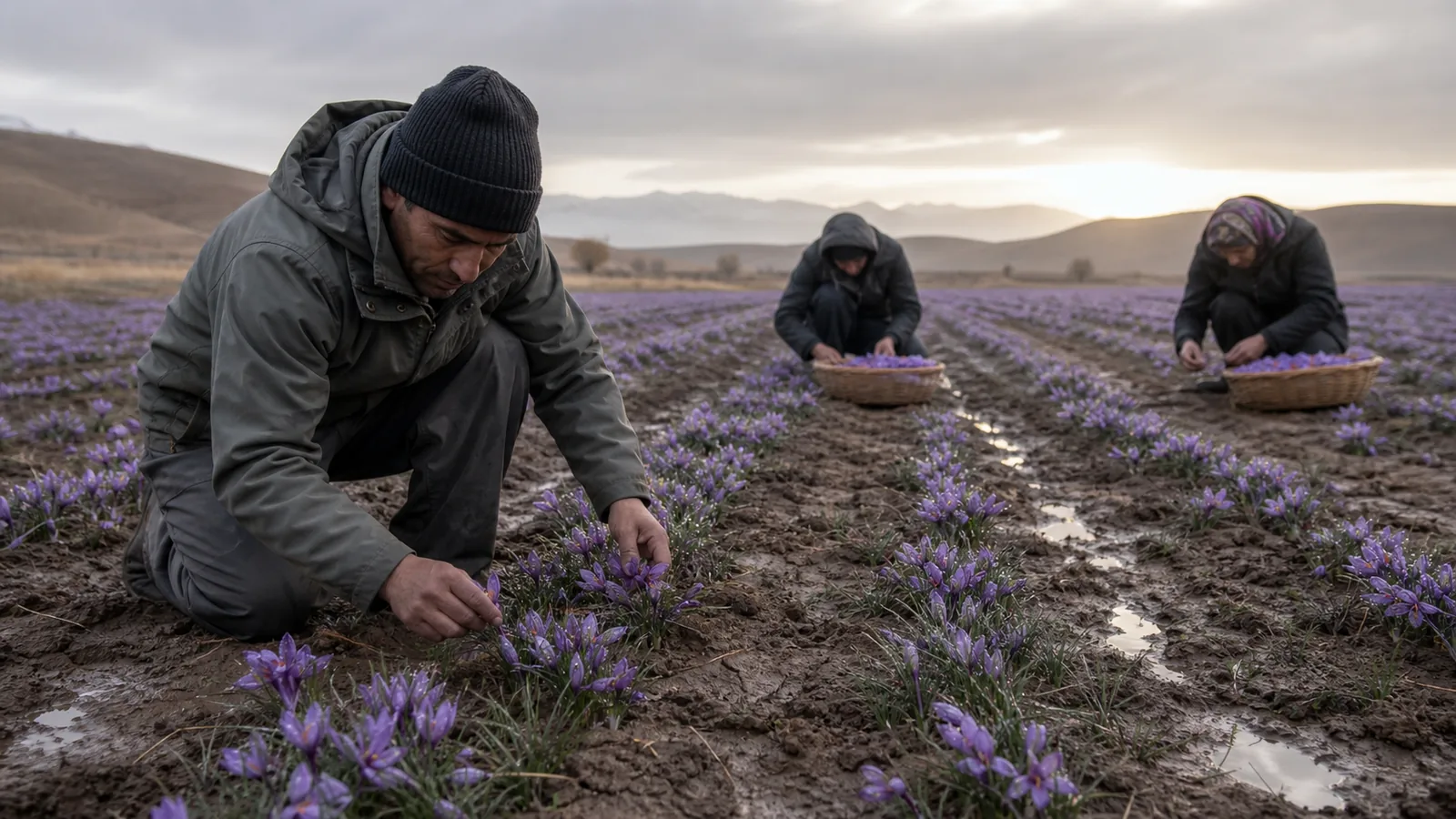
Rain and frost reduced saffron production across parts of Khorasan by damaging flowers during the short harvest window. A national council estimate put the overall fall near 20%, while a local report from Boshruyeh in South Khorasan recorded a 55% reduction after temperatures reached −10°C.
These are historical reports from one difficult season. Their production, rainfall and damage values should not be treated as current forecasts.
A 300-tonne forecast was cut after bad weather
Ali Hosseini, a member of Iran’s National Saffron Council, said the country had initially been expected to harvest about 300 tonnes. Following rain and frost in saffron-growing areas of Razavi Khorasan and South Khorasan, he revised the expected crop to roughly 240–270 tonnes from about 80,000 hectares.
The wide revised range reflects uncertainty rather than a final measured result. A 20% reduction from 300 tonnes would equal 240 tonnes, the low end of the forecast. Hosseini also said production would not fall below the preceding year’s crop, but the source did not state that earlier total.
Torbat Heydarieh, Kashmar and Bardaskan were named among the main rain-affected areas. In mountainous parts of Kashmar, frost reportedly destroyed flowers that had emerged for that day’s picking.
Why rain during flowering creates a quality risk
Rain does not automatically make every recovered saffron thread poor quality. The immediate problem is that wet flowers are fragile, difficult to separate and slower to process. If harvesting, stigma separation or dehydration is delayed, the final spice may lose consistency.
Post-harvest treatment is measurable and important. A peer-reviewed study on saffron drying temperature and airflow found that drying conditions affected retention of crocin pigments and formation of safranal, compounds linked with colour and aroma. The current ISO 3632-1:2025 saffron specification sets requirements for dried saffron and includes storage and transport recommendations.
The practical response to rain is therefore speed and control: collect salvageable flowers carefully, keep them clean, separate stigmas promptly, dry them with a validated process and test the finished lot. A general news report cannot determine the grade of an individual farmer’s saffron.
Boshruyeh: 534 hectares hit by frost
The local South Khorasan case was more severe. Hossein Sarchehai, then director of Boshruyeh’s agricultural administration, said temperatures had fallen below freezing and reached −10°C during saffron flower harvest. He reported frost across 534 hectares and an approximately 55% reduction in the city’s saffron crop.
The wording that the full 534 hectares were frost-hit should not be confused with a 100% crop loss. The same source’s 55% harvest reduction indicates that damage affected the area but did not eliminate every recoverable flower.
Officials valued the damage at about 10 billion tomans in that reference period. That is a dated estimate in historical currency, not a present replacement-cost figure. Wheat, barley and rapeseed were also reported damaged, showing that the cold event extended beyond saffron.
Drought and frost struck the same farms
The frost followed an exceptionally dry agricultural year. Sarchehai reported only 19.7 millimetres of rainfall and described Boshruyeh as the country’s least-rainy city in that period. The source does not identify the national rainfall comparison dataset, so that ranking remains an attributed local statement.
Farmers had already been supplying some saffron fields by tanker to keep the crop alive. Tanker irrigation is expensive and difficult to scale. After growers carried fields through drought, frost at flowering removed much of the harvest they were trying to protect.
What compensation needs to recognise
Sarchehai asked the provincial crisis-management authorities to plan special compensation for affected farmers. A credible damage assessment would need to distinguish planted area, productive area, degree of flower loss, expected yield, salvageable output and damage to corms or irrigation infrastructure.
That distinction prevents a headline percentage from becoming the only evidence. Two farms within the same 534 hectares may have experienced very different losses depending on elevation, cold-air drainage, flowering stage and field protection.
Reducing risk before the next harvest
No farm can remove a regional freeze or stop rain at flowering. It can improve readiness: monitor local forecasts, organise labour so flowers can be collected quickly, prepare clean separation and drying capacity before bloom, and document each field and lot. Regional authorities can support timely warnings, damage surveys and practical financial relief.
The national 20% estimate and Boshruyeh’s 55% local loss describe different scales of the same weather event. The first shows the effect on supply; the second shows what that average meant in one drought-stressed city. Keeping both perspectives makes the production decline understandable without overstating the certainty of either report.

![Exporting Saffron to Turkey + Price Guide [Complete 0 to 100]](https://img.rowhanisaffron.com/20260827003933/saffron-export-turkey-quality-inspection.webp)



