


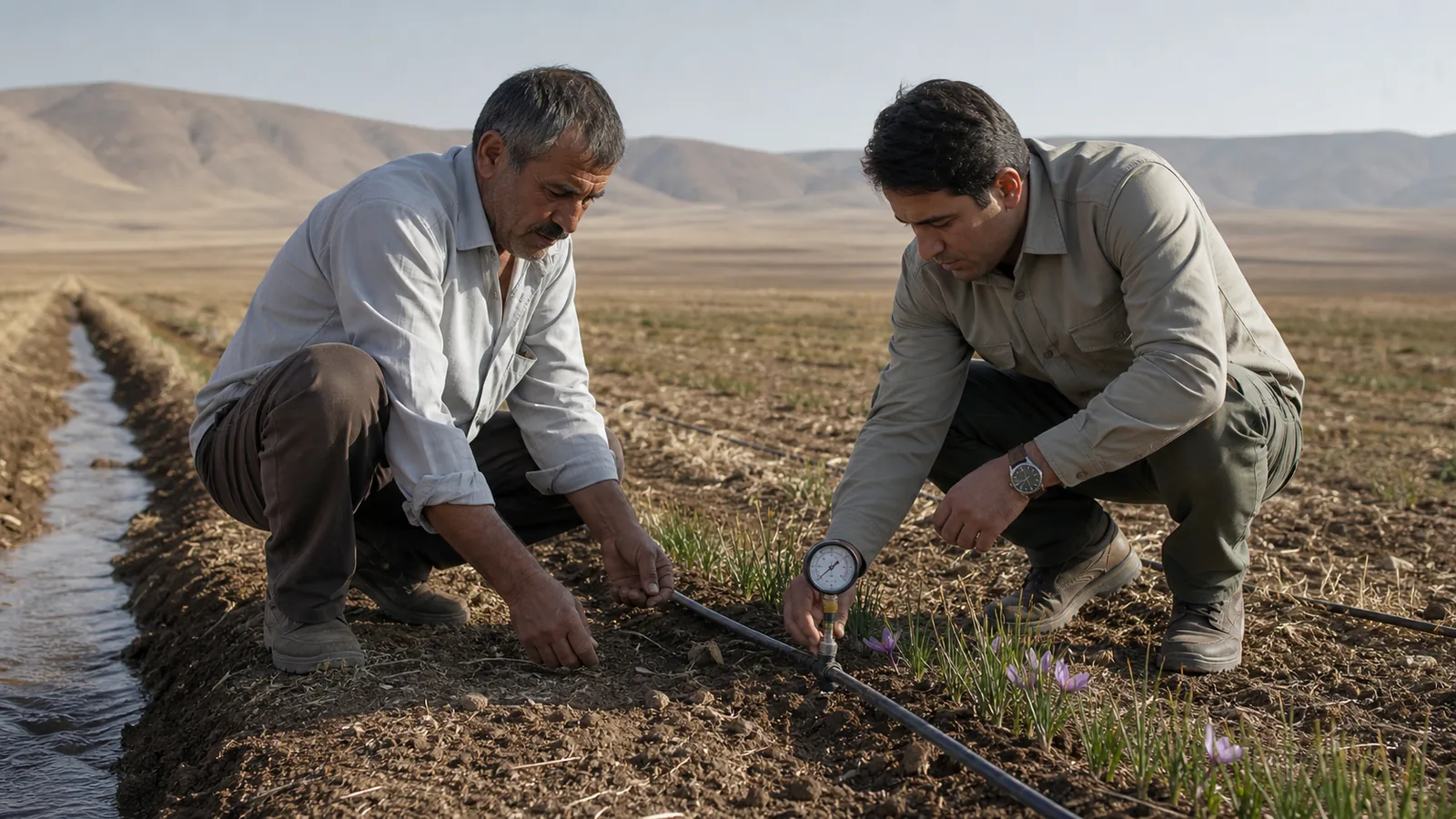
Rashtkhar saffron production fell by more than 45% in the drought-affected historical season covered by this report. Local farms harvested about 6.7 tons of dried saffron, far below the more than 18 tons reported before the long drought. Officials and farmers connected the decline with frost, low rainfall, falling groundwater, saline-water movement, and inefficient irrigation.
The problem was not confined to one bad harvest. A related account described farmers gradually moving away from saffron as water conditions and returns worsened. Read together, the reports show an immediate crop loss and the longer structural pressures behind it.
All production, acreage, and price statements below are historical. They do not describe the current Rashtkhar crop or today’s saffron market.
How far Rashtkhar saffron production declined
Mohammad Ebrahim Asadi, then head of plant production at Rashtkhar’s agricultural authority, said frost and continued drought reduced production by more than 45%. He reported a harvest of approximately 6 tons and 700 kilograms.
The article also says Rashtkhar produced more than 18 tons before the drought. Comparing 6.7 tons directly with 18 tons would imply a fall of at least 62.8%, not 45%. The report does not explain whether the 45% used a different recent baseline, preliminary harvest data, or a translated figure. Both statements are therefore retained, but they are not presented as mathematically identical comparisons.
Rashtkhar was described as Khorasan Razavi’s second-largest saffron-producing city. One report listed more than 5,300 hectares; the related farmer account listed more than 6,200 hectares. Those figures may represent different years, active versus registered fields, or another reporting difference. There is not enough evidence to claim that exactly 900 hectares were abandoned.
Weather damage was the immediate cause
Asadi linked the sharp seasonal loss with earlier cold and frost, continuing drought, and reduced rain. A second local official, Hamidreza Rezaei, said flowering and harvest timing had been delayed by the weather and that a reliable production forecast could not be made until conditions became clearer.
Farmers had completed three irrigation stages, but timing had shifted. That matters because a schedule is not useful on its own: water availability, temperature, soil condition, and the stage of the crop determine whether an irrigation helps.
The reports are interviews, not a field experiment. They support the conclusion that weather and water stress were central concerns, but they do not isolate the percentage of loss caused by frost, drought, salinity, or irrigation practice.
Groundwater decline and saline-water movement
Farmer Mohammad Yousefinejad described a longer-term change beneath the Rashtkhar plain. In his account, groundwater levels had fallen sharply, while saline water moved through parts of the aquifer system. Pumping that poorer-quality water for fields added another risk to crop performance and soil condition.
He called the plain the most critical in the province. That is his local assessment; the source provides no groundwater-monitoring series or provincial ranking with which to verify the superlative. The underlying warning remains important: drawing more water from a declining aquifer can make both quantity and quality problems harder to reverse.
Why traditional flood irrigation became part of the problem
Farmers interviewed for the source criticized continued flood irrigation. Alireza Zare argued that inefficient field application increased withdrawals and that some growers had not yet adjusted their methods to the worsening water balance.
Saffron is often chosen in dry regions because it can require less seasonal water than many competing crops. That does not make every saffron field water-efficient. Poor land levelling, leaking conveyance, unsuitable timing, and applying more water than the root zone can use still waste a scarce supply.
Local agricultural programs included land levelling, pipes, canal rehabilitation, and newer irrigation methods. The reports do not publish field-level water savings, so the measures are best understood as the direction of work rather than proof that the aquifer problem had been solved.
How saffron monoculture changed Rashtkhar farming
Yousefinejad said saffron gradually displaced crops that had once been more visible around Rashtkhar, including almonds, pomegranates, seasonal fruit, sugar beet, and sesame. Saffron’s value and comparatively modest irrigation needs encouraged growers to concentrate on it.
That concentration increased exposure. When frost, drought, water quality, or saffron prices turned against the crop, a household with few alternatives had less room to absorb the loss. The source’s concern about “migration” from saffron is therefore about both declining harvests and farmers reconsidering a production system built heavily around one crop.
Rezaei noted that cotton, pistachio, saffron, pomegranate, wheat, barley, beet, and newer medicinal plants were still cultivated in the city. The proposed response was not to erase saffron, but to improve its management while keeping a more diverse local crop mix.
What farmers asked for
The farmer interviews called for practical training from the agricultural authority, especially on crop choice and modern irrigation. Zare also proposed experimenting with greenhouse saffron as a way to reduce groundwater withdrawals and protect production from cold.
The source provides no trial design, energy use, cost comparison, or yield data for the greenhouse proposal. It should not be treated as a proven replacement for field cultivation. Any protected or soilless system would need local trials that count all water, energy, planting material, labour, disease, and equipment costs.
Training, irrigation maintenance, soil and water testing, and reliable farm records are less dramatic but more immediately testable. They help growers see whether a change actually saves water or improves usable dried yield.
The economic effect on growers
Asadi said the reduced crop left many farmers earning little beyond harvest wages and irrigation costs, making saffron uneconomic for that season. He argued that the product price should triple in response to the provincial shortage.
That price proposal is advocacy from the interview, not evidence that the market did or should produce a threefold rise. Price depends on grade, stocks carried from earlier seasons, buyer demand, exports, currency conditions, and contracts as well as the current local harvest. For today’s buying context, use the site’s current saffron price information.
What the combined Rashtkhar reports establish
Rashtkhar’s 6.7-ton season was the visible outcome of several pressures. Frost and drought damaged the immediate crop. Groundwater decline, possible saline intrusion, and inefficient irrigation threatened the production base. Heavy dependence on saffron then magnified the economic effect when yields fell.
The response needed more than waiting for better rain. Farmers and officials pointed toward irrigation improvements, training, crop diversity, and trials of alternative production methods. The figures in the reports contain unresolved baseline and acreage differences, but their central message is consistent: sustaining saffron production in Iran requires protecting the field and water system on which the crop depends.

![Exporting Saffron to Turkey + Price Guide [Complete 0 to 100]](https://img.rowhanisaffron.com/20260827003933/saffron-export-turkey-quality-inspection.webp)



