


An archival production snapshot placed Yazd behind Khorasan Razavi and South Khorasan as Iran’s third-largest saffron-producing province. It reported about three tonnes of annual output from roughly 600 hectares, centred on Tabas and Bahabad.
Date note: the source did not identify the statistical year behind its rank, area or forecast. Those figures are preserved as a historical provincial account, not asserted as Yazd’s current 2026 position.
Where Yazd saffron was grown
The report located the main cultivation areas in Tabas and Bahabad. Within the Tabas area, it specifically named Dastgerdan and Dehuk districts. These places sit in a dry landscape where a high-value autumn-flowering crop can be attractive, but “low water” should not be confused with “no water.”
FAO’s description of the qanat-based saffron system in arid Gonabad provides useful regional context: saffron can support livelihoods under severe water scarcity when cultivation is matched with dependable, locally adapted water management. Yazd farms still need irrigation at the right stages, drainage and protection from salinity or corm disease.
Three tonnes from about 600 hectares
The archived figures were:
- approximately 600 hectares under saffron;
- an average dry-stigma yield of about 5.4 kg per hectare; and
- roughly three tonnes expected for the year.
The arithmetic is broadly consistent: 600 hectares multiplied by 5.4 kg gives 3,240 kg, or 3.24 tonnes. “Roughly three tonnes” may reflect rounded area, a forecast rather than final harvest, or fields producing above and below the provincial average.
Average yield does not describe every farm. It changes with field age, number and size of flowering corms, planting density, soil, weather, irrigation timing, nutrition, disease pressure and how quickly flowers are picked and separated.
The 14 kg-per-hectare Tabas benchmark
A farm sample from Tabas reportedly produced 14 kg of dry saffron per hectare and was recognised as a provincial benchmark crop in 2012. That is much higher than the stated 5.4 kg provincial average.
A benchmark plot is useful for asking which practices worked, but it should not become an automatic target for every grower. The field area used for measurement, corm density, crop age, harvest method and moisture basis of the final saffron all affect a yield comparison. Replication across several seasons is more informative than one exceptional result.
From saffron flower to dry spice
The article said some Yazd saffron was processed within the province, while the rest left as fresh flowers for neighbouring provinces. In practical terms, that means stigma separation and drying happened outside the growing area.
Fresh flowers are bulky and perishable. Delay, compression and heat can make separation harder and affect the condition of the stigmas before drying. Local processing can keep more work and traceability near the farm, provided facilities use hygienic handling, controlled drying and suitable storage.
The Codex saffron standard CXS 351-2022 sets internationally relevant requirements for dried saffron, including product styles, quality characteristics, contaminants, hygiene, packaging and labelling. A provincial origin claim is strongest when each dried lot remains linked to its field and process records.
Packaging and corm supply were the main constraints
Fluctuating prices, limited packaging facilities and a shortage of equipment associated with producing high-quality corms were named as the sector’s largest challenges. The last phrase needs clarification: corm quality is biological, not something a machine creates.
A strong planting programme begins with correctly identified, healthy corms of suitable size. It also needs clean lifting, sorting, curing and storage, plus controls that reduce physical damage and the movement of disease between fields. Equipment can make those operations more consistent; it cannot turn infected or undersized planting material into a high-quality corm.
Packaging addresses a different point in the chain. It should protect dried saffron from moisture, light, odours, contamination and tampering while presenting accurate weight, grade and origin information. Neither elaborate packaging nor a large corm compensates for poor drying, weak traceability or an unsupported grade claim.
What the saffron plant looks like
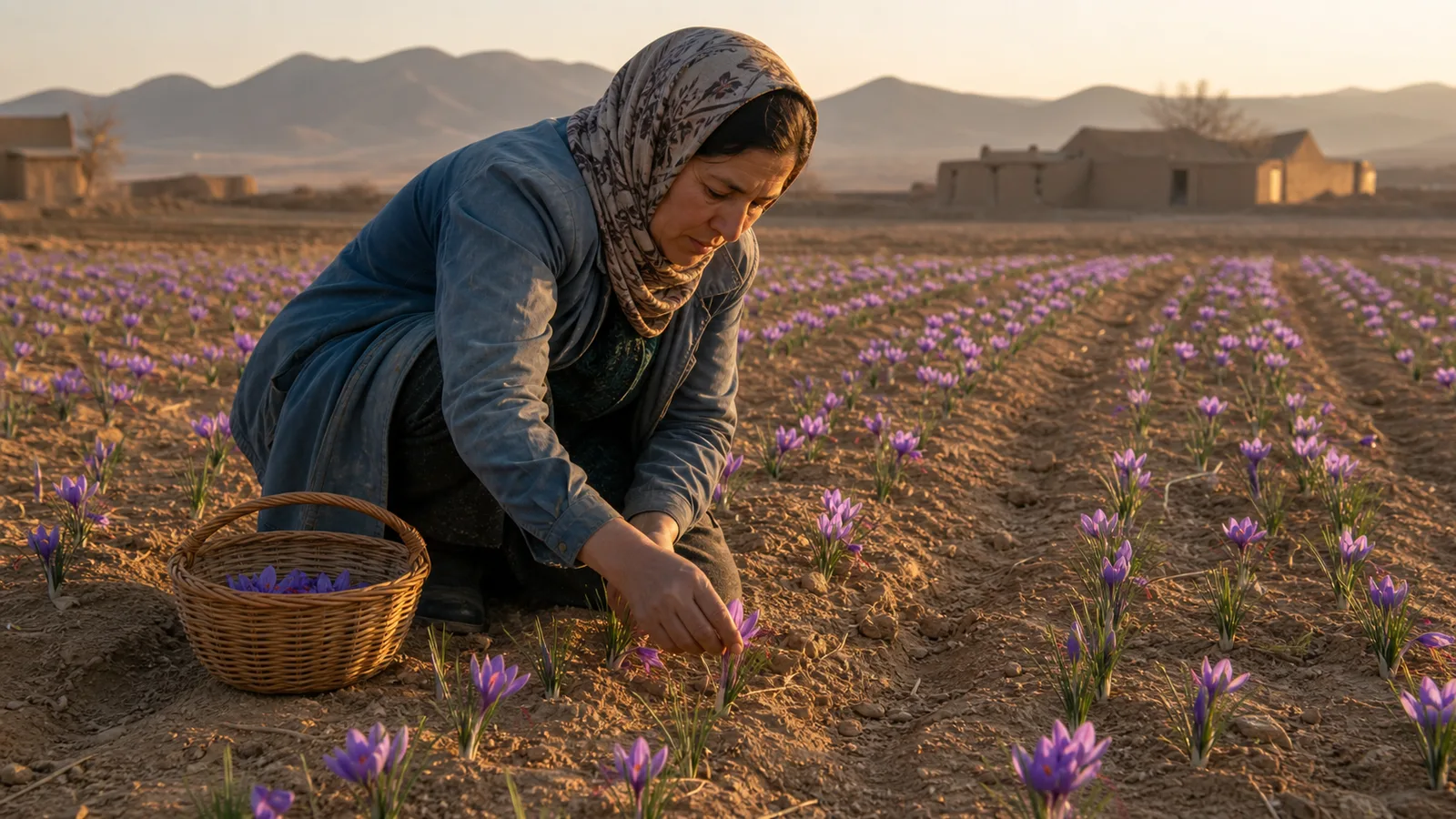
Crocus sativus normally bears a purple flower with six petal-like tepals. At its centre are three red stigma branches. Those red stigmas are separated and dried to make the spice; the whole flower is not saffron spice.
The plant is sterile and is propagated with corms rather than ordinary viable seed. Daughter corms multiply underground over several seasons, which is why field age, crowding and corm health matter to future harvests.
Harvest season in Yazd
The report placed the provincial harvest from the second half of October through the end of December. That wide window is best understood across different sites, elevations and seasons, not as a single field flowering continuously for ten weeks.
Each field’s main flowering flush is much shorter. Flowers are normally picked promptly, often early in the day, and the stigmas separated before the blossoms deteriorate. Labour availability during that concentrated period can limit how much clean material reaches the dryer.
Saffron in food and traditional use
Saffron is valued in Iranian cooking for colour, aroma and a distinctive floral, earthy taste. The older copy also called it appetising, calming and sedative. Those traditional descriptions should not be turned into a promise that a culinary portion treats anxiety, insomnia or another condition.
Human trials have examined concentrated saffron preparations for several health outcomes. A 2025 meta-analysis in people with metabolic syndrome or related disorders assessed blood pressure and metabolic markers, but trial results for a defined supplement do not make Yazd saffron—or food use generally—a proven treatment for high blood pressure. It should not replace medical care.
What the “third-largest producer” claim means today
The title preserves the ranking reported at the time, and one historical impression was associated with that page. A provincial rank can change with planted area, weather, yield, final harvest estimates and the year used for comparison. Without a current official table covering all provinces on the same basis, the article should not imply that Yazd is definitively third in 2026.
Its more durable contribution is the production profile: Yazd had an established saffron sector around Tabas and Bahabad, a reported average near 5.4 kg per hectare, one high-yield Tabas benchmark, and clear gaps in processing, packaging and corm handling. Those are the points future provincial data can be measured against.

![Exporting Saffron to Turkey + Price Guide [Complete 0 to 100]](https://img.rowhanisaffron.com/20260827003933/saffron-export-turkey-quality-inspection.webp)



