


15% of saffron crop is turned into waste records an industry representative’s warning that harvest pressure, repeated flower transport and weak processing practices were reducing usable output.
The report was published on this site in April 2021 and attributes its figures to Ali Hosseini, identified as a member of the National Saffron Council and vice president of the Association of Saffron Producers and Exporters of South Khorasan. The percentages and acreage are historical claims, not current national estimates.
Why Hosseini said 15% was being lost
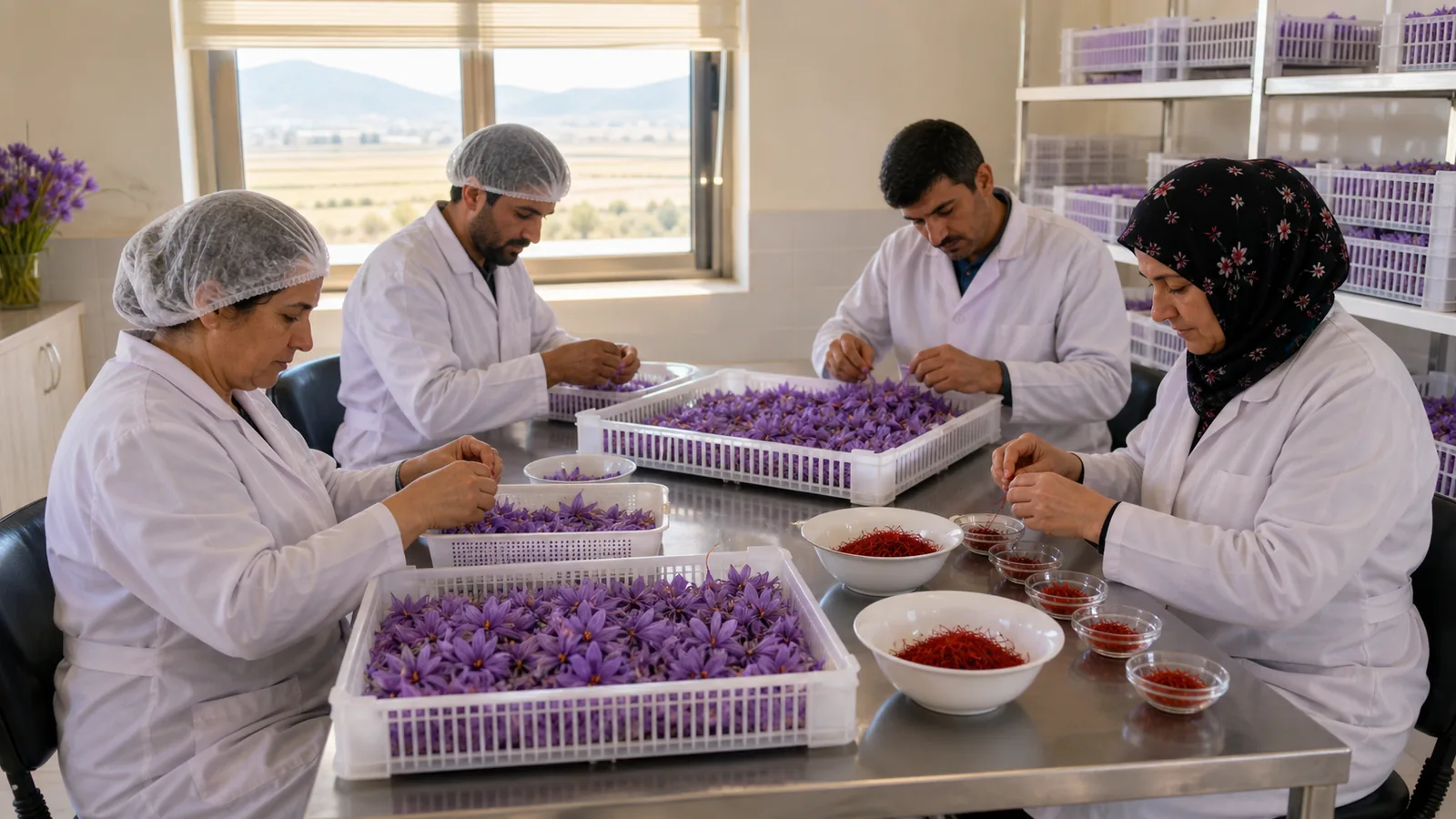
Saffron flowers arrive in a short, labour-intensive harvest window. Hosseini said the sheer number of flowers gathered at once, followed by repeated movement to processing sites, contributed to waste. Delays and unnecessary handling can leave a delicate flower waiting before its stigmas are separated.
He linked the lower harvest per unit of land to three related pressures: rapid expansion of saffron farms, too few workers available to collect flowers, and non-technical processing on the outskirts of cities. In his account, growing more hectares had not automatically produced a proportional rise in finished saffron.
The four-kilogram and five-kilogram yield figures
Hosseini said farms were producing about four kilograms of saffron per hectare at the time. He regarded five kilograms per hectare as a desirable and achievable level.
Those figures were presented as broad benchmarks, not guaranteed yields. Field age, corm density and health, soil, irrigation, weather, flower-picking speed, stigma separation and drying practice all affect the finished amount. The source did not supply a survey method or a regional breakdown for the four-kilogram average.
Expansion from 74,000 to 80,000 hectares
The article reported that saffron cultivation had increased from 74,000 hectares in the previous year to 80,000 hectares in the reporting year. Hosseini expected at least 300 tonnes of saffron from that area, but said actual output was below that level.
His concern was efficiency: considerable resources and more cultivated land were producing less than the total he expected. The report did not state the final national tonnage, so it cannot support a precise calculation of the shortfall.
Larger fields and a concentrated harvest
Hosseini contrasted traditional small plots of less than three hectares with newer farms that often exceeded three hectares. He said consolidation during the preceding decade had created fields ranging from five to 100 hectares.
The original translation describes traditional saffron lands as “more than a thousand years old.” This is best read as a reference to the long history of the small-plot cultivation pattern, not a claim that an individual modern field had remained unchanged for a millennium.
When a large area flowers together, workers must pick and process an unusually high volume in a narrow period. Hosseini argued that insufficient labour or capacity during that peak increased harvest waste.
The saffron quality-improvement pilot
To reduce losses and raise output per hectare, Hosseini said a saffron quality-improvement plan had been tested in the previous year. He claimed that, where the plan and its harvesting and processing principles were followed, waste in the pilot reached zero.
That statement is retained as his reported pilot result, not a promise that all loss can be eliminated at commercial scale. The article did not give the number of participating farms, a control group or the definition used for zero waste.
Correcting the flower-to-saffron unit
The stored English translation says that one kilogram of saffron flowers normally produced “9 to 13 kilograms” of saffron. That cannot be physically correct: finished saffron cannot weigh many times more than the flowers from which it came. The intended unit is evidently grams, which is also consistent with the next figure in the same passage.
Read coherently, Hosseini reported a normal return of 9 to 13 grams of saffron from one kilogram of flowers, rising to 15 to 17 grams under the improvement plan. The correction changes only the impossible unit; it preserves every number and the comparison made in the source.
Implementation across 22 production centres
Hosseini said the project was being implemented in 22 saffron-production “poles,” meaning principal production centres or clusters. The article did not list them or report results for each location.
The practical message of this archive is that acreage alone does not protect value. Picking capacity, short travel to processing, careful stigma separation and controlled drying determine how much of the flower becomes saleable saffron. The 15% figure remains an attributed historical estimate, while the causes it highlights explain where harvest systems can lose quality and output.

![Exporting Saffron to Turkey + Price Guide [Complete 0 to 100]](https://img.rowhanisaffron.com/20260827003933/saffron-export-turkey-quality-inspection.webp)



