


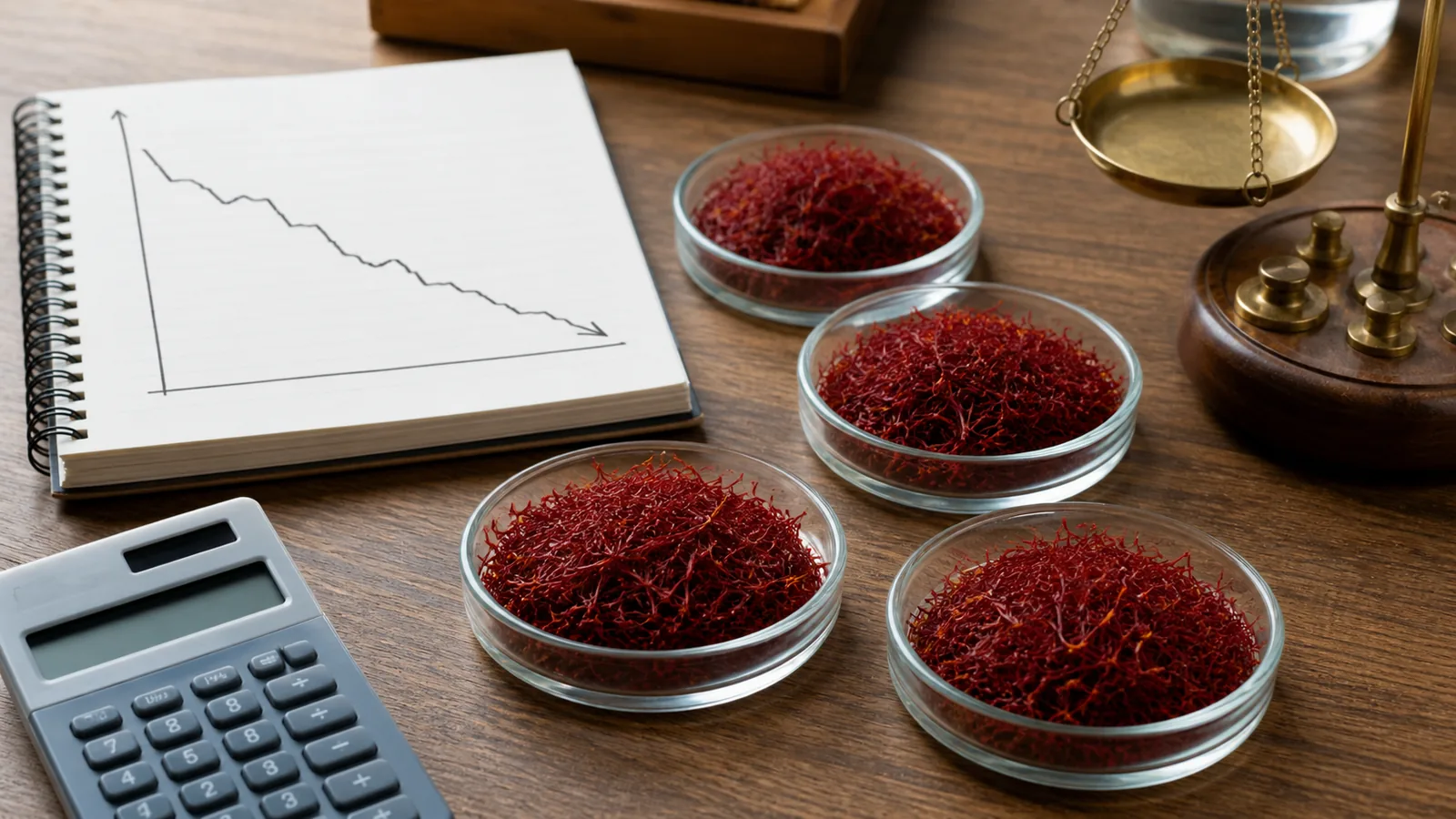
The saffron price on the stock exchange fell during the market episode described here because a large exchange offer was announced below the price farmers’ representatives had been paying. At the same time, weaker exports and a large domestic supply left sellers with fewer alternatives.
This is a historical market report, not a current saffron quotation or forecast. It records an explanation given by Gholamreza Miri, then vice-president of Iran’s National Saffron Council, after prices were reported to have fallen by about 50 percent.
The short answer
Miri linked the decline to several pressures working together:
- A large volume of saffron was available after harvest.
- Exports had slowed, reducing demand for a crop heavily dependent on foreign buyers.
- Banking and regulatory constraints made it harder for established exporters to operate.
- A 40-ton stock-exchange offer was announced at a price below the range previously paid by the farmers’ union.
- That lower exchange figure became a reference point for farmers and buyers in the wider market.
No single item explains the whole decline. The exchange price mattered because it arrived in a market already carrying excess supply and weaker export demand.
The stock-exchange price gap
According to the original report, the farmers’ union had bought saffron at 10.5 million to 11.5 million tomans. The stock market then announced an offer of 40 tonnes at 9.2 million tomans.
The article did not identify the saffron grade, contract specification or unit explicitly; the figures are commonly understood in the report’s wholesale context as a per-kilogram price. They should not be compared directly with a modern retail price for a one-gram package.
The difference was substantial. The 9.2 million toman offer sat about 12 percent below the bottom of the reported union range and 20 percent below its top. Once a visible institutional offer appeared at that level, private buyers had a reason to bid lower as well.
Why the exchange could affect farm prices
A commodity exchange does more than provide another place to sell. Its quoted offers are visible to traders, warehouses, exporters and producers, so they can influence expectations outside the exchange itself.
In Miri’s account, farmers were effectively pushed toward the lower stock-market reference. If buyers believed a large quantity could be obtained at 9.2 million tomans, they had little incentive to match the earlier 10.5-to-11.5-million range.
That does not mean a stock exchange always makes saffron cheaper. The direction depends on contract quality, volume, delivery terms, buyer participation and the balance between supply and demand. In this episode, the reported offer was both large and lower-priced.
Exports were the second pressure
Miri said around 80 percent of the saffron crop was exported at the time. That percentage is retained as his statement in the historical report, not presented as a current statistic.
When a crop relies heavily on overseas sales, an export slowdown leaves more product competing for fewer domestic buyers. The report described exactly that combination: plentiful saffron in the market and reduced export activity.
If the export decline continued, Miri warned that saffron prices could fall further. His reasoning was straightforward: supply that normally left the country would remain in Iran, increasing pressure on farmers and traders to accept lower bids.
Banking and regulatory barriers
The report attributed part of the export slowdown to banking problems, limited physical presence in international markets and concern among reputable exporters about financing, penalties and referral to judicial authorities.
Miri gave one exporter as an example. The translated source labelled the years “1996” and “1997,” but the Iranian context indicates Solar Hijri years 1396 and 1397—roughly March 2017 to March 2019—not the Gregorian years 1996 and 1997.
For that exporter, annual sales were said to have fallen from about $40 million in 1396 to roughly $3 million–$4 million in 1397. This was an attributed example, not a complete national export series, but it illustrated how sharply legitimate trade could contract when financing and settlement became difficult.
The role of informal trade
Miri also said the smuggling route remained active. That matters because informal exports do not necessarily support the same contracts, traceability, branding or transparent price discovery as declared trade.
The original interview argued that reputable exporters were being constrained while informal channels stayed busy. In that situation, official export numbers can weaken even though saffron still moves across borders, and formal businesses may be less able to develop stable markets.
What the reported 50 percent fall means
The article referred to a 50 percent decrease in saffron, but it did not provide the starting date, grade, contract or complete price series needed to reproduce that percentage. It should therefore be read as the decline discussed in the interview, not as a precise calculation that applies to every saffron type.
Saffron is not one uniform product. Grade, moisture, colouring strength, origin, certification, packaging and lot size all influence the price. A wholesale exchange offer and a branded retail packet answer different market needs.
Lessons from this saffron stock-market episode
- Visible exchange offers can reset wider buyer expectations, especially when their volume is large.
- Harvest supply becomes more difficult to absorb when exports slow at the same time.
- Financial and regulatory access can affect commodity demand even when consumer interest has not disappeared.
- Historical price claims need a date, unit, grade and market channel before they can be compared.
- A quoted official or industry representative should not be mistaken for a complete audited market dataset.
So, why did the price of saffron on the stock exchange go down? In the account preserved here, the immediate trigger was a 40-ton offer at 9.2 million tomans, below the earlier farmers’ union range. Its effect was amplified by surplus saffron, weaker formal exports and banking and market-access barriers. The explanation belongs to that period; a current buying or investment decision needs current contract and market data.

![Exporting Saffron to Turkey + Price Guide [Complete 0 to 100]](https://img.rowhanisaffron.com/20260827003933/saffron-export-turkey-quality-inspection.webp)



