


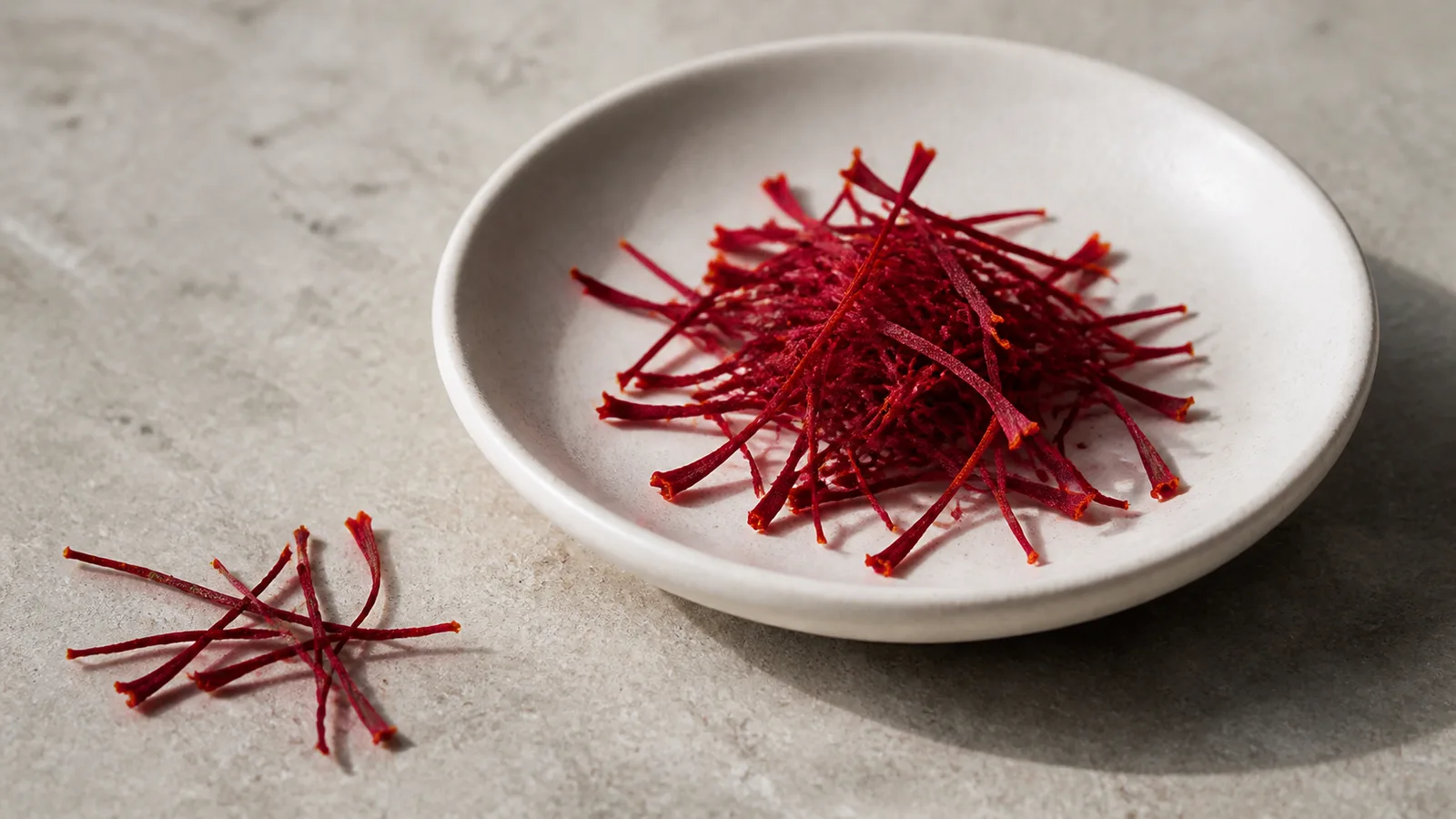
Negin saffron is a commercial thread category, not a separate saffron plant. It is made from the red stigmas of Crocus sativus, selected and dried so the threads are long, relatively thick, well separated, and show little or no yellow-white style.
That clean appearance makes Negin attractive for gifting, retail display, and dishes where visible threads matter. It does not, by itself, prove that a batch has stronger color, aroma, or flavor than every other saffron. Those qualities depend on the crop, processing, storage, purity, and laboratory measurements as well as the commercial cut.
What is Negin saffron?
Each saffron flower carries three stigmas attached to a lighter style. After harvest, workers separate and dry these parts in different ways. Iranian trade names such as Pushal, Negin, and Sargol describe the form and trimming of the finished threads.
Negin generally consists of long red stigma sections with the pale style removed. The threads are selected for a uniform, unbroken appearance and are less tangled than bunch-style saffron. “Negin” is therefore best understood as a commercial presentation category. It is not a botanical variety and not a guarantee of origin.
How Negin saffron is harvested and prepared
Saffron flowers are picked during their short flowering season, often early in the day while the blossoms remain relatively closed. The stigmas are separated by hand and dried promptly. Drying matters: it must reduce moisture enough for storage while preserving the compounds responsible for color, bitterness, and aroma.
For Negin, workers trim away the pale style and select longer red sections. Careful handling reduces breakage and helps the threads remain visually distinct. The final product is then sorted, packed, and protected from moisture and light.
Negin saffron characteristics
- Color: predominantly deep red threads, without a large yellow or white portion.
- Shape: long, relatively thick stigma sections with visible trumpet-like ends.
- Condition: mostly intact and separate rather than heavily crushed or tangled.
- Aroma: a clean, complex scent often described as floral, hay-like, and gently earthy.
- Taste: a distinctive mild bitterness; saffron should not taste simply sweet.
Appearance is useful for inspection, but color intensity in food cannot be judged reliably by thread length alone. ISO 3632 specifies requirements for dried saffron and provides a framework for assessing saffron in filament, cut-filament, and powder forms. Laboratory testing, not a trade name, is the stronger basis for claims about analytical quality.
Negin saffron benefits: what the grade actually offers
The practical benefits of Negin saffron are commercial and culinary:
- Long red threads have an appealing, consistent presentation.
- Whole threads are easier for a buyer to inspect than powder.
- Low visible style content means the package is predominantly red stigma material.
- Intact threads are convenient for counting, grinding, garnishing, and blooming.
- Carefully handled batches can retain an excellent aroma and deliver strong color in cooking.
The labor and uniform premium presentation often contribute to a higher price, but price is not proof of stronger flavor or cleaner laboratory results.
These are not unique medical benefits. Negin is made from the same plant and the same stigma tissue as other genuine red saffron categories. Saffron contains studied antioxidant compounds, including crocin and safranal, but a Negin label does not show that normal culinary use improves mood or overall well-being. It should not be used as a health-treatment claim.
What is Super Negin saffron?
Super Negin saffron is a more selective commercial presentation within the Negin family. Sellers generally use the name for especially long, straight, thick, evenly colored threads with minimal breakage and no visible pale style. The exact boundary between Negin and Super Negin can vary between suppliers because these trade labels are not a complete substitute for a laboratory standard.
Super Negin saffron benefits and limits
Super Negin’s main advantages are visual consistency and a premium presentation. Those traits can be valuable for gifts, display, or recipes where threads remain visible. They do not automatically mean that the batch will outperform a well-produced Negin or Sargol batch in blind color, aroma, or taste testing. Ask for objective quality information when that distinction matters.
Negin compared with Sargol and Pushal
Sargol is also red-only saffron, but its pieces are commonly shorter and may include more broken stigma tips. It can provide excellent culinary strength even when it looks less uniform.
Pushal retains part of the lighter style attached to the red stigma. This gives the buyer more of the flower’s original connected structure to inspect, while increasing the amount of non-red material by weight.
Negin emphasizes longer, red, separated sections and a tidy appearance. None of these names alone verifies purity, freshness, geographical origin, or an ISO analytical category.
How to use Saffron Negin for cooking
Professional chefs and home cooks can use Negin in exactly the same way as other genuine whole-thread saffron.
Use Negin as you would any good whole-thread saffron:
- Count a modest pinch, usually 12 to 20 threads for a family-size dish.
- Crush the threads gently with a small mortar and pestle.
- Add 2 to 4 tablespoons of warm-to-hot water, cover, and leave for 15 to 20 minutes.
- Add the infusion and softened threads to rice, soup, sauce, dessert, or a drink.
Milk can be used when it belongs in the recipe, but water is the most flexible blooming liquid. Avoid prolonged boiling and add at least part of the infusion late enough to preserve its aroma. See our full guide to preparing saffron for cooking for detailed timing by dish.
What is Negheen saffron extract?
The query “negheen saffron extract” appears to use an alternative spelling or a product name. Negin normally describes a thread presentation; an extract is a processed, concentrated ingredient. They are not interchangeable terms.
If a product is sold as a Negin or Negheen extract, check the label for the actual saffron species, plant part, extraction method, concentration, added ingredients, batch testing, and responsible manufacturer. The appearance rules for whole Negin threads cannot authenticate the contents of a capsule or liquid extract.
How to judge quality when buying Negin saffron
- Inspect the threads: look for a natural variation in shape with flared ends, not identical dyed fibers.
- Smell before judging color: a clean, characteristic aroma matters; mustiness suggests poor storage.
- Watch the infusion: genuine threads release golden color gradually rather than producing an immediate artificial red cloud.
- Check the package: look for a sealed container, batch details, origin information, and a best-before or packing date.
- Ask for evidence: if a seller makes analytical claims, request a current test report tied to the batch.
You can view our Negin red saffron page for the available product presentation. The trade name is useful, but the batch, storage, and evidence behind it still matter.
How to store Negin saffron
Keep the threads in an airtight container in a cool, dark, dry cupboard. Protect them from steam, direct sun, and strong kitchen odors. Take out only what you need and close the container promptly. Good storage preserves aroma and color better than moving the saffron frequently between decorative open dishes.
Negin’s appeal is easy to understand: long red threads look impressive and are pleasant to work with. The useful buying rule is equally simple. Treat Negin as a form of saffron, then judge the actual batch by purity, aroma, handling, storage, and verifiable quality.
Sources
- ISO 3632-1:2025 — specification for dried saffron
- International Organization for Standardization: recognizing quality saffron
- 2026 open-access study classifying Iranian Sargol, Negin, and Pushal commercial types
- Food Chemistry study on saffron trimming and chemical characterization
- 2024 study of saffron infusion conditions and measured compounds

![Exporting Saffron to Turkey + Price Guide [Complete 0 to 100]](https://img.rowhanisaffron.com/20260827003933/saffron-export-turkey-quality-inspection.webp)



