


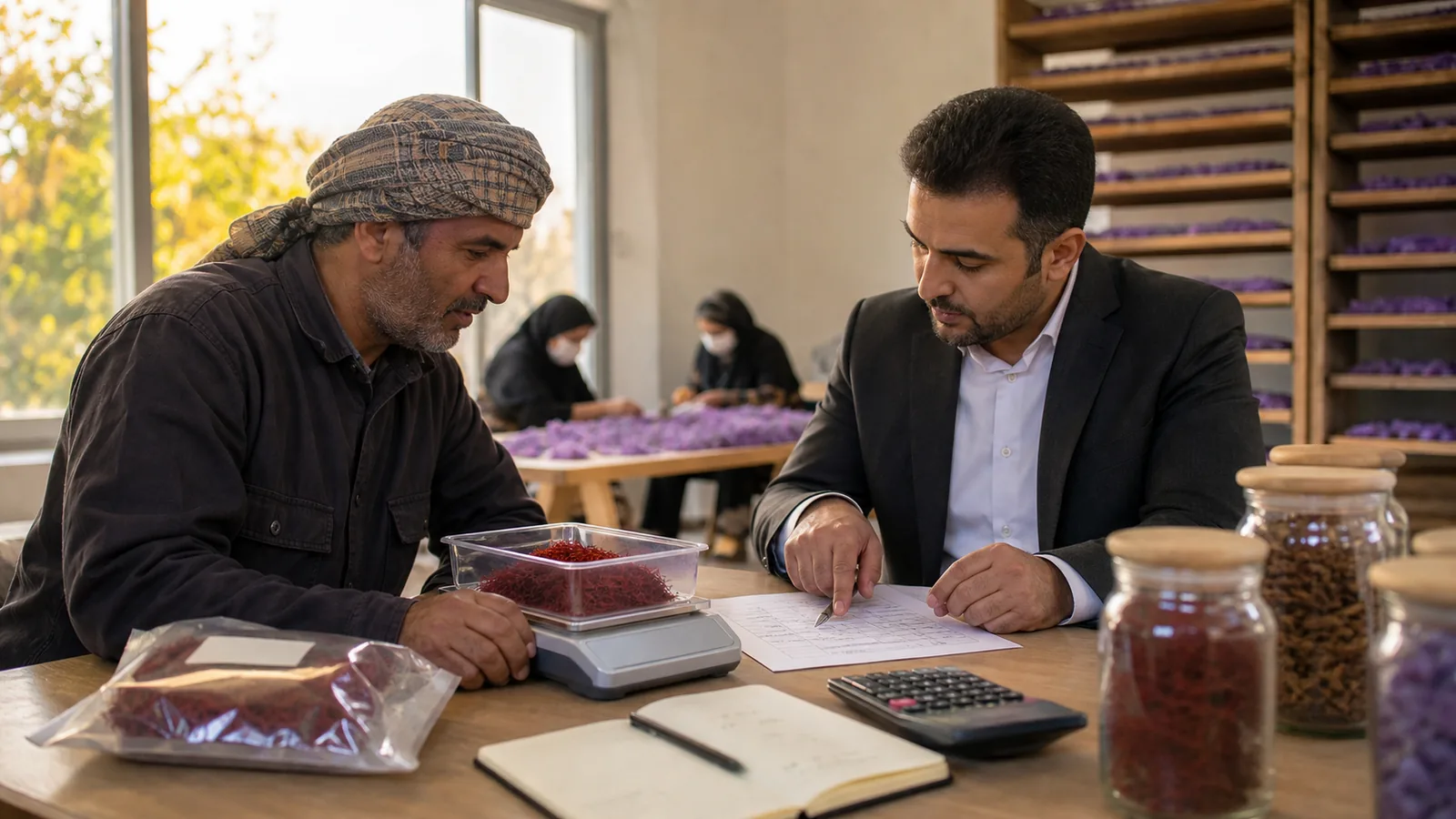
“Wage income of farmers billions dealers” is a rough translation of a familiar complaint in saffron country: growers carry the cost and risk of producing the crop, while traders may capture a larger and faster return after harvest. Saffron farmer income depends on much more than the headline price per kilogram. The 2016 text came from Khorasan Razavi during the autumn saffron season. Its anger is clear, but its claim that a farmer received only one-tenth of a broker’s profit was not supported by a calculation. A useful account needs to show where the costs and margins actually arise.
What the farmer pays before a gram is sold
A saffron field does not produce income simply because the flowers appear. The grower first pays for land preparation, corms, manure or other soil amendments, fertiliser where required, weed and pest management, irrigation, and labour. Weather adds another layer of uncertainty. Heat, cold and badly timed rain can affect flowering and field work even when the farmer has managed the crop carefully.
The original article specifically mentioned ploughing, manure storage, water—including water brought by tanker in some places—harvesting, collection and cleaning. Those details should not be lost. Saffron uses little summer irrigation compared with many crops, but “low water” does not mean no water, no cost or no production risk.
Harvest creates the sharpest labour demand. Flowers must be gathered promptly, then the three stigmas are separated and dried. A kilogram price refers to dried saffron, not the much heavier mass of fresh flowers handled to produce it. When family labour is not counted, a farm can appear more profitable on paper than it feels to the household doing the work.
Why growers may sell at the weakest moment
Autumn brings a large volume of saffron into the local market within a short period. At the same time, farmers may need cash for wages, debts and household expenses. A grower who cannot store the dried crop safely or wait for a better offer has less bargaining power than a buyer with cash and a warehouse.
This is the pressure behind the original description of farmers being “forced” to supply a volatile market. It does not mean every sale is literally compulsory. It means the timing of expenses can leave only one practical buyer or price on the day the farmer needs money.
Price volatility makes the decision harder. Holding saffron can produce a better price, but it can also expose the grower to a fall in the market, theft, moisture damage or quality loss. The choice is a financial risk decision, not simply a contest between a patient farmer and an opportunistic dealer.
A dealer’s margin is not automatically profit
The difference between the farm-gate price and the final selling price is a marketing margin. It can include transport, sorting, grading, laboratory tests, finance, storage, insurance, packaging, sales commissions, wastage, tax and the risk of holding stock. Profit is what remains after those costs.
That distinction does not excuse an unfair market. It prevents a second error: treating every rial between two prices as money kept by a broker. To establish whether farmers or dealers earned more, the comparison needs the same grade, weight, date and currency, plus a cost record for each stage.
The 2016 article did not provide that evidence. It referred to the average price per kilogram of dried saffron and said that analysis of all the production stages would show how little reached the farmer, but no actual price series or cost sheet survived in the page. Its one-tenth comparison should therefore be read as the author’s criticism, not an audited ratio.
What research says about Iran’s saffron marketing chain
Research supports the broader concern that market structure affects the producer’s share. A study of saffron marketing in Mashhad, Torbat Heydarieh and Ghaen identified 11 different channels and found large differences in price spread depending on how the crop moved from producer to consumer. Across those channels, the reported average producer share of the consumer price was 51.23% in the study period.
That figure is not a current national rate and it does not prove the original “one-tenth” line. It is useful because it shows why the route matters. Direct sales, a rural cooperative, a local intermediary, a processor, an exporter and a foreign retailer each create a different set of costs and bargaining relationships.
Another Iranian study using farm, wholesale and retail price data examined how price changes moved through the saffron market. It recommended stronger agricultural marketing cooperatives involving farmers, wholesalers and dealers. The point was not that all intermediaries should disappear; it was that farmers needed better information and a more organised route to market.
Why “the dealer did no work” is too simple
The original article called speculators a “mafia of red gold” and said they profited effortlessly while farmers sacrificed their income. That language records the frustration of the period, but it is not a fair description of every buyer.
A capable buyer can provide cash at harvest, assemble small lots, check quality, find a customer and accept price risk. A processor or exporter may add testing, documentation and market access that an individual farm cannot supply alone. Those services have value.
The problem begins when the grower cannot see the reference price, cannot compare bids, cannot verify grade, or must accept a tied loan and sale. A market can be unfair without every intermediary being dishonest. The practical target is unequal information and bargaining power.
How to calculate the farmer’s real income
A farm-level calculation should start before planting and end only after sale. For one production year, record:
- paid inputs, irrigation and machinery costs;
- hired labour for field work, picking, separation and drying;
- a realistic value for unpaid family labour;
- the dry weight and grade of each lot;
- storage, finance, packaging, transport and testing costs;
- the date, buyer and net price of each sale; and
- any loss from rejected, damaged or downgraded saffron.
Net farm income is the sale revenue minus those costs. The dealer’s net profit requires the same treatment. Only then can two participants be compared without confusing revenue, margin and profit.
Ways to improve the grower’s share
Farmers gain options when they can separate and dry saffron consistently, receive an independent grade, see current bid prices and combine small lots without losing individual traceability. Safe short-term storage can reduce the need for a distress sale, although it should never be promoted without explaining financing and price risk.
Producer organisations can negotiate services that are difficult for one farm to buy: laboratory testing, tamper-evident packaging, insurance, market information and direct contact with processors or exporters. Written contracts can define grade, sampling method, payment timing and the way a dispute will be resolved.
FAO’s current work with Iran emphasises authenticity, traceability and innovation in the saffron value chain. Those measures can protect the buyer and also help a grower demonstrate why a documented lot deserves a better price.
The lesson behind the angry headline
The original page was right to keep the farmer’s work visible. Saffron reaches the market only after months of field costs and a concentrated burst of careful labour. It was not justified, however, in turning an unshown calculation into a precise one-tenth claim or in treating all dealers as people who add nothing.
A fairer saffron market starts with comparable evidence: the same grade, the same date, transparent costs and a traceable sales route. With that information, farmers can see which part of the price spread pays for a real service and which part reflects weak bargaining power. That is a stronger basis for raising farm income than any claim about billions earned effortlessly.
Sources reviewed: peer-reviewed research on marketing efficiency and price spread in Iranian saffron, a study of price transmission in the Iranian market, and FAO material on the Iranian saffron value chain. Historical claims from the 2016 page are retained as period commentary where its underlying calculations are unavailable.

![Exporting Saffron to Turkey + Price Guide [Complete 0 to 100]](https://img.rowhanisaffron.com/20260827003933/saffron-export-turkey-quality-inspection.webp)



