


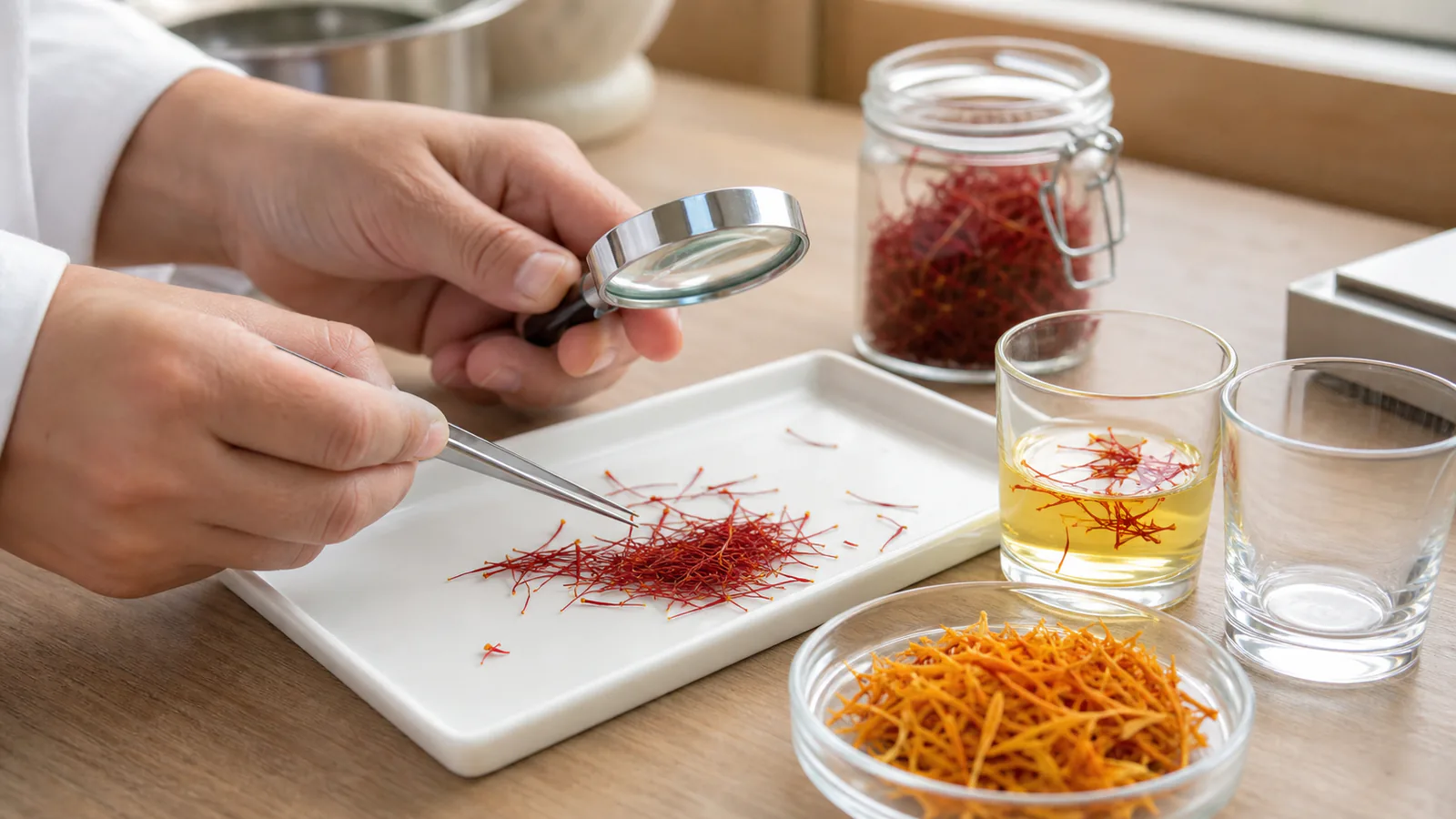
You can spot some signs of counterfeit saffron at home, but no single water, paper or taste test can prove authenticity. The safest purchase combines traceable packaging, intact threads, a credible seller and, where certainty matters, laboratory testing.
Counterfeit saffron is not always one thing. A product may contain another flower, dyed plant fibres, exhausted saffron from which colour has already been extracted, extra moisture or an undeclared synthetic colour. Each kind of fraud can behave differently in a home test.
What genuine saffron threads look like
Commercial saffron comes from the dried stigmas of Crocus sativus. A whole stigma widens slightly at one end and narrows toward the other. Threads are irregular rather than machine-perfect, with a deep red to crimson body and sometimes a small orange or yellow portion where the stigma joined the style.
Colour alone is not enough. Dyed fibres can be red, and real saffron grades differ in how much yellow style they contain. A bag of identical, uniformly cut red strands deserves scrutiny, but natural variation does not by itself prove quality or origin.
Common substitutes and adulterants
A 2026 systematic review of saffron-fraud research identifies safflower, marigold, turmeric, other plant material and synthetic dyes among documented adulterants. Weight may also be increased with moisture, oil, sugar, salt or mineral material.
Safflower is a real culinary plant, sometimes called “American saffron,” but it is not Crocus sativus. Its petals can contribute colour and may resemble thin orange-red strips. Turmeric is another genuine spice that makes food yellow, yet its earthy flavour, powdered form and chemistry are different. Selling either one clearly under its own name is not fraud; selling it as saffron is.
The original version of this page referred to an unidentified red chemical under a mistranslated name and described it as carcinogenic. Because the substance cannot be established from the surviving text, the name should not be repeated as fact. The broader warning remains valid: undeclared industrial dyes are a food-safety concern, and appearance cannot identify a chemical.
The warm-water test: useful, not conclusive
- Place a few threads in a clear glass of warm water.
- Watch the threads and water for several minutes without crushing them.
- Notice whether colour diffuses gradually and whether the threads keep their basic shape.
Genuine saffron normally releases a golden-yellow colour rather than a vivid red cloud. A suspicious product may release surface dye immediately or leave colourless fibres behind. However, temperature, grade, storage age and broken threads all affect the result. A skilled adulterator can also use yellow food colour. Passing this test does not certify saffron.
Paper, rubbing and taste checks
Rubbing a damp thread on white paper can reveal an obvious applied dye or oily coating. It cannot distinguish every natural pigment or identify a hazardous dye. The old article’s “oil mark” test for safflower is therefore a clue at most, not a verdict.
Saffron’s aroma is complex—often described as honeyed, hay-like and slightly metallic—and its taste is bitter rather than sugary. Strong perfume, chemical harshness or sweetness can be warning signs. Do not deliberately taste an unknown or visibly dyed product just to test it.
Burning threads, adding chemicals or relying on viral tricks is unnecessary and may create new hazards. Home tests should help decide whether to stop using a product, never justify consuming a questionable one.
Why powder is harder to authenticate
Grinding removes most of the visual structure that a buyer can inspect. Powder can be diluted with turmeric, paprika, starch or coloured material more easily than intact stigmas. Even a genuine powder may release colour faster simply because it has more surface area.
If a recipe needs ground saffron, buying traceable threads and grinding a small amount at home preserves more information about what you purchased. Keep the remainder whole, airtight and away from light, heat and moisture.
Packaging and traceability checks
Before buying, look for:
- the seller or producer’s name and contact details;
- a sealed, food-grade package;
- a lot or batch identifier and packing date;
- declared net weight and country of origin;
- storage instructions and an intact tamper seal; and
- evidence that the supplier can trace the lot back through its supply chain.
A respected brand is helpful, but branding alone is not proof. Certificates should identify the tested batch and the laboratory; a generic certificate on a website may describe another lot. Extremely low pricing is a reason to ask questions, not a laboratory result.
What laboratory testing can establish
Professional laboratories can use microscopy, chromatography, spectroscopy, DNA methods and chemical-marker analysis to examine identity and quality. ISO 3632 provides recognised methods and categories for saffron quality testing, including measurements related to colour, aroma and bitterness.
No home test reproduces that evidence. Businesses, restaurants and importers buying high-value lots should use qualified sampling and batch-specific testing rather than inspect only the top of a container. A good sample must represent the lot; otherwise even an accurate instrument answers the wrong question.
Food safety matters beyond fraud
The radio interview behind the old article also warned about hygiene in bulk spices. Spices do not become sterile because some of their compounds show antimicrobial activity in a laboratory. Soil, harvesting, drying, grinding, transport and open-bin handling can introduce microorganisms, foreign material, pesticide residues or heavy metals.
The US Food and Drug Administration’s risk profile on pathogens and filth in spices documents why controls are needed across the spice supply chain. Packaging cannot guarantee purity, but sealed, traceable product from a supplier with appropriate food-safety controls is safer than an anonymous open bin with no lot information.
What to do if saffron seems counterfeit
Stop using it. Keep the package, receipt, lot number and a sample, and photograph what raised concern. Contact the seller and the relevant local food-safety authority. If anyone becomes ill, seek medical advice and provide the product information rather than attempting more home tests.
Do not mix a suspect batch with genuine saffron or return it to the storage jar. That destroys traceability and can contaminate the good product.
The most reliable buying strategy
Learn the signs of counterfeit saffron, but treat them as screening clues. Choose intact threads, traceable packaging and a seller who can explain origin, handling and batch testing. Use water and visual checks to notice obvious problems, not to award a homemade certificate.
Authentic saffron has a price because each stigma is harvested and separated by hand. The aim is not to find the reddest or cheapest product; it is to buy a clearly identified food whose quality can be traced beyond the photograph on the package.

![Exporting Saffron to Turkey + Price Guide [Complete 0 to 100]](https://img.rowhanisaffron.com/20260827003933/saffron-export-turkey-quality-inspection.webp)



