


Saffron production trends were unusually hard to read as Iran approached its 2025 harvest. Growers and traders had firm prices in front of them, but the size of the crop was still uncertain because the condition of saffron corms cannot be judged from the surface alone.
What the 2025 saffron harvest report said
The original report, published on 21 October 2025, relayed comments from the vice president of Iran’s National Saffron Council. The next crop was expected to reach the market in November, yet a dependable production estimate was not available. That distinction matters: the arrival of flowers can be anticipated from the harvest calendar, but output depends on how many flowers emerge and how much dried saffron those flowers ultimately yield.
For readers following saffron harvest news in 2025, the message was therefore one of timing without certainty. A harvest was close, but neither a larger crop nor an immediate fall in prices could safely be assumed.
Iran saffron prices per kilogram in 2025
The report recorded the following wholesale market ranges. They are a historical snapshot in Iranian tomans, not a current quotation or a retail price list:
- Bunch saffron: 65 million tomans per kilogram
- Pushal saffron: 84–86 million tomans per kilogram
- Sargol saffron: 90–92 million tomans per kilogram
- Negin saffron: 97–98 million tomans per kilogram
The spread is understandable because these names describe different presentations of the stigma. Bunch saffron retains the red stigma with the paler style attached. Pushal includes more red stigma and less style, while Sargol is red stigma separated from the style. Negin is selected for long, intact red threads and commands a higher quoted price when appearance and quality meet the buyer’s specification.
A price per kilogram still needs context. Grade, moisture, laboratory results, lot size, packaging, payment terms and the exchange rate can all change the final commercial offer. Anyone comparing the 2025 figures with another quotation should first confirm that both prices refer to the same grade and terms.
Why prices appeared stable before harvest
The report described a market with limited available stock. Some farmers were holding saffron rather than selling immediately, while investors and other holders were managing inventory ahead of the new crop. With fewer lots offered and buyers waiting for the harvest, quoted prices could remain steady even though the production outlook was unclear.
This should not be read as proof that inventory management alone fixed the price. Supply entering the market, export demand, quality differences and currency conditions all influence the trading range. The report captured what participants were seeing at that point in the season: restricted availability and no decisive price break before the crop arrived.
Why Iran’s 2025 production was difficult to forecast
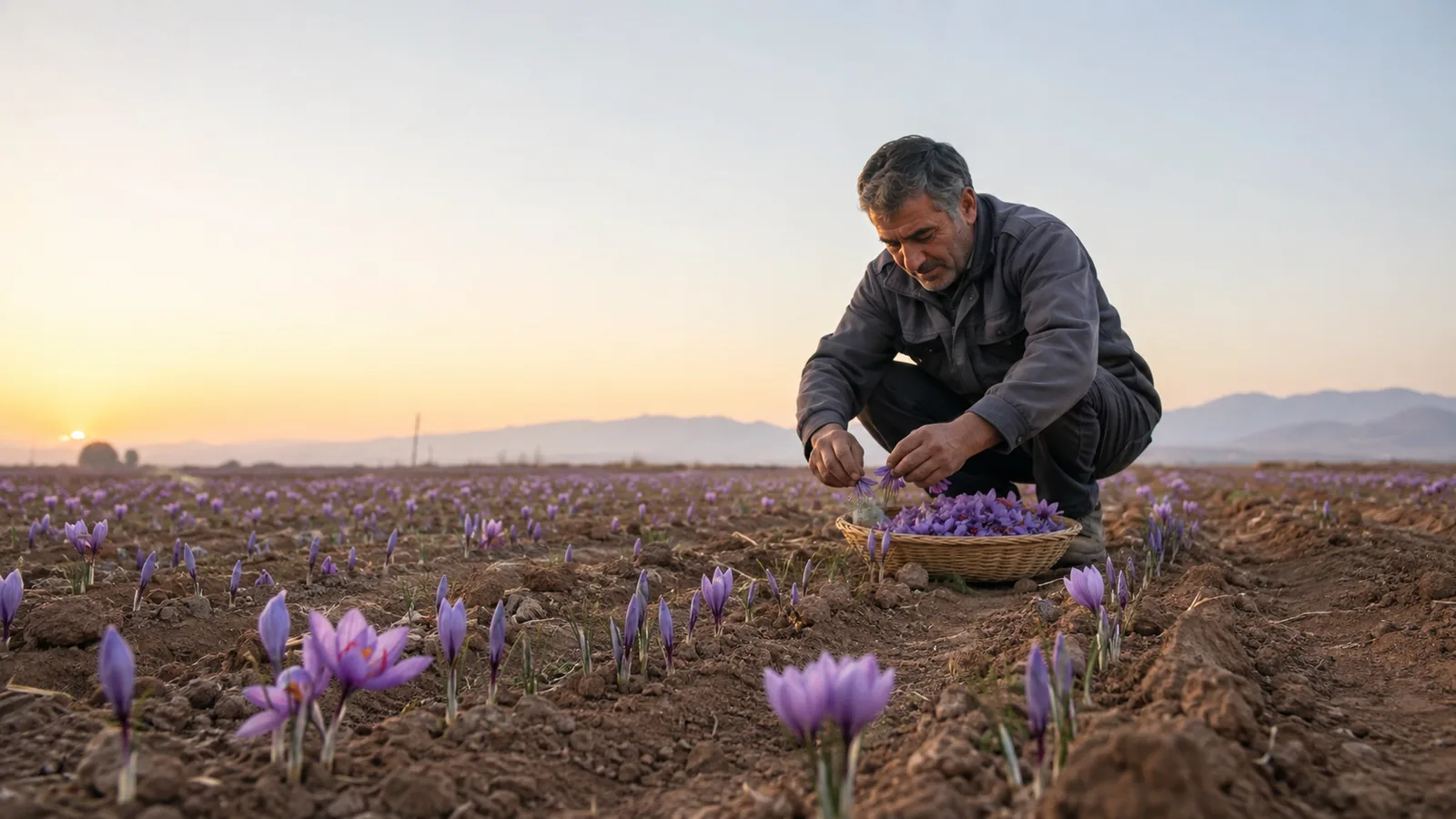
Saffron is a perennial crop grown from underground corms. Until flowering begins, a field can look quiet while important changes are taking place below the soil. Weather, irrigation, corm health, field age and the timing of farm operations affect flowering, and the flowers must then be picked and processed quickly. That makes a pre-harvest forecast less certain than a simple estimate of planted area might suggest.
The uncertainty also explains why reports about the world’s top saffron-producing countries need careful dating. Iran remained the central producer and trading origin, but shares and tonnage vary by season and by the dataset being used. Our separate guide to saffron production statistics explains how to compare those figures without treating an old estimate as a current fact.
What export data adds to the picture
The 2025 report stated that Iran had exported 1,505 tonnes of saffron over the preceding six years, an average of roughly 250 tonnes a year. It also said Iranian saffron reached more than 70 countries, while five or six major importing markets accounted for much of the trade. Those figures preserve the industry statement as it was reported; the article did not identify the precise customs period or dataset behind the six-year total.
Independent trade data supports the broader point that demand is concentrated. World Bank WITS data, drawn from UN Comtrade, shows that in 2023 the European Union, Spain, China and the United Arab Emirates were among the largest declared import markets for saffron from Iran. The reported quantities and values should not be added together indiscriminately because regional and country entries can overlap. The WITS saffron trade record for Iran is best used to examine individual reporting markets and the HS 091020 product code.
Concentration creates both efficiency and exposure. A handful of established buyers can move substantial volumes, but changes in one market’s payment access, import rules or re-export activity can be felt quickly. Reaching many countries on paper is therefore different from having balanced demand across them.
The role of quality and post-harvest handling
Production does not end when flowers leave the field. Picking, stigma separation, drying, storage and testing determine how much of the crop reaches saleable quality. In a 2025 visit to farms and processing facilities around Mashhad, the UN Food and Agriculture Organization highlighted post-harvest practice and quality integrity as priorities for Iran’s saffron value chain. The FAO account of the visit provides useful context for interpreting production figures: harvested volume and commercially dependable saffron are related, but they are not the same measure.
For a buyer, this is why origin or a grade name should not replace verification. A representative sample, suitable analysis and clear lot documentation are more useful than a broad claim about the season.
What supportive purchasing can and cannot do
The National Saffron Council comments presented long-term supportive purchasing as a way to reduce financial pressure on growers and soften abrupt market swings. In practice, any such programme needs transparent grading, payment, storage and release rules. Otherwise, purchasing can move stock off the market without solving quality, demand or cash-flow problems.
For growers, predictable buying conditions can make it easier to avoid distress sales immediately after harvest. For processors and exporters, the more durable contribution is a chain that protects quality and traceability from the field to the finished lot. Neither approach can guarantee a price, but both can reduce avoidable losses.
How to read this 2025 market snapshot
This page records an uncertain moment before the 2025 Iranian saffron harvest. The four price bands belong to that date, the expected November arrival was a forecast, and the six-year export total was a figure attributed to the industry statement rather than a live customs total.
The useful conclusion is not that one price or production number will remain fixed. It is that saffron production trends should be read through several signals together: flowering and harvested output, the amount and grade of stock offered, buyer concentration, verified trade data and the quality retained after processing. That combined view is more dependable than treating any single pre-harvest prediction as settled.

![Exporting Saffron to Turkey + Price Guide [Complete 0 to 100]](https://img.rowhanisaffron.com/20260827003933/saffron-export-turkey-quality-inspection.webp)



