


The three percent increase in saffron cultivation in Bahabad city was reported for a particular earlier season. At the time, the local Agricultural Jihad office expected farmers to harvest about 765 kilograms of dried saffron.
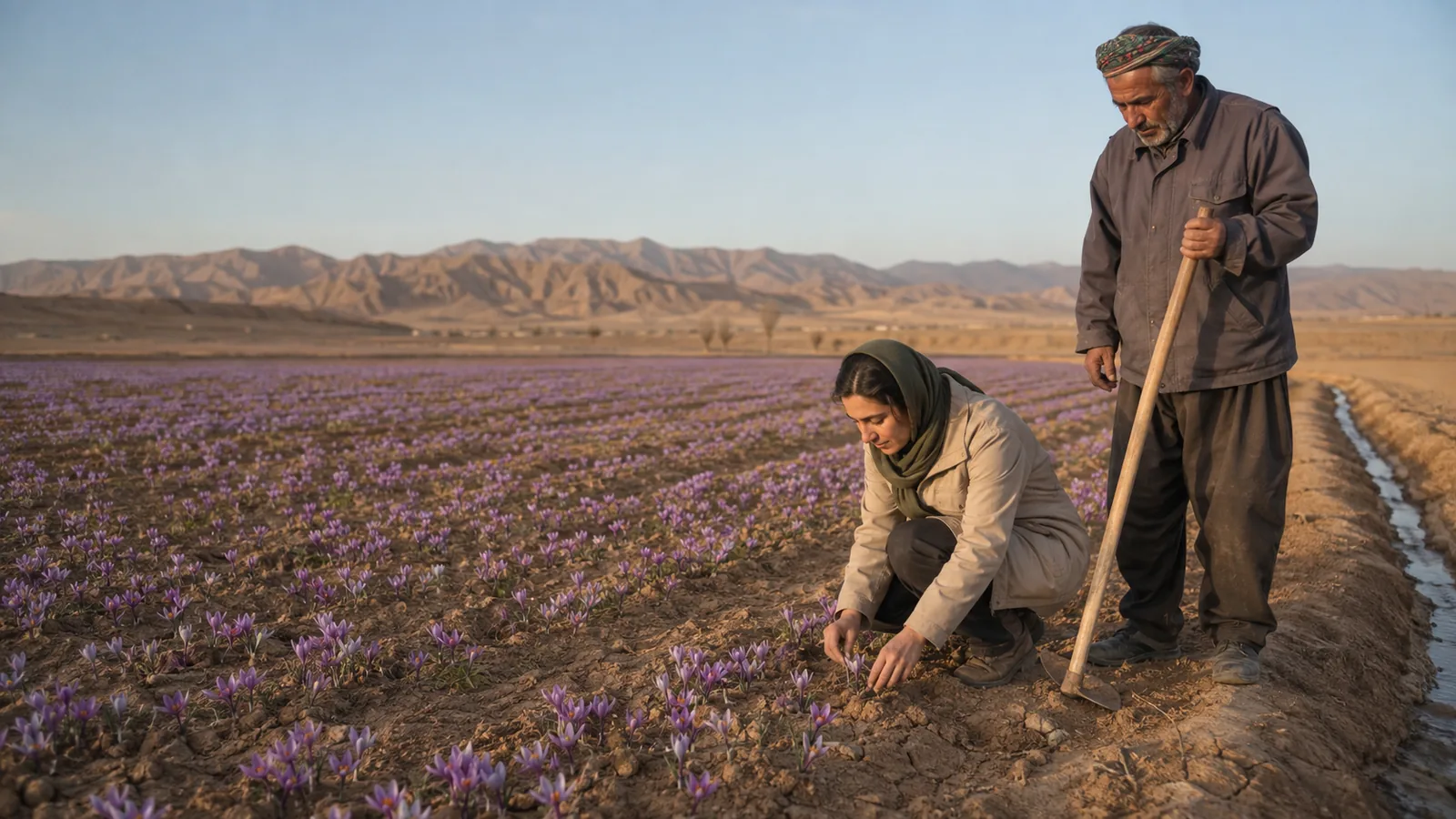
What the three percent increase referred to
The original report quoted Sadeghzadeh, then head of horticulture at the Bahabad Agricultural Jihad office. He said the city’s saffron growers were expected to produce 765 kilograms of dried saffron from that season’s farms.
The headline recorded a three percent rise in saffron cultivation, although the short source text did not provide the previous and new cultivated-area figures. That makes it impossible to reconstruct the percentage from the article alone. Both the growth rate and the 765-kilogram forecast should therefore be treated as historical figures from the reporting period, not current Bahabad statistics.
Why saffron cultivation matters in Bahabad
Bahabad lies in Yazd Province, where water scarcity shapes farming decisions. Sadeghzadeh described saffron as a crop with relatively low water demand and a useful source of farm income. He also identified Bahabad as one of Yazd’s important saffron-producing areas.
Low water demand is a comparison, not a claim that saffron needs no water. The crop still requires suitable soil, healthy corms and correctly timed irrigation. In a dry district, the timing and efficiency of that water use matter as much as the total volume.
What was said about Bahabad saffron quality
The local horticulture official described Bahabad saffron as having a distinctive quality. The stored report did not include laboratory results, a grade or the analytical values needed to compare that harvest with saffron from another region.
Quality should therefore be judged batch by batch. Colouring strength, aroma, flavour, moisture, cleanliness and handling after harvest all affect the finished spice. Regional reputation can be helpful context, but it is not a substitute for testing and careful processing.
A later snapshot of saffron farming in Yazd
A later report from the Iranian Agriculture News Agency, published in December 2019, identified Bahabad as the largest saffron-growing county in Yazd at that time. It reported about 400 hectares under cultivation and an average dry-saffron yield of 5.5 kilograms per hectare.
That later snapshot is useful because it confirms Bahabad’s continuing importance within the province. It should not be mixed with the earlier 765-kilogram forecast, however: the two reports describe different periods and measures.
Bahabad’s dry landscape and the Shur River
The original account described Bahabad as semi-arid, with average annual rainfall of about 153.9 millimetres. It also noted cooler upland areas to the west and south that attract visitors in spring and summer.
The Shur River, north of the city, was identified as Bahabad’s only permanent river. The land around it is of interest to geography and geology researchers because of its distinctive landforms. These details help explain the setting in which local farmers choose crops and manage limited water, even though they do not by themselves determine saffron yield.
From cultivation area to dried saffron
An increase in planted land does not guarantee the same increase in dried output. Saffron yield varies with the age and size of the corms, planting density, soil fertility, irrigation timing, temperature during flower development and the speed and care of harvesting.
The work continues after the flowers leave the field. Pickers separate the red stigmas from each bloom, and processors must dry them promptly and hygienically. Poor handling at this stage can reduce quality even when the crop looked strong in the field.
How to read this Bahabad saffron report today
The historical news is straightforward: cultivation was reported to have increased by three percent, and officials forecast a 765-kilogram dried-saffron harvest. It also records why growers in Bahabad valued the crop in a semi-arid district.
The figures are not a current production forecast. For present-day farming, purchasing or investment decisions, consult the latest data from the Yazd agricultural authorities. As an archived account, the report remains a useful picture of saffron’s place in Bahabad’s agriculture and local economy.

![Exporting Saffron to Turkey + Price Guide [Complete 0 to 100]](https://img.rowhanisaffron.com/20260827003933/saffron-export-turkey-quality-inspection.webp)



