


The forecast of more than 200 tons of Iranian saffron production belonged to a specific earlier crop year. It was based on favourable rainfall at the time and should be read as a historical outlook, not a prediction for the coming season today.
Why officials expected production to exceed 200 tons
Ali Hosseini, then head of Iran’s National Saffron Council, said rainfall in the preceding months had improved the outlook for the next crop year. On that basis, he expected the country’s saffron output to reach a desirable level and exceed 200 tons.
The comparison in the original report was a previous annual crop estimated at roughly 140 to 180 tons. Both ranges are tied to the report’s historical period. Actual saffron production changes from one season to another, so neither number should be substituted for a current official estimate.
Iran as a saffron-producing country
The report identified Khorasan Razavi and South Khorasan as Iran’s main saffron-producing provinces. Their dry climate, farming knowledge and established harvesting networks have made saffron an important part of local agriculture and rural income.
The old English text gave their combined cultivated area as “more than 600,000 hectares.” That figure is inconsistent with other figures from the period and appears to be a translation or transcription error, so it should not be repeated as verified fact. The central point remains sound: the two Khorasan provinces accounted for the country’s principal concentration of saffron fields.
The Food and Agriculture Organization’s profile of Gonabad’s qanat-based saffron system gives useful context. It describes Khorasan Razavi’s arid to semi-arid conditions and the crop’s role in livelihoods where water is scarce.
Why a high saffron price does not guarantee a prosperous farmer
Saffron sells for far more per kilogram than most field crops, but comparing kilogram prices alone gives a distorted picture. Hosseini rejected the assumption that every saffron grower must therefore be prosperous. A farmer’s result depends on yield, plot size, labour, input costs, product grade and the price offered at the farm gate.
The report put average output at about 3 to 3.5 kilograms of dried saffron per hectare. A grower with only a small plot may therefore produce a limited quantity even when the spice carries a high unit price.
One kilogram represents an extraordinary amount of work
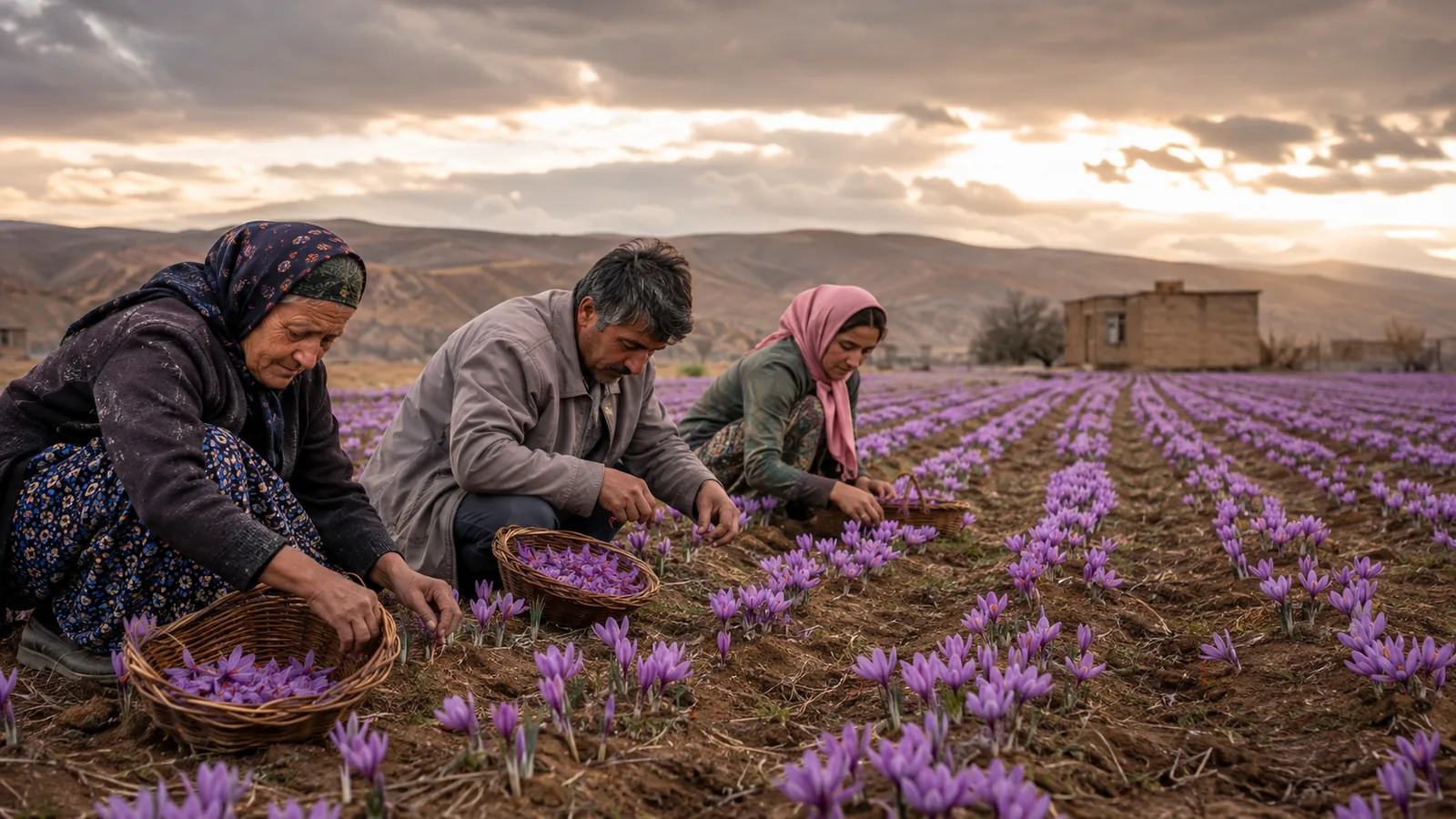
Hosseini said a farmer had to collect about 150,000 saffron flowers to produce one kilogram of dried spice. That figure is consistent with agricultural references: an FAO publication on saffron production and processing gives a range of roughly 150,000 to 170,000 flowers per kilogram.
Each flower yields only three red stigmas. The flowers must be picked during a short harvest window, and the stigmas are then separated and dried with care. The price of the finished spice reflects this labour as well as its quality; it does not flow directly to the grower as profit.
Small plots can make the economics difficult
The original account highlighted the small scale of many farms in South Khorasan. When a household cultivates only a limited area, the harvested volume may be too low to cover labour and other costs comfortably. Some families grow saffron alongside other work, while in certain communities the crop is central to household income.
This distinction is important. National production may rise while individual smallholders remain under pressure. A strong crop can increase the volume available to sell, yet a larger supply may also affect market prices if demand and market access do not grow with it.
The historical production-cost warning
The stored translation ended with a plainly incorrect unit, describing the production cost of one kilogram as “one million and 600 thousand tons.” In context, Hosseini was discussing money, not weight. The intended historical amount was about 1.6 million tomans per kilogram.
His wider concern was that buyers sometimes offered farmers less than their production cost. That price is now obsolete and must not be used as a current benchmark, but the economic principle still matters: revenue per kilogram has to be considered alongside the real cost of cultivation, picking, separation and drying.
What the 200-ton forecast does and does not tell us
The forecast shows how rainfall shaped expectations for Iranian saffron production in that particular season. It also records the concerns voiced at the time about low yields, labour-intensive processing, small farm size and weak returns to growers.
It does not establish today’s output, cultivated area, production cost or market price. Those decisions require current crop reports and current market data. Read as an archived industry snapshot, however, it explains why a promising national harvest did not automatically translate into easy profits for every saffron farmer.

![Exporting Saffron to Turkey + Price Guide [Complete 0 to 100]](https://img.rowhanisaffron.com/20260827003933/saffron-export-turkey-quality-inspection.webp)



