


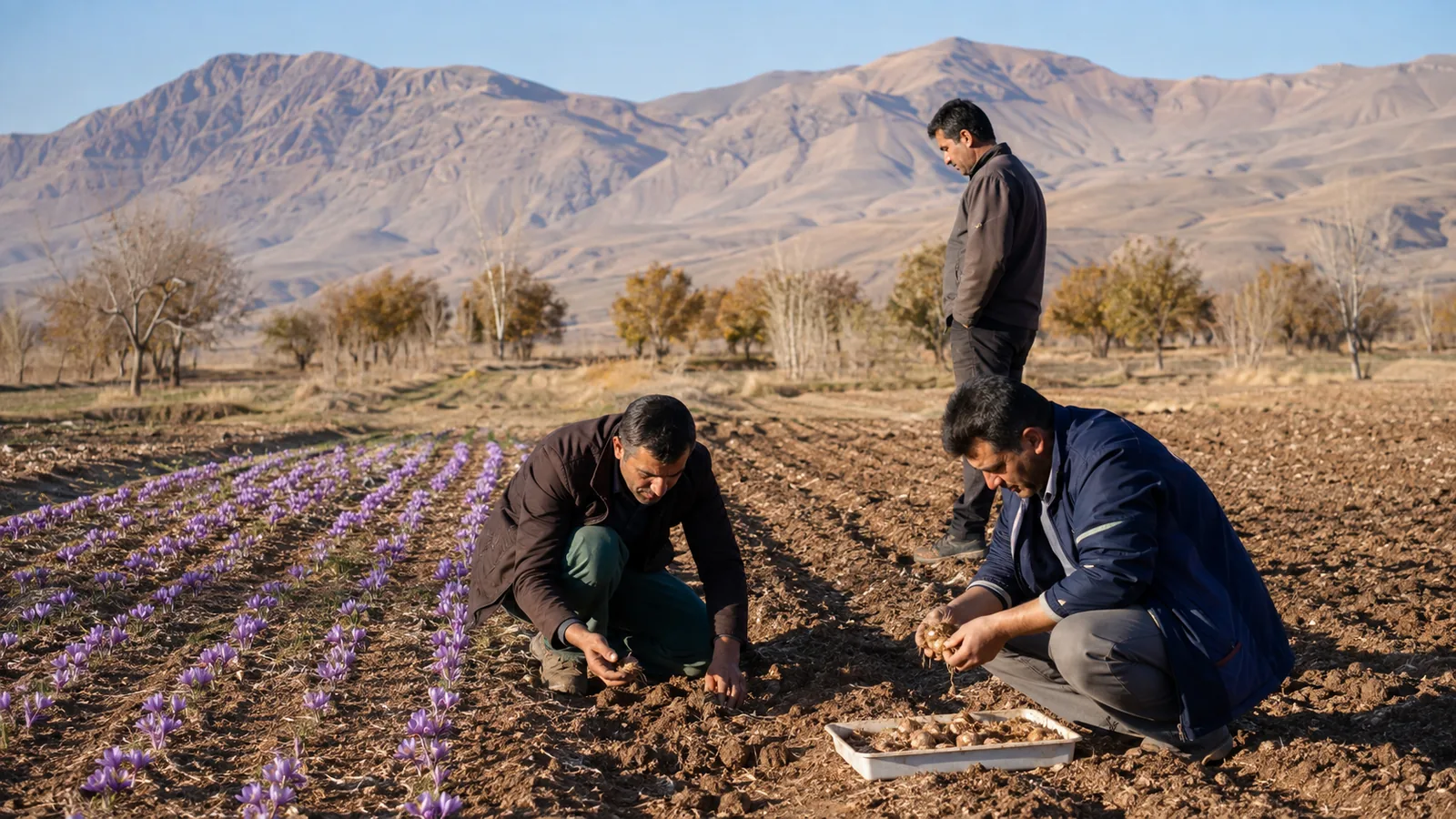
Markazi province has genuine capacity to expand saffron cultivation, but capacity is not the same as a blanket recommendation to plant more land. The original provincial report supports careful development of lower-water crops while also containing a numerical inconsistency that needs to remain visible.
What the Markazi report was trying to show
Mahmoud Nemati, identified as director general of the Economic and International Affairs Office of the Markazi Governorate, described saffron and medicinal plants as possible sources of rural value and employment. His central argument was that water scarcity required a more suitable crop pattern without abandoning agricultural production.
The report also cited Damask rose and other medicinal plants, so its idea of “capacity” included the processing and marketing of several specialist crops rather than saffron alone.
The saffron numbers in the English copy conflict
The surviving English text says six hectares were under saffron and that more than 637 kilograms were produced annually. Taken together, those figures imply more than 106 kilograms of dry saffron per hectare, far outside the scale reported in ordinary field statistics. They should not be repeated as a valid area-and-output pair.
A digit may have been lost in translation or transcription, but the original-language statement has not been located in a sufficiently reliable source to correct it confidently. The responsible approach is to retain both reported numbers as a documented inconsistency, not silently change six to a guessed figure.
Later data confirm cultivation, not the missing number
A later report quoting Markazi’s provincial horticulture director recorded 385 hectares and 1,180 kilograms of saffron for its reporting year. It also reported 50 hectares of new planting.
Those figures show that Markazi’s saffron sector had expanded by that later date, but they do not identify what the earlier area should have been. Different years must not be combined to repair a damaged sentence.
Why saffron is considered under water pressure
Saffron has a different seasonal water pattern from many summer crops. Its corms are dormant through the hottest part of the year, and the main irrigation and growth periods fall outside that peak. This can make it worth assessing where irrigation water is limited.
It is still a cultivated crop with real water needs. Establishment, autumn irrigation, spring leaf growth and the quality of available water all matter. “Lower water” should describe a comparison made for a particular farm, not a promise that saffron can thrive without adequate moisture.
Expansion starts with suitable land
A field should be screened for drainage, soil texture, salinity, corm disease risk, winter conditions and access to irrigation at the right times. Labour availability is just as important because the flower season is short and picking cannot be postponed for long.
Small pilot areas allow growers to record flowering dates, labour hours, dried yield and quality before committing more land. This is safer than treating a province-wide policy statement as a farm business plan.
Damask rose was the larger example in the report
Nemati said more than 716 hectares in Markazi were under Damask rose and that 1,400 tons had been harvested in the stated year. These figures belong to the report’s period and are not current estimates.
The rose data matter because they show the wider context for specialist crops. Flowers are perishable, and both rose and saffron depend on timely collection and processing. A province may have suitable land yet still lose value if distillation, drying, storage or buyer capacity does not keep pace.
Medicinal-plant volume needs a clear definition
The report also referred to 1,600 tons of various medicinal plants produced each year in different parts of Markazi. Tonnes describe output, not cultivated area, and fresh plant material cannot be compared directly with dried saffron.
A separate later account put total medicinal-plant cultivation at 3,300 hectares and annual production at 4,200 tons. Its crop list included saffron, Damask rose, green cumin, lavender, peppermint, rosemary and flixweed. The change illustrates why every number needs a date, unit and product definition.
Processing determines whether cultivation creates value
Saffron leaves the field as delicate flowers, not as a shelf-ready spice. Rapid transport, clean stigma separation, controlled drying, grading, traceable lots and protective packaging are needed before a crop can command a dependable price.
That value chain is also where employment can continue beyond picking. Nemati’s goal of sustainable work is plausible only when growers have trained labour, functioning processors and buyers, rather than planted area alone.
Profitability cannot be inferred from water use
A crop may use less irrigation than an alternative and still be a poor investment on a particular farm. Corm cost, labour, establishment losses, field age, yield, quality and market price all affect the result.
An official agricultural report on another Iranian province notes a national-average saffron yield of about four kilograms per hectare. It is useful only as broad context; Markazi growers still need local field records.
What responsible expansion would look like
A sound programme would identify suitable zones, test water and soil, secure healthy corms, train growers, map harvest labour and confirm processing capacity before hectares rise. It would then publish area, bearing area, output and yield separately each year.
Market planning belongs in the same process. Buyers need consistent grades and traceability, while growers need realistic terms and an outlet for each harvest. Expansion without that coordination can increase supply without improving farm income.
How to read the capacity claim today
The report’s lasting point is sensible: Markazi should assess saffron and other lower-water specialist crops as part of its response to water scarcity. Its Damask rose and medicinal-plant figures also show that relevant skills and industries were already developing.
The flawed six-hectare/637-kilogram sentence cannot support a precise baseline. Current decisions should use current provincial records and field evidence. Capacity exists where land, water, labour, processing and a market align—not merely because a crop has a valuable reputation.

![Exporting Saffron to Turkey + Price Guide [Complete 0 to 100]](https://img.rowhanisaffron.com/20260827003933/saffron-export-turkey-quality-inspection.webp)



