


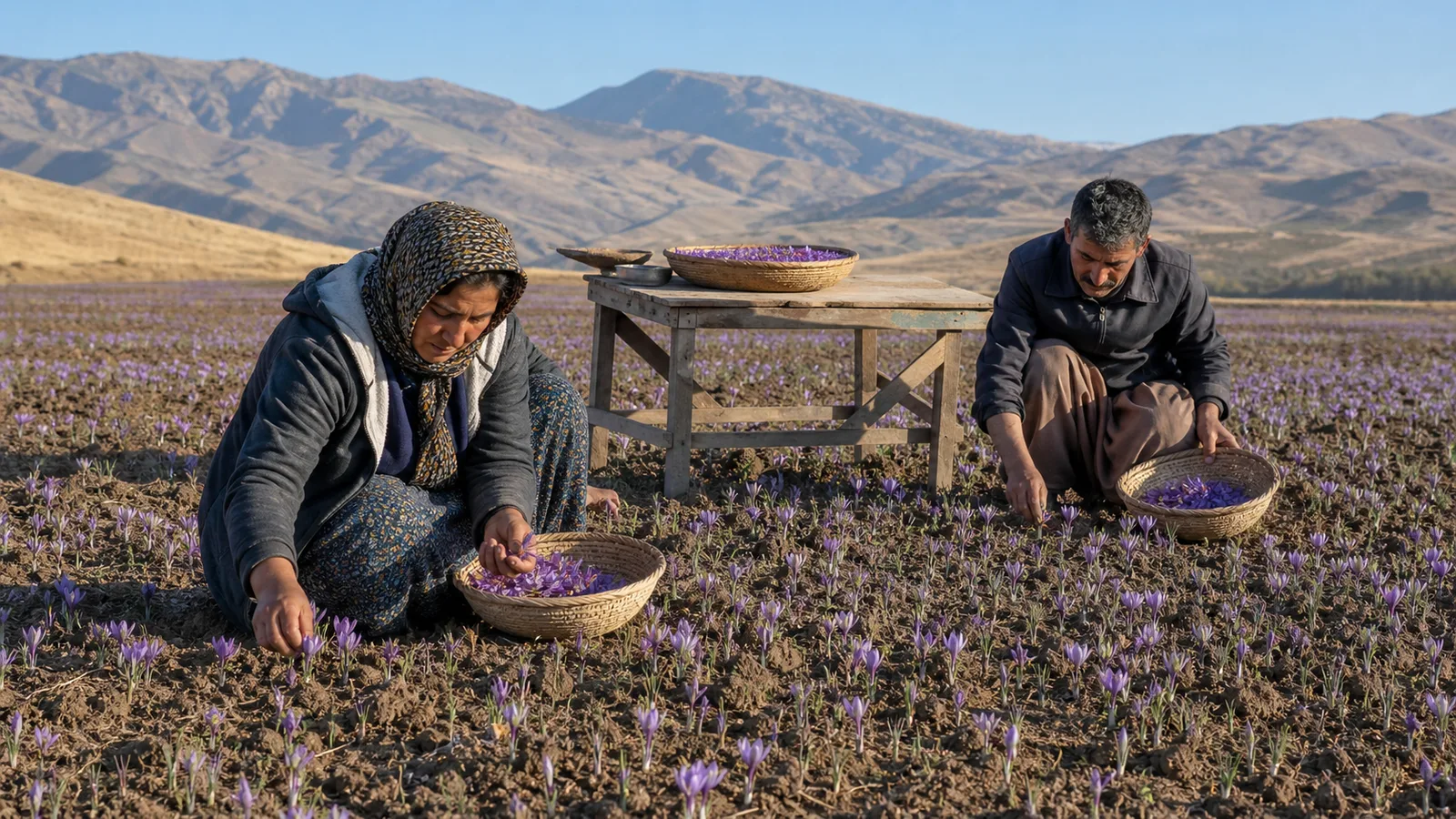
Saffron cultivation in Kermanshah reached a reported 211 hectares during a provincial expansion program that revived a crop with an older local history. The archived announcement describes 105 hectares already added in one stage and another 106 hectares added with support from county authorities. It also records two active packaging workshops and an estimated provincial harvest of about 400 kilograms.
These are historical program figures, not current acreage or a promise of farm income. They show how Kermanshah was trying to connect field expansion with local processing. A smaller pilot in Ahar, East Azerbaijan, followed the same broad idea on just over two hectares: introduce saffron as part of a better cultivation pattern, then judge it over the following seasons.
How Kermanshah reached the 211-hectare figure
The Kermanshah report is attributed to Khosrow Shahbazi, then head of the province’s Jihad Agriculture Organization, after a visit to saffron farms in Shahini village near Sarab Niloufar. He said saffron had been cultivated in the province before falling out of attention, and that organized growth resumed around 2011.
The acreage in the announcement was built in two steps:
- 105 hectares were added in the preceding stage;
- a further 106 hectares were then added across the province;
- the reported cultivated total consequently reached 211 hectares.
The report also referred to two processing and packaging workshops, one in Kuzran and one in Sarab Niloufar. That detail matters. Saffron flowers have a short harvest window, and their stigmas need careful separation, drying and storage. Expanding the field area without enough trained labour and post-harvest capacity can undermine the quality that the crop is intended to deliver.
Reading the production claims carefully
The archived Kermanshah text gives a working yield of four kilograms of dried saffron per hectare and a total harvest of about 400 kilograms. Those figures do not reconcile if four kilograms is applied to all 211 hectares. The most plausible reading is that some newly planted or immature land was included in the area total while the output came from a smaller productive area, but the report does not provide enough detail to prove that explanation.
It also contains a claim that laboratory “analysis” of Kermanshah saffron was 30 percent above Khorasan saffron. No test parameter, sampling method, laboratory report or harvest year is supplied, so the statement cannot support a quality comparison. Saffron quality is not a single percentage. The current ISO 3632-1 specification defines requirements for dried saffron, while laboratory methods examine characteristics such as colouring strength, aroma-related compounds, moisture and purity.
A further claim of potential production up to 40 kilograms per hectare is omitted because the archive supplies no field trial or measurement to substantiate it. Research indexed by FAO’s AGRIS database shows that corm weight, planting density and cultivation conditions can materially change yield, but the reported experimental results are far below a blanket 40-kilogram expectation.
What a grower should take from the Kermanshah program
The useful lesson is not a headline yield. It is the need to plan the entire chain before expanding the crop. A prospective field should be assessed for drainage, soil condition, winter temperatures and dependable irrigation at the stages when the crop needs it. Healthy, traceable corms and sensible planting density are central to establishment.
The business plan also needs to include work that happens after planting:
- monitoring weeds, pests and corm health over a multi-year field cycle;
- organizing pickers for a concentrated early-morning flower harvest;
- separating stigmas promptly and hygienically;
- drying each batch consistently rather than relying on appearance alone;
- protecting dried saffron from moisture, light and contamination;
- using appropriate testing and packaging for the intended market.
The Kuzran and Sarab Niloufar workshops were therefore more than a side note. They represented an attempt to keep processing and some added value within the province instead of treating cultivation as the only measure of success.
Ahar’s two-hectare planting: a smaller version of the same strategy
The source report from Ahar describes a very different scale. Karim Abedi, then governor of Ahar in East Azerbaijan, announced that saffron had been planted for the first time on more than two hectares of the county’s agricultural land. The program expected useful harvests in subsequent years rather than presenting the first planting as an immediate commercial result.
Saffron was one part of Ahar’s cultivation-pattern reform. Peppermint and barberry were also being introduced as alternative crops. The agricultural initiative appeared inside a wider county development plan that included transport, water, tourism and local investment, but those unrelated infrastructure projects do not establish whether the saffron fields succeeded.
The Ahar example provides a useful contrast with Kermanshah. A small pilot can test whether corm establishment, winter conditions, labour and market access work locally before a program expands. The 211-hectare Kermanshah figure reflects a later, province-wide stage in which processing and quality control become more urgent.
How to judge regional saffron expansion
Area planted is easy to announce, but it is only one measure. A stronger assessment tracks the productive area separately from newly planted land, records dry-stigma yield by field age, documents corm health, and uses consistent laboratory methods. It also follows the share of flowers processed promptly and the price growers actually receive.
That distinction protects readers from treating old targets as current facts. The Kermanshah and Ahar reports show real regional interest in saffron and two different approaches to crop diversification. They do not, on their own, prove present acreage, superior quality or guaranteed profitability. Current provincial guidance, input costs, licensing requirements and buyer access should be checked before any planting decision.
References: FAO AGRIS: effect of corm weight and plant density on saffron yield; ISO 3632-1:2025 saffron specification. Local acreage and program details are historical figures retained from the two archived provincial reports consolidated here.

![Exporting Saffron to Turkey + Price Guide [Complete 0 to 100]](https://img.rowhanisaffron.com/20260827003933/saffron-export-turkey-quality-inspection.webp)



