


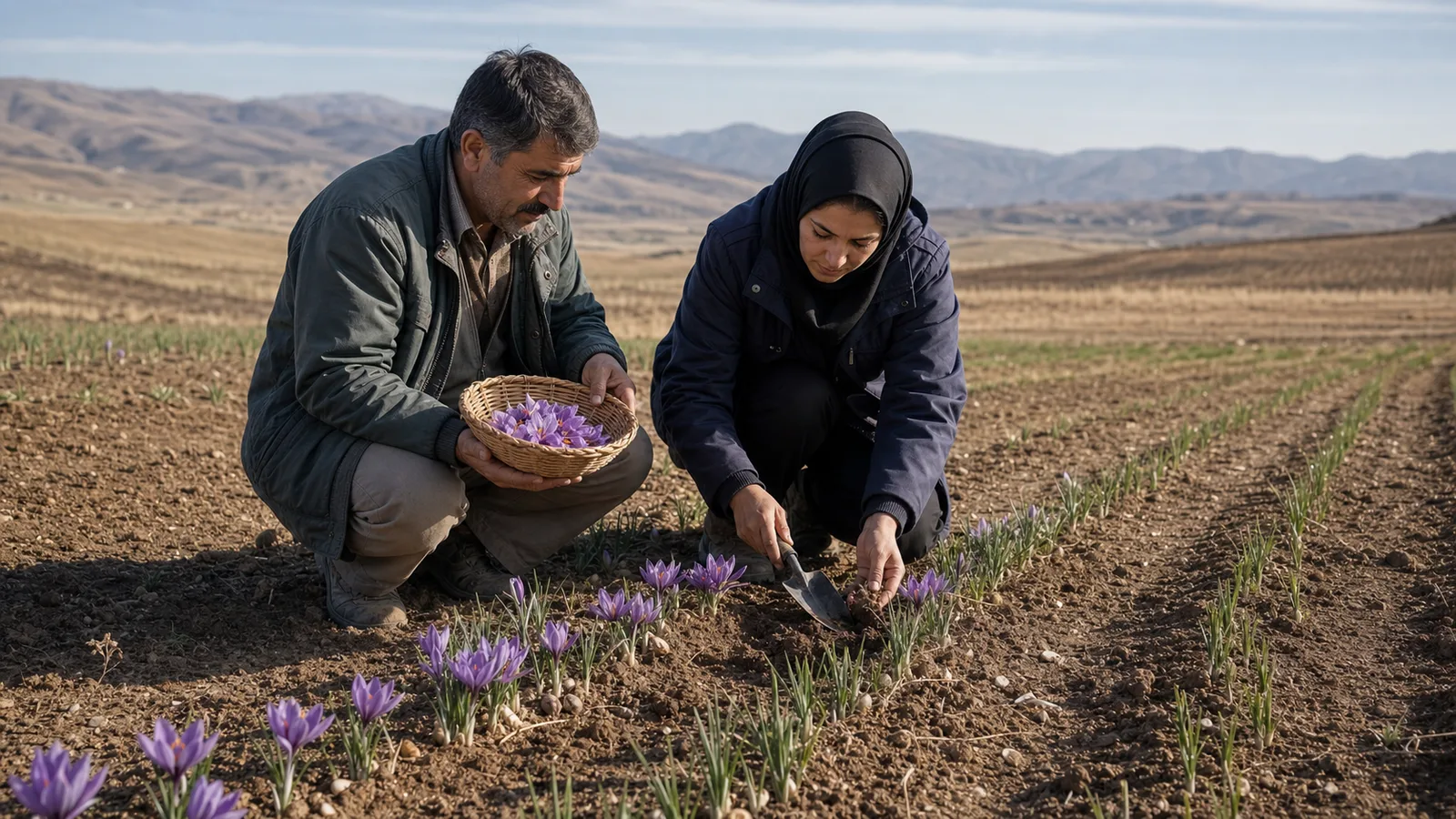
Zanjan’s saffron harvest was forecast at 60 kilograms during a program that expected the province’s cultivated area to reach 40 hectares, including six hectares of new planting. The historical announcement gave an average yield of five kilograms per hectare and noted that saffron fields typically approach stronger production after about three years.
Those numbers make sense only when young and bearing fields are separated. Sixty kilograms at five kilograms per hectare represents about 12 productive hectares, not all 40 reported hectares. The remainder could include newly established or immature plots, but the archive does not provide a field-age breakdown to confirm the exact split.
What the 60-kilogram forecast tells us
Behnam Ojaghloo, then director of horticulture for Zanjan’s agricultural organization, presented saffron as part of the province’s effort to manage limited water more carefully. The crop’s cool-season growth cycle can fit local conditions, and its dormant summer period reduces demand during part of the hottest season.
“Low water demand” is not the same as “no irrigation.” Establishment, flowering and spring corm growth still depend on adequate soil moisture. The original statement also suggested that the crop would be safe from frost because flowers emerge before severe cold. That is a planning assumption, not a guarantee: flowering time and damaging weather can vary by elevation, planting date and year.
The report said the provincial production chain had been operating for about one year. That distinction between field expansion and a working chain matters. A durable saffron program needs healthy corms, technical support, harvest labour, hygienic drying, testing, packaging and buyers—not acreage alone.
How saffron was being established across Zanjan
An earlier program report said saffron had been planted in 344 plots across all Zanjan counties. Officials described productive results in the bearing plots, but the distribution of trial sites does not prove that every field in every county is equally suitable. Soil drainage, water quality, elevation, exposure and field history still require site-level assessment.
The local planting window was under review. Late June planting was described as possible, while the operating recommendation at the time favoured the second half of September through the first half of October. The first post-planting irrigation was to be completed before 15 October, and harvest was expected in the first half of November.
These dates preserve the historical Zanjan guidance; they are not a permanent calendar for every year. Current weather, soil moisture and updated provincial instructions should determine field operations.
The “Green Field” support model
A support company translated as “Green Field” was assigned to follow the production process from site selection to market. Its services included:
- initial field assessment and location selection;
- training courses and technical advice;
- access to production inputs;
- distribution of saffron corms through the provincial program;
- marketing and delivery of the finished product to buyers.
This structure addresses a common weakness in crop-expansion plans: growers may receive planting material without a clear quality standard or sales route. Corm distribution should still be documented by source lot, size and plant-health condition. A support-company label is not a substitute for inspecting the planting stock.
Why field age changes the yield calculation
Cultivated saffron multiplies vegetatively through corms. A newly planted field, a three-year field and an older crowded field do not have the same flower population. Research indexed by FAO’s AGRIS database shows that corm weight and planting density significantly affect yield components.
For Zanjan, a useful annual report would record:
- total planted hectares and newly planted hectares;
- bearing hectares by field age;
- dry-stigma kilograms from each age group;
- corm source, size and density;
- irrigation and relevant weather events;
- the quantity dried and sold to specification.
Without that breakdown, “40 hectares,” “five kilograms per hectare” and “60 kilograms” look contradictory. With it, the figures can describe different parts of the same developing program.
What a grower should verify now
The 60-kilogram figure and 40-hectare target are historical, not a current Zanjan forecast. Anyone considering a new field should obtain current provincial guidance on planting dates, irrigation, corm movement and available support. The field should be checked for drainage and soil constraints, and the budget should include labour and post-harvest work.
Zanjan’s 344-plot network and end-to-end support plan show that the province was testing saffron widely rather than relying on a single demonstration. The safer conclusion is that saffron can work in selected Zanjan fields when the whole production chain is managed—not that every plot is automatically suitable or frost-proof.
References: FAO AGRIS: corm weight, density and saffron yield; FAO: Iranian qanat-based saffron farming. Zanjan acreage, calendar, support-company and harvest figures are identified as historical details from the two local reports consolidated here.

![Exporting Saffron to Turkey + Price Guide [Complete 0 to 100]](https://img.rowhanisaffron.com/20260827003933/saffron-export-turkey-quality-inspection.webp)



