


A provincial report said 53 kg of saffron was harvested from farms in Sistan and Baluchestan after cultivation began as a small pilot. The figures describe an early stage of the crop’s development in the province, not its present-day area or output.
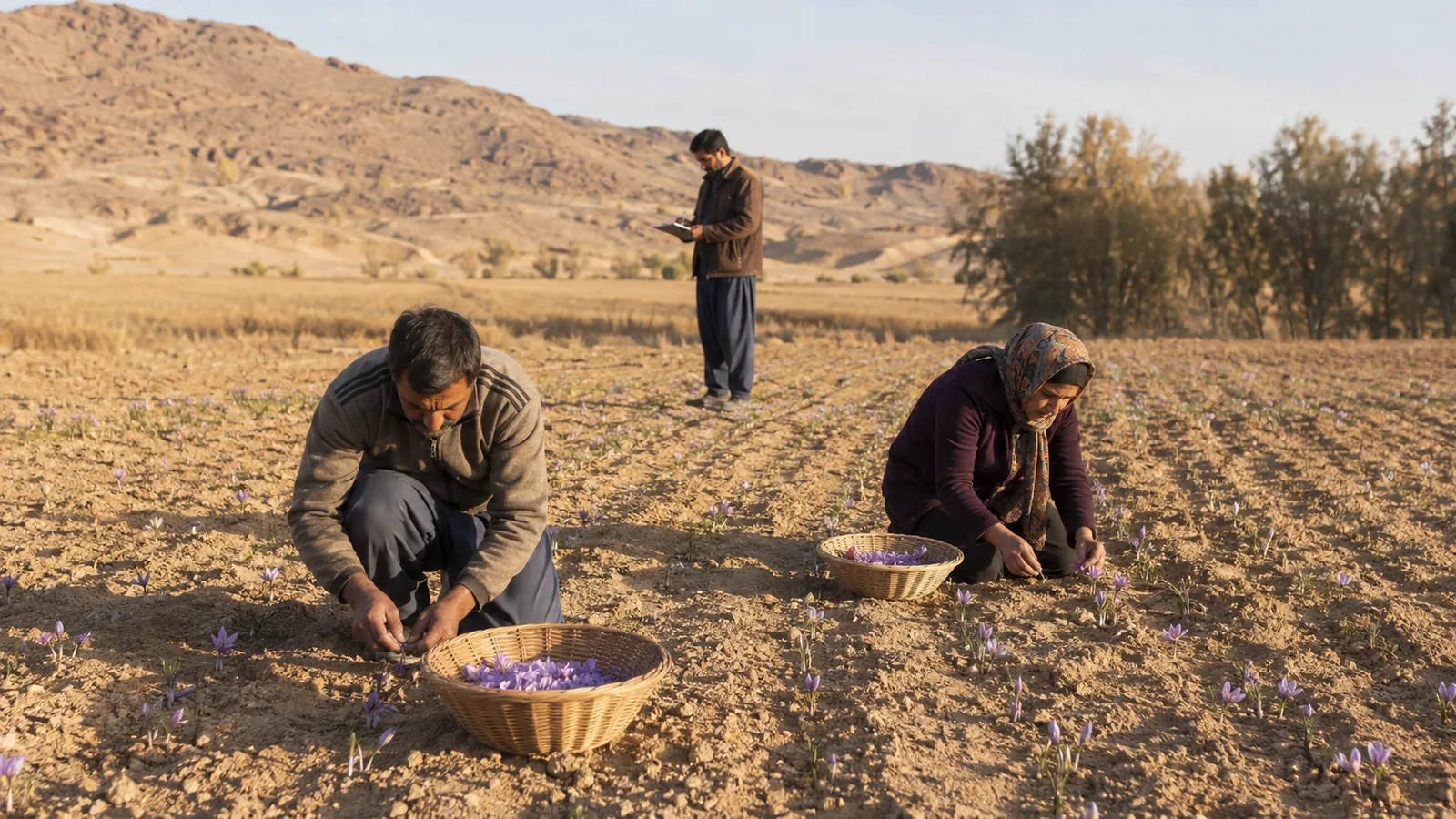
What the 53 kg harvest represented
Ardeshir Shahraki, then identified as head of the provincial Jihad-e-Agriculture Organization, said 18 hectares of farmland had been planted with saffron. According to the report, the project had started three years earlier on five hectares and another 13 hectares were brought into the programme that year.
The 53 kg in the title should therefore be read as a dated provincial harvest report. It is not a forecast for every farm, and it should not be applied to today’s planted area without a current agricultural record.
The area included fields of different ages
New and established saffron plots do not contribute equally to one season’s total. Shahraki said the first year produced relatively little because the work was still in its pilot stage. That distinction helps explain why multiplying the full 18 hectares by a mature-field yield would give the wrong picture.
He also said development would continue for the following two years. This was a plan stated at the time, not evidence that every proposed hectare was subsequently planted.
How to understand the reported yield range
The same account gave a broad harvest range of about five to 10 kg of saffron per hectare. Such a range is useful only when the unit means dried saffron and the age and bearing status of the field are known. The English copy does not provide those details.
Corm size and health, planting density, soil drainage, irrigation timing, weather, field age and harvest handling can all change the result. A provincial range is not a dependable yield guarantee for an individual grower.
Why a pilot approach made sense
The historical account described saffron as a subtropical plant. That broad label is not enough to select a field, because elevation, winter cold, autumn temperature and local soil conditions vary sharply across the province.
Sistan and Baluchestan covers very different elevations and local climates. A trial plot lets growers see whether a particular site provides the winter conditions, drainage and autumn timing that saffron needs before they commit more land and labour.
A useful pilot records more than the final weight. Flowering dates, number of picking days, labour hours, dried yield, quality, corm survival and water used should all be tracked. Those records reveal whether expansion is practical on that farm.
Low-water does not mean no-water
Saffron is often considered where water is scarce because its active season avoids much of the hottest summer period. The FAO’s account of Iran’s qanat-based saffron system describes a crop adapted to severe water shortages, supported by dependable irrigation and local knowledge.
That context matters. Saffron still needs suitable water quality and correctly timed irrigation. A dry field, saline water or poor drainage can limit corm growth and future flowering even when the crop uses less water than a local alternative.
The planting sentence needs careful translation
The surviving English report says the land was irrigated after preparation, then fertilised, and that saffron “onion” was prepared from early June to late September according to regional weather. In agricultural English, the planting material is a corm rather than an onion.
The sentence is too compressed to serve as planting instructions. Soil preparation, fertiliser choice and planting date should be based on a local soil test, corm condition and advice suited to the district. Copying a calendar from a short news item could place corms into unsuitable soil or weather.
Healthy corms and drainage come first
Expansion depends on clean, vigorous planting stock. Damaged or diseased corms can carry a problem into a new plot, while waterlogged soil encourages loss below ground. Growers need a source they can trace and a field where excess water can move away from the root zone.
Planting density also affects cost and future management. More corms are not automatically better if labour, irrigation or disease control cannot keep pace. A measured trial is more informative than a province-wide average.
Harvest and drying determine usable output
The flowers must be picked promptly and handled cleanly. Stigmas then need careful separation and controlled drying; otherwise a promising field result can become uneven or damaged spice. The report did not describe those practices, but they are part of what a kilogram figure actually represents.
Labour planning is especially important because flowering is concentrated into a short period. Before adding hectares, a grower should know who will pick the flowers, where separation will happen and how the dried saffron will be protected from moisture, light and contamination.
What responsible expansion would require
The original project showed that saffron cultivation in Sistan and Baluchestan was being tested beyond its initial five hectares. The 13-hectare addition and reported 53 kg harvest were evidence of that early effort, not proof that the crop suits every part of the province.
Any new expansion should begin with current local data: suitable districts, bearing and non-bearing area, available water, field-level yields, corm health, labour capacity and a realistic buyer. That preserves the useful lesson in Shahraki’s report while avoiding promises the historical figures cannot support.

![Exporting Saffron to Turkey + Price Guide [Complete 0 to 100]](https://img.rowhanisaffron.com/20260827003933/saffron-export-turkey-quality-inspection.webp)



