


Iran’s share of the global saffron market can look large or small depending on what is being measured. Iran was the leading declared saffron exporter in 2016, yet growers and Iranian brands did not capture every part of the value created after harvest. Bulk trading, foreign packing, retail distribution and customer ownership can all sit outside the country that produced the crop.
The original article described a proposed cooperation among Iran’s Central Organization for Rural Cooperation, FAO and laboratories to strengthen that value chain. Its assigned source added production, export and commodity-exchange figures, but some of those numbers compare incompatible markets or lack a primary record. A useful analysis has to separate production volume, customs export value, retail value and brand share.
The official 2016 trade picture
World Bank WITS, presenting UN Comtrade data, records Iranian saffron exports in 2016 at $286.05 million and 203,348 kg. That made Iran the leading named exporter in the WITS ranking for the year.
The assigned source said Iran produced 336 tonnes in 2016. Production and export quantity are not the same measure: part of a crop can be consumed domestically, stored, processed later or recorded in another period. The source attributes 336 tonnes to the National Saffron Association but provides no linked production release, so it should remain an attributed historical figure rather than be used to calculate an exact export ratio.
WITS also shows Spain exporting $65.68 million and 76,275 kg of saffron in 2016. On the import side, Spain reported $52.95 million and 89,521 kg, while the UAE reported $16.67 million and 96,430 kg. Quantity and value anomalies can occur in trade data, and the European Union aggregate overlaps its member countries, so these rows should not simply be added into a world total. They do, however, confirm that major importing and re-exporting hubs operated alongside Iran.
Why the $8 billion comparison is unreliable
The source contrasted an “$8 billion global saffron market” with Iran earning less than $300 million. The second number is close to Iran’s 2016 declared export value. The first has no source, year, geography or definition in the article and is far larger than the country-level customs values shown for the saffron tariff code.
A retail-market estimate might include wholesale and retail mark-ups, extracts, supplements, cosmetics or forecasts across several years. A customs number measures goods declared at a border under a product code. Comparing the two directly does not reveal Iran’s share; it compares different scopes.
The source’s claim that Iran held 42% of global saffron exports has the same problem. It does not say whether the denominator is value or weight, which reporters were included, or how re-exports and the EU aggregate were handled. The claim is preserved as part of the source’s argument, not adopted as a verified share.
Where value is added after saffron leaves the field
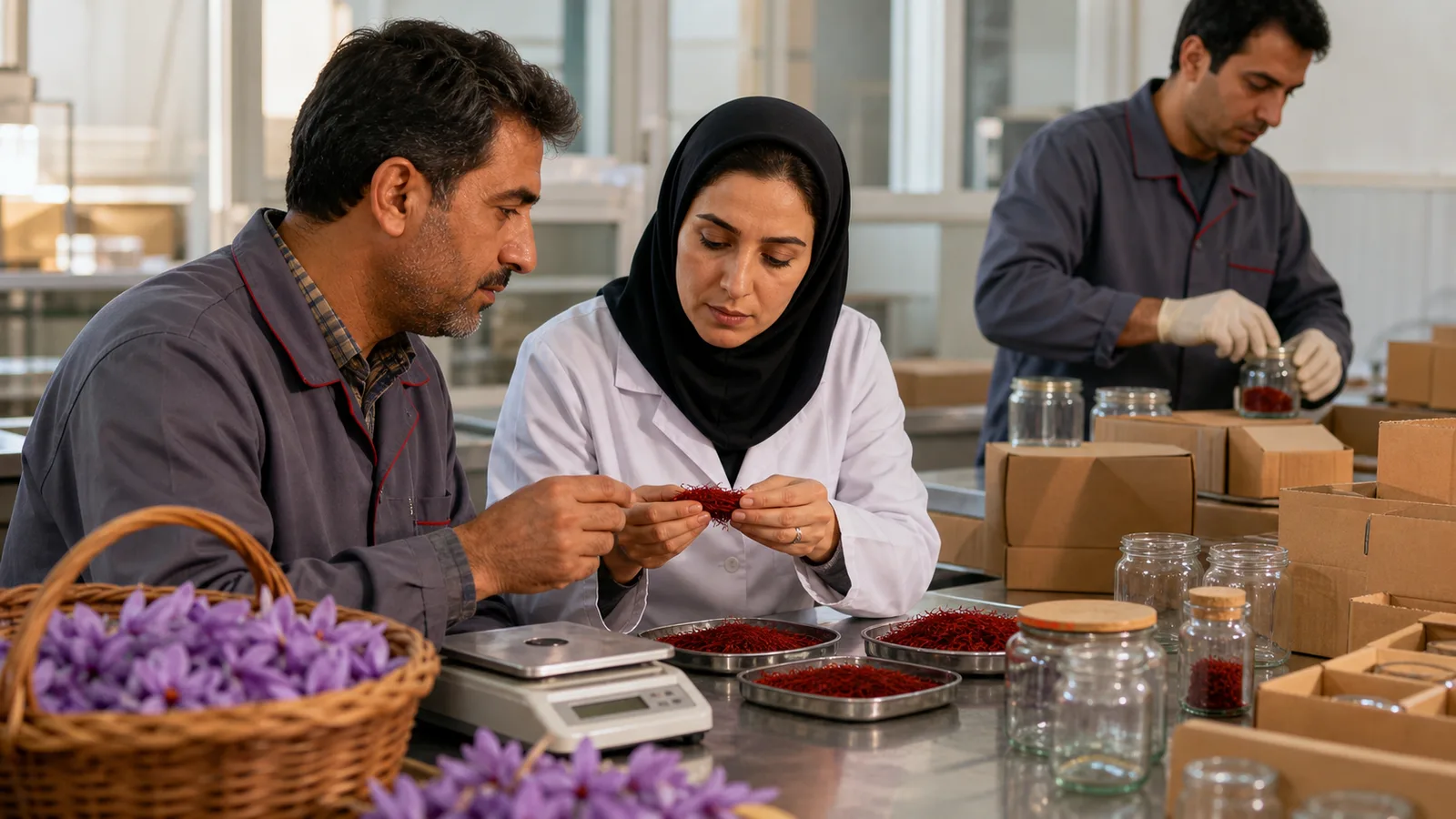
A saffron value chain includes more than cultivation and harvest. Flowers are separated, threads dried, lots aggregated, sampled, tested, graded, financed, packed, marketed, exported, distributed and sold. Each stage can reduce risk or improve convenience for the next buyer.
If Iran sells an anonymous bulk lot and another business performs reliable testing, creates consumer packs and maintains retail distribution, that business has added real work as well as margin. The problem is not automatically the foreign partner. It is the loss of origin visibility and bargaining power when Iranian suppliers cannot document, differentiate or sell their own value.
The source named Spain, Italy and the UAE as places where Iranian material was repacked. Trade flows support their importance as saffron markets, but they do not prove that every exported pack in those countries contained Iranian saffron. Our examination of Iranian saffron in world markets explains the difference between legitimate re-export and misleading origin.
The proposed FAO and cooperative value-chain work
Hossein Shirzad, then managing director of the Central Organization for Rural Cooperation, described official correspondence seeking technical cooperation with FAO. The proposed work covered market analysis, sustainable value-chain development, value-added products, geographical indication, stronger cooperatives and private companies, and a possible FAO delegation to review practical options in Iran.
The article presents these as discussions and offers of assistance, not as completed outcomes. It also stresses a move from repeated studies towards operational plans. A market analysis can identify target buyers or bottlenecks, but implementation requires responsible organisations, budgets, dates and measurable results.
Geographical identity can help when it connects a defined place and product to traceable production rules. It cannot substitute for ordinary lot quality, accurate origin and reliable delivery. Cooperatives can help small farms aggregate volumes and services while still preserving producer records.
The laboratory network named in the proposal
Shirzad said the rural-cooperation organisation had introduced experienced saffron specialists and laboratories for the project. The article named Rubina Gol Pasargad Laboratory, Kian Toos Laboratory, the Food Science Research Institute laboratory in Mashhad, Atcom Laboratory at Ferdowsi University of Mashhad, Mostafavi Laboratory, Testa Laboratory and Tarvand Saffron Laboratory in Qaen.
Being named in a historical project report is not proof of current accreditation, scope or FAO approval. For any commercial decision, a laboratory’s present competence must be checked for the exact method. A report should identify the sample, lot, standard edition, result, unit and date.
The value of a network is comparability. Laboratories using defined sampling and validated methods can help growers understand quality differences, support contracts and reduce disputes. If each lab reports a different method or receives an untraceable jar, more testing does not create a common market language.
Warehouse receipts and deposit certificates
The source described guaranteed purchasing through saffron deposit certificates on the Iranian Commodity Exchange. In a warehouse-receipt system, an approved warehouse receives and records a defined lot; a document representing that stored commodity can then be transferred or used in trading and finance.
This can reduce the need to move saffron for every transaction and can make quantity, ownership and some quality information more visible. It may also give a producer an alternative to an immediate harvest sale. The benefit depends on warehouse governance, grading, insurance, fees, access, dispute resolution and prompt payment.
A certificate does not remove middlemen by definition, guarantee a favourable price or make every lot export-ready. The warehouse specification also has to match what an international buyer needs.
What saffron futures can and cannot do
A futures contract fixes terms for a transaction at a later date. A grower, processor or trader may use it to reduce exposure to an adverse price move. The position can also create margin calls and basis risk when the contract price, grade or delivery point does not move like the participant’s physical saffron.
The source says more than 3.3 million saffron futures contracts had been executed by June 2017. It does not link an exchange bulletin, define contract size or explain whether the count represents contracts, kilograms or another trading statistic. That number is not repeated as fact without a primary exchange record.
Futures cannot guarantee price stability or make Iran the global benchmark on their own. A credible benchmark needs sufficient participation, transparent trades, deliverable grades, dependable warehouses, enforceable settlement and relevance to physical exporters and buyers.
How Iran can retain more saffron value
The strongest opportunities are practical rather than rhetorical:
- help farms and cooperatives preserve lot-level origin through aggregation;
- use representative sampling and comparable laboratory methods;
- grade and price lots according to evidence buyers can verify;
- offer bulk, food-service and retail formats suited to real customer needs;
- build lawful payment, delivery and claims processes for target markets;
- measure repeat orders, producer returns and origin recognition—not just tonnes shipped.
A national brand can support those activities, but it cannot replace company-level performance. Buyers return for consistent product, documentation, communication and delivery. Origin becomes commercially durable when it helps them manage risk and understand what is different.
How to measure market share honestly
Before stating Iran’s share of the global saffron market, define the metric:
- production share compares harvested weight by growing country;
- direct export share compares border-reported weight or value by exporter;
- origin share follows Iranian-grown material through re-export, which customs exporter data alone cannot do;
- branded retail share measures sales under identified brands in a defined consumer market;
- producer value share asks how much final value returns to farms and domestic processors.
Those measures answer different questions. Iran can lead production and direct exports while retaining a smaller share of branded retail value. That is the coherent meaning behind the title—and a better basis for action than an unsupported $8 billion comparison.

![Exporting Saffron to Turkey + Price Guide [Complete 0 to 100]](https://img.rowhanisaffron.com/20260827003933/saffron-export-turkey-quality-inspection.webp)



