


Saffron cultivation in Razan city had increased to 28 hectares when local agricultural director Mahmoud Fathi described the sector. The more revealing part of his account was not the area alone: processing still happened mainly at home, and Razan had no industrial saffron-processing unit.
What the 28-hectare figure tells us
Fathi, then director of Jihad-e-Agriculture in Razan, said the city’s saffron area had reached 28 hectares. It was a dated snapshot of cultivation, not a current land figure or a production total.
The report did not separate new fields from mature, bearing fields. It also gave no harvest weight or average yield. Those omissions matter because planted area by itself cannot show how much saleable saffron growers produced.
Razan’s saffron was built around home businesses
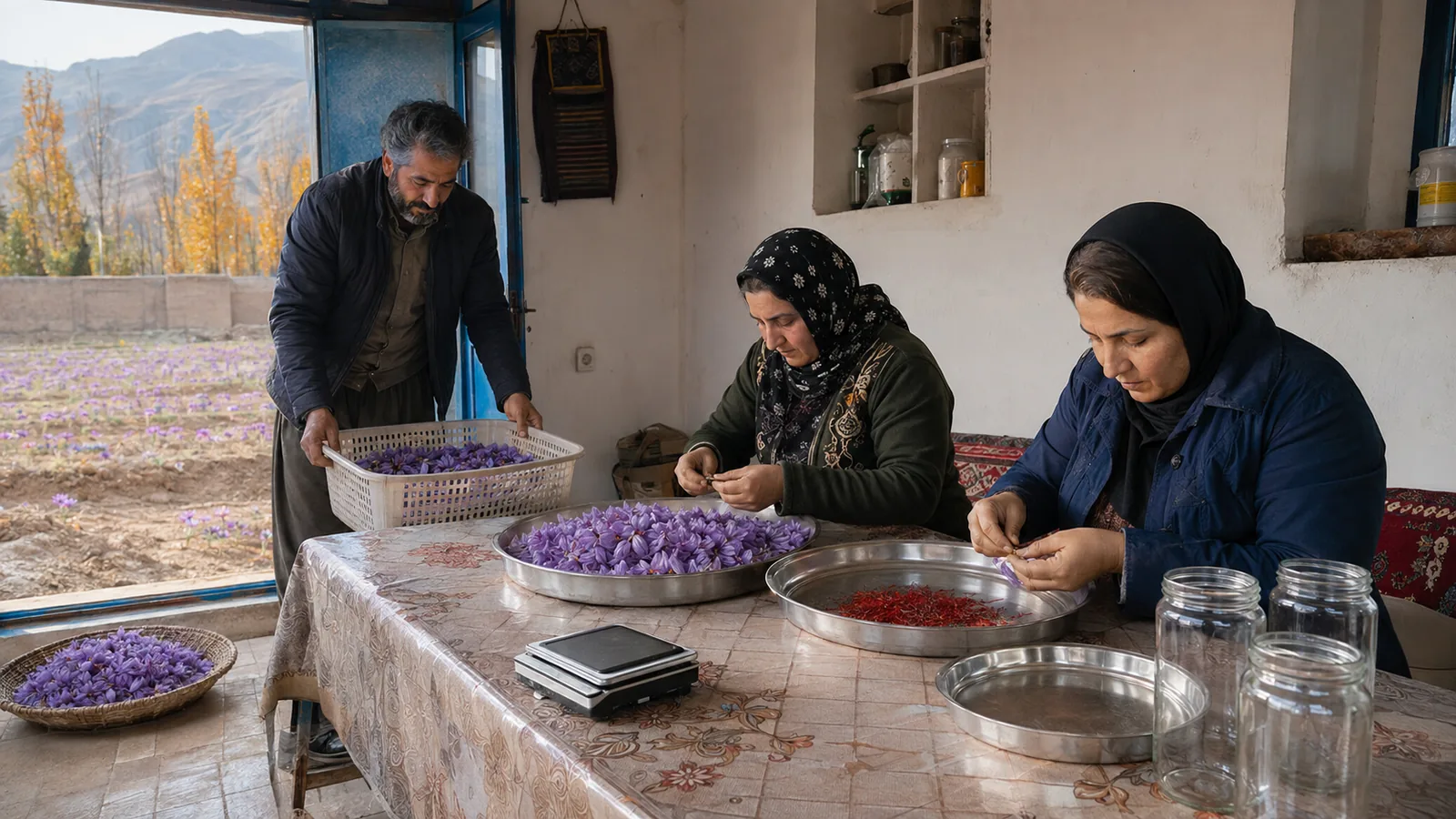
According to Fathi, most processing took place through home businesses and traditional household work. Growers prepared the product for sale in special packages, but no industrial unit was active in the city for saffron processing.
“Traditional” does not necessarily mean poor quality. Careful small-scale work can produce good saffron. The limitation is consistency: clean separation, controlled drying, moisture protection, lot identification and repeatable packaging all need to be managed every time.
Three local operators had established brands
Fathi said three people in Razan had succeeded in obtaining a brand for saffron and were exporting it under their own labels. The report did not name the brands, define the registration involved or give export volumes and destinations.
That makes the claim useful as evidence of early commercial ambition, but not enough to measure the market. A brand becomes valuable when buyers can connect its name with a consistent grade, origin, package and accountable supplier.
Processing is more than putting saffron in a box
Packaging is the final visible step, but value can be lost much earlier. Flowers need prompt handling, stigmas must be separated cleanly, and drying must protect colour, aroma and flavour without leaving excess moisture. Storage then has to limit light, humidity, contamination and physical damage.
A shared local facility could help with those controls, but only if it matches the volume and needs of Razan’s growers. An expensive plant without enough seasonal supply, trained staff or buyers would not solve the underlying problem.
What an appropriate processing model could include
For a 28-hectare sector, the right next step might be a modest service centre or cooperative arrangement rather than a large factory. Growers could share clean workspaces, calibrated drying equipment, accurate scales, batch records and suitable storage while keeping their own businesses.
Before investing, the city would need current answers: how much dry saffron is produced, over how many harvest days, what work is already done well at home, where quality varies and which package sizes buyers actually request.
Why medicinal plants were part of the discussion
The original article placed saffron within a wider argument about medicinal plants and Hamedan province’s agricultural capacity. Razan was presented as a city with land suited to a range of agricultural and medicinal crops, with saffron one of its more visible successes.
That framing also connected local agriculture to Iran’s effort to earn more from non-oil production and exports. It is a broad economic goal. Whether saffron contributes meaningfully depends on product quality, market access and the share of value that stays with growers and local processors.
Water use needs a farm-level comparison
The report asked whether incentives for this lower-water crop had been strengthened as pressure on water resources grew. Saffron’s seasonal cycle can make it worth considering in dry regions; the FAO’s account of Iran’s qanat-based saffron system describes the crop within a landscape of severe water shortage and dependable traditional irrigation.
It still needs water at the right times. “Lower-water” should compare saffron with a realistic local alternative using measured irrigation, yield and income. It should never be read as a claim that every field in Razan is suitable or that cultivation is risk-free.
Branding has to rest on traceable product
A credible Razan label should tell a buyer who produced the saffron, when it was harvested and dried, what grade is being sold and how the lot was stored. Accurate net weight and tamper-evident food-safe packaging matter more than decorative claims.
Testing and records are especially useful when several home businesses feed one brand. They allow the seller to investigate a problem and keep one inconsistent lot from weakening confidence in everyone else’s work.
What the city needed beyond more hectares
The report’s strongest question remains relevant: had Razan turned cultivation potential into packaging, branding, processing and conversion industries? Its own answer was mixed. Twenty-eight hectares were planted, household businesses were active and three operators had moved towards branded exports, yet there was no industrial processing unit.
Future progress should be judged with current, separate figures for planted area, bearing area, dry output, quality, household processors, licensed facilities, branded sales and exports. More hectares can matter, but a dependable chain from field to buyer is what turns saffron cultivation into durable local value.

![Exporting Saffron to Turkey + Price Guide [Complete 0 to 100]](https://img.rowhanisaffron.com/20260827003933/saffron-export-turkey-quality-inspection.webp)



