


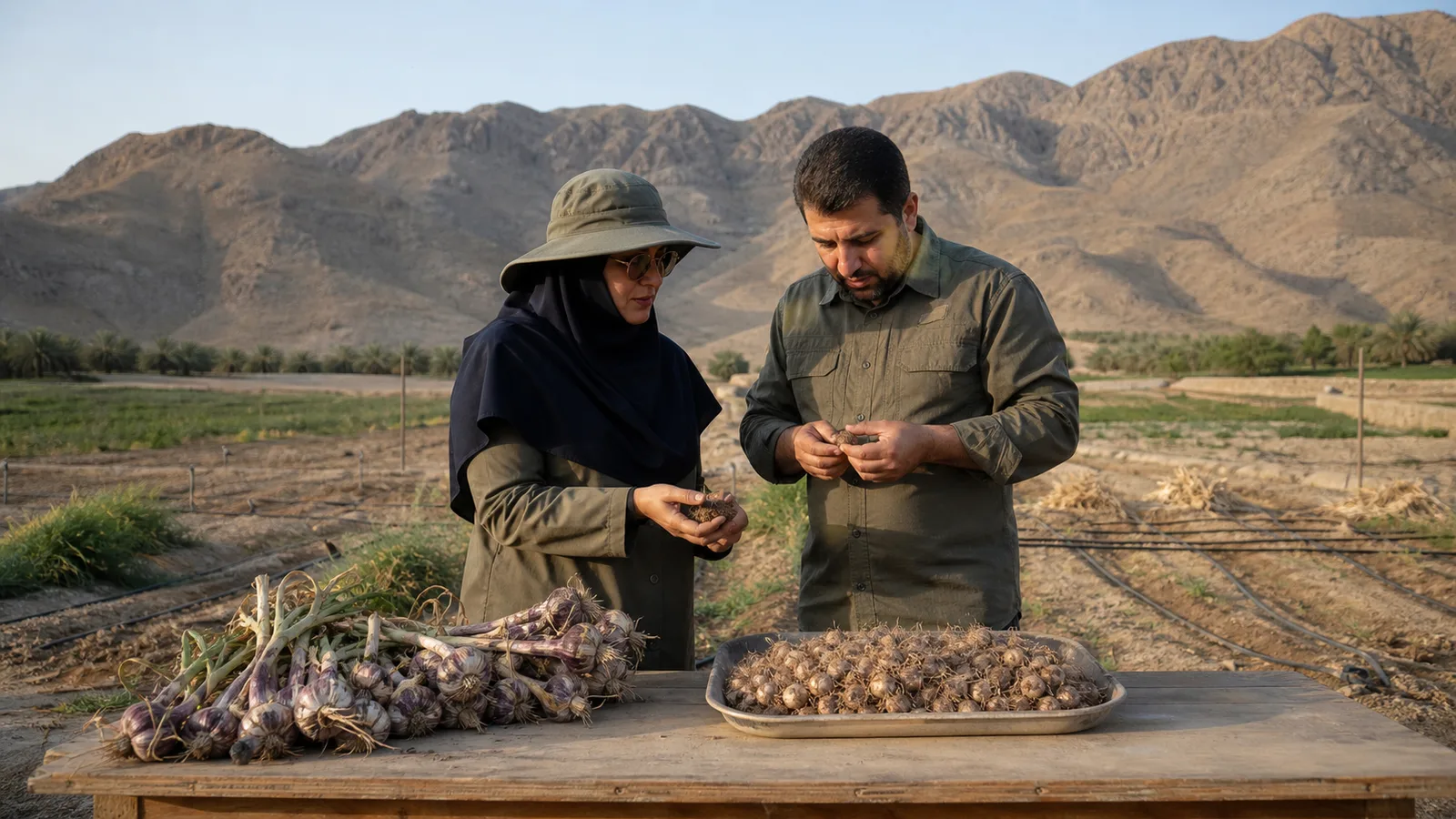
Garlic and saffron cultivation in Bashagard can support rural income, but the two crops need separate, evidence-led plans. Red garlic already has a documented production history in this mountainous county of Hormozgan. Saffron, by contrast, should be promoted only on sites where soil, elevation, temperature, water quality and market access have first been tested.
This distinction matters because an earlier report about development in Bashagard carried a headline calling for the promotion of garlic and saffron, while its body described a much broader investment meeting. The report did not give a saffron planting area, harvest figure or named field trial. Those missing details should not be filled with assumptions.
What the earlier Bashagard development report actually said
The archived account named Iraj Heydari, then Hormozgan deputy governor for economic-affairs coordination, and a meeting with the Shahid Hajji jihadi investment group. Heydari described comprehensive development as a provincial priority and said lasting measures were needed to create employment and production. He also referred to services delivered since Iran’s 1979 revolution.
Agriculture was only one part of that economic picture. The report discussed Bashagard’s mineral potential, training skilled workers for different sectors and strengthening a micro-employment fund for rural women. Those subjects remain relevant to a crop programme because production alone does not create a durable local industry. Farmers also need trained labour, finance, processing, storage and buyers.
Bashagard is a mountainous county in eastern Hormozgan in southern Iran, with Sardasht as its administrative centre. Conditions vary sharply between valleys and higher ground. A crop that succeeds in one village may be unsuitable in another, so a county-wide recommendation is too broad.
Garlic has a documented local base
Garlic is not merely a proposed crop for Bashagard. In a May 2020 report, the county’s Agriculture Jihad director described Bashagard as Hormozgan’s garlic-production centre. The report recorded 100 hectares of red garlic, an expected average yield of five tonnes per hectare and a harvest season from the first half of May through the end of June. It also noted that Bashagard garlic received a registered geographical indication in February 2017. These are dated figures, not a claim about today’s planted area.
That established identity gives a garlic programme something concrete to build on. The practical priorities are healthy planting cloves, efficient irrigation, field hygiene, appropriate drying, protected storage and coordinated sales. A geographic name has value only when buyers receive consistent quality and the product can be traced back to its origin.
Saffron needs local proof before expansion
Saffron uses relatively little summer water, but that does not make every dry location suitable. Corms are vulnerable to waterlogging, and flowering performance depends on the interaction of temperature, soil, irrigation timing, corm quality and field management. Bashagard’s lower, hotter sites should not be treated as equivalent to its cooler high ground.
The sensible starting point is a small demonstration plot, not an immediate promise of commercial returns. A local agronomist should document:
- soil texture, drainage, salinity and pH;
- site elevation and seasonal temperature pattern;
- the source, health and size of the saffron corms;
- irrigation water quality and the reliable water supply;
- flower and dry-stigma yield over more than one season;
- labour available for the short picking and separation window;
- drying, packaging, testing and buyer arrangements.
If those records show that a site is agronomically and economically viable, planting can expand in measured stages. If they do not, describing saffron as a low-water crop is not enough reason to continue.
What a credible crop-promotion programme would look like
Keep the garlic and saffron plans distinct
Garlic is an annual food crop harvested as bulbs; saffron is a perennial corm crop harvested for its stigmas. They have different planting material, field operations, post-harvest risks and buyers. Shared training can cover water management, recordkeeping and cooperative marketing, but crop-specific advice should remain separate.
Connect finance to real operations
The rural women’s micro-employment fund mentioned in the earlier report could support clearly costed activities such as stigma separation, hygienic drying, garlic grading, packaging or bookkeeping. Funding should follow a viable production and sales plan rather than precede it.
Measure value, not just planted hectares
A useful annual report would publish bearing area, marketable yield, rejected product, water use, production cost, farm-gate price and the number of participating households. For saffron, it should also distinguish flowers picked from dry stigma produced. For garlic, storage loss and the proportion sold under Bashagard’s geographic identity matter.
Plan the route to market before scaling
Road access, storage and processing are especially important in dispersed mountain communities. A larger crop can lower farm income if it reaches the market late or in inconsistent condition. Purchase agreements, aggregation points and quality specifications should therefore be settled before new acreage is encouraged.
The realistic opportunity for Bashagard
Bashagard’s red garlic has a recorded local identity and a basis for quality-focused development. Saffron may offer an additional opportunity on suitable sites, but the available archived report does not prove county-wide suitability or document an established saffron industry. The responsible approach is to protect what garlic growers already know, test saffron locally, publish the results and expand only where both the field evidence and the market justify it.

![Exporting Saffron to Turkey + Price Guide [Complete 0 to 100]](https://img.rowhanisaffron.com/20260827003933/saffron-export-turkey-quality-inspection.webp)



