


A historical report marked the beginning of the saffron harvest in Zarand with 410 hectares under cultivation and an estimated 3.5 to 4 kilograms per hectare. The account also records what growers wanted next: dependable branding, local processing and a crop strategy that responded to drought without overstating saffron’s advantages.
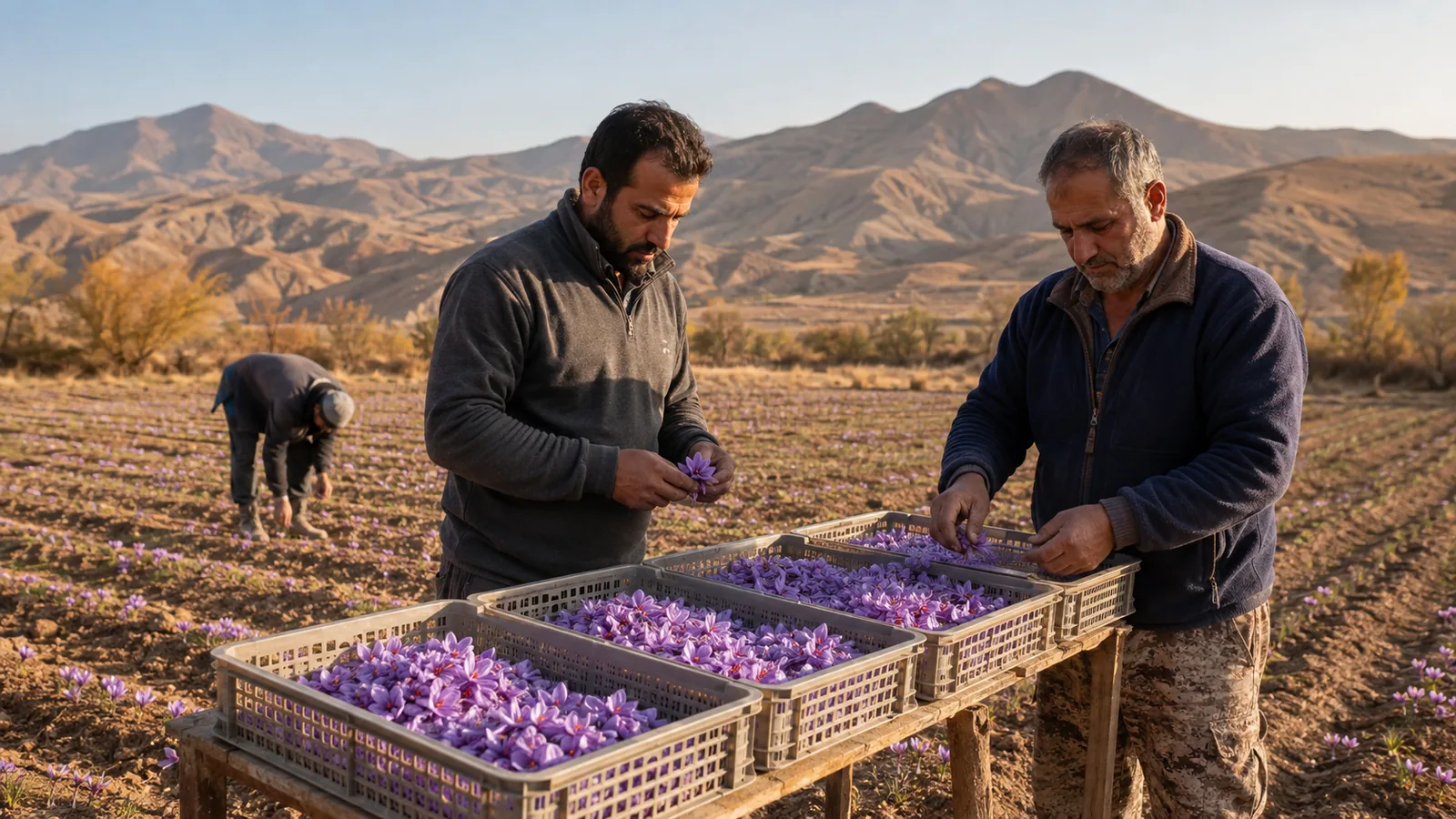
The reported saffron area and yield
Reza Mohammadi said 410 hectares of land in Zarand were planted with saffron and placed average dry yield at three and a half to four kilograms per hectare. If every hectare was bearing, those figures would imply roughly 1.44 to 1.64 tons of saffron. The report does not state the bearing area or total measured harvest, so this remains an estimate rather than a final production figure.
An official 2021 account from Zarand gave a nearby but different snapshot: 390 hectares in total, of which 350 were bearing. It also ranked Zarand first in Kerman Province by saffron area. The change between 390 and 410 hectares is plausible over time, but neither figure should be presented as today’s area without a current survey.
Why saffron expanded during drought
Zarand Governor Ali Sadeghzadeh linked the crop’s growth with successive droughts and a severe decline in groundwater. He described saffron as more economical than some other irrigated crops and connected it with the region’s “resistance economy” goals.
Saffron avoids irrigation through much of summer, which can reduce competition with summer crops. It still needs water at important stages, and a lower-water reputation does not prove that every field saves the same amount. The proper comparison is total water applied, saleable dry yield and net return against the crop that would otherwise occupy that land.
Low-water crops were part of a wider local plan
Sadeghzadeh said saffron, barberry and Mohammadi rose had expanded in recent years, especially on mountainous land with suitable weather and soil. He also said the county supported farmers who developed lower-water crops in place of high-water alternatives.
These crops do not have identical site needs or markets. A farm still has to test soil drainage, water quality, frost exposure, labour availability and access to a buyer. Replacing a crop is safest when the new option has been trialled locally and the household can manage the transition period.
The harvest creates a short, intense demand for labour
Zia al-Dini, a saffron grower in the Dashtkhak region, pointed to the employment created by saffron production. Much of that work arrives in a narrow window: flowers are picked early, stigmas are separated promptly, and the product is dried before quality deteriorates.
Seasonal work can be valuable without being permanent employment. A useful local count would distinguish field owners, year-round staff, pickers, stigma separators, processors and packers instead of combining them into one number.
Growers asked for a Zarand saffron brand
Zia al-Dini asked officials to give more attention to branding the region’s saffron. Another grower, Ghasemi, described Zarand as the province’s centre of saffron production and called for effective measures on both branding and processing.
The official 2021 report identifies the same gap: growers lacked distinctive regional packaging and a recognised brand, while facing high agricultural-input costs. Repeating “high quality” on a label would not solve that problem. A regional identity has to be supported by traceable origin, consistent grades, clean handling and records that follow each lot.
Processing determines whether field quality survives
Local processing can shorten the time between picking and controlled drying. It can also provide shared grading, moisture checks, hygienic packing and storage rather than forcing each grower to solve those steps alone.
A facility needs enough seasonal volume, trained workers and buyers for its grades. Equipment should be selected around the actual bottleneck in Zarand, not installed merely to claim that the county has a processing plant.
“Completely hygienic” needs a visible process
Mehdi Ghorbani said farmers harvested saffron in a completely hygienic way. Hygiene is not a permanent quality attached to a district; it comes from repeatable practice.
Clean picking containers, protected separation surfaces, healthy workers, controlled drying, food-safe storage and prevention of cross-contamination are all observable. Documenting those steps gives a buyer more confidence than an unqualified claim.
Colour and taste claims also need testing
Ghorbani attributed strong colour and taste to the climate of the plain and said Zarand saffron could compete with leading producing provinces. Climate and handling can influence the finished product, but the report supplies no side-by-side sensory or laboratory results.
A fair comparison uses samples from the same season, prepared and stored under defined conditions, then assessed with the same grading and analytical method. Until that evidence exists, Zarand’s quality should remain an attributed grower claim rather than a guaranteed superiority statement.
Planting and summer dormancy
The official Zarand account says local planting ran from August to early November and highlights the lack of summer irrigation as one advantage. Timing should still follow local temperature and water conditions, corm health and field preparation rather than a calendar date alone.
Once established, the crop’s summer dormancy helps explain its appeal under groundwater pressure. Autumn irrigation and later crop care still need to be managed so that saving water does not become simply under-watering the field.
What Zarand needed beyond a larger area
The beginning of the red-gold harvest was more than a seasonal announcement. It showed a county with a substantial saffron area, a stated yield range, a leading provincial position and growers asking to retain more value locally.
The strongest next step is to publish dated bearing-area and dry-output figures, measure field water use, document hygienic processing and build a traceable regional grade. Those actions would support the brand that Zia al-Dini, Ghasemi and Mehdi Ghorbani wanted without turning historical estimates or local pride into unsupported promises.

![Exporting Saffron to Turkey + Price Guide [Complete 0 to 100]](https://img.rowhanisaffron.com/20260827003933/saffron-export-turkey-quality-inspection.webp)



