


A closed-room trial in Tangestan used 140 kilograms of saffron corms in what local officials called an aeroponic system. The project is a useful starting point for understanding aeroponic saffron farming, but several claims in the original report need correction before anyone treats it as a training guide or investment plan.
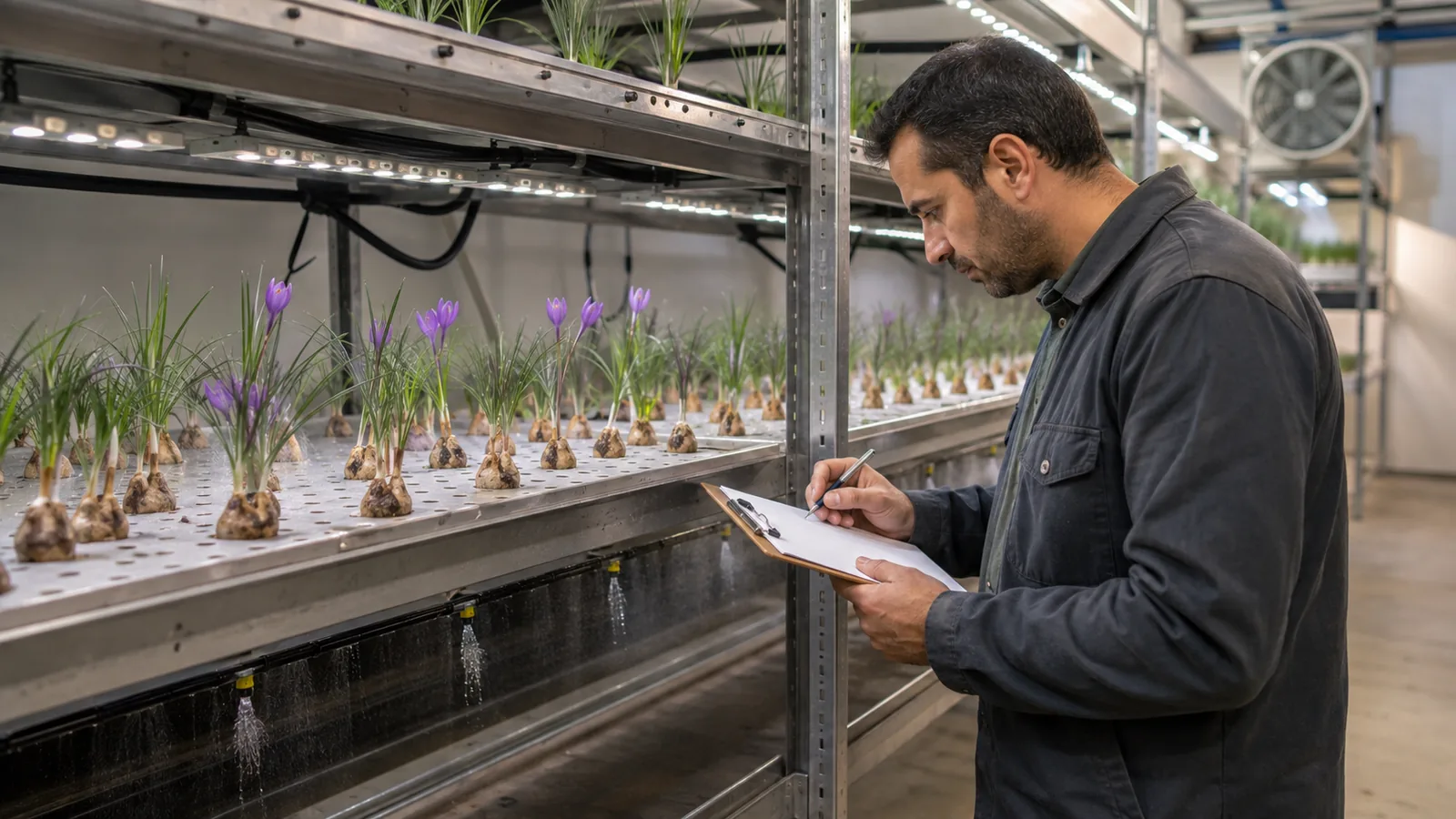
What was cultivated in Tangestan
Hamzeh Abbasi-Pour Bahrani, director of Tangestan Agricultural Jihad, said saffron was cultivated indoors in the Gorkat area of Tangestan, Bushehr Province. The starting material was 140 kilograms of what the English translation calls “saffron onion.” The botanical and farming term is corm.
No floor area, corm count, corm grade, environmental set points or measured stigma yield appears in the report. Without those details, the 140-kilogram trial documents that cultivation took place but cannot establish commercial performance.
What aeroponic saffron farming actually means
In aeroponics, roots are held without soil and receive water and dissolved nutrients as a controlled mist. The original description says moisture replaces both water and soil. Soil is absent, but water is not: it is delivered in droplets rather than through a field or a pot.
The phrase “aeroponics saffron farming” is also used in searches, although “aeroponic saffron farming” is the clearer English form. Both refer to keeping the root zone in air and delivering moisture through a mist system.
The corm should not sit submerged in water. Unlike conventional pot culture, an aeroponic installation does not need potting soil or repeated replacement of individual pots. It still has to manage root-zone moisture, nutrient concentration, pH, air temperature, relative humidity, airflow, light and sanitation. Calling the process “aeration” does not remove these requirements.
Aeroponics and shelf-forcing are not always the same system
Saffron corms can initiate and open flowers using reserves accumulated before they enter a controlled room. Some indoor operations place dormant corms on shelves mainly to force flowering, then move them back to soil for the leaf and daughter-corm phase. A true aeroponic or hydroponic production cycle also supports roots and later vegetative growth with water and nutrients.
This distinction matters when comparing demonstrations. A room that produces one flush of flowers is not automatically a closed-loop aeroponic farm, and flower emergence alone does not show that the corms will remain productive in the following cycle.
Why corm size and condition matter
The corm carries the flower buds and stored energy. Its size, health, dormancy history and temperature exposure strongly influence whether it flowers. A tray filled with small or damaged corms cannot be made productive simply by raising humidity.
Research comparing field and controlled-environment production has measured flowering percentage, flowers per corm and dry stigma weight rather than relying on the starting weight of corms alone. A grower evaluating aeroponic saffron should record corm count and size classes as well as total kilograms.
The “seven times more” claim is not demonstrated
Abbasi-Pour Bahrani attributed a major advantage to stacking and higher planting density, then said production could be about seven times traditional cultivation with better quality. Vertical shelves can increase the number of corms per square metre of floor, but a density comparison is not the same as a sevenfold increase in yield per corm or profit.
A controlled hydroponic and aeroponic saffron study reported its own corm count, flowering percentage, flowers per corm and dry stigma yield per square metre. Its results also varied by system and year. That is the kind of measurement needed before a multiplier can be applied to Tangestan.
Quality has to be measured after drying
Indoor control may produce clean flowers and make handling easier, but appearance does not prove better saffron. Quality depends on the stigma, separation, drying and storage, then on measured characteristics such as moisture and the compounds associated with colour, aroma and taste.
A peer-reviewed comparison of field and controlled-environment saffron assessed both quantity and quality. It found that production method can affect results, but the outcome depends on the actual cultivation conditions. “Better quality” should therefore be supported by analysed samples from the Tangestan crop.
Soil-borne risk is reduced, not eliminated
The original report says the probability of pests and diseases entering from soil is zero. Removing soil does remove one route of exposure, but it does not make a crop sterile. Corms can arrive carrying fungi, mites or physical damage; trays, tools, water, workers and recirculating equipment can also spread contamination.
Good aeroponic saffron farming begins with sound, traceable corms and cleanable equipment. Batches should remain identifiable, damaged material should be isolated, and temperature and humidity should not encourage rot. Sanitation reduces risk; it cannot honestly promise zero disease.
The four-month period covers only part of the biology
The Tangestan account describes a process lasting about four months. That may cover conditioning, sprouting and flowering in the room. Saffron’s annual cycle continues through leaf growth, formation of replacement corms and dormancy.
A training programme needs to say what happens after the stigmas are collected. If corms are returned to a field, the labour, land, irrigation and disease-management costs still exist. If they remain soilless, the system must support roots and foliage long enough to produce viable daughter corms for another season.
The one-to-two-kilogram statement is not usable
The translation says that one to two kilograms of large saffron bulbs can be harvested and equates that with one to two kilograms of saffron. Taken literally, that would mean roughly equal weights of corms and dry spice, which is not credible.
The sentence may have lost a unit or reversed the relationship between starting corms and stigma yield. Because the source provides no corm count, flower count or dry-stigma measurement, it should not be used for yield, cost or revenue calculations.
A practical aeroponic saffron farming training checklist
Before scaling beyond a trial, record the inputs and outputs that make one cycle comparable with the next:
- corm origin, health, total count, weight and size distribution;
- usable shelf area as well as the room’s floor area;
- temperature, humidity, airflow, light and root-mist schedule;
- water quality, nutrient recipe, pH and electrical conductivity where nutrients are supplied;
- flowering percentage, flowers per corm and fresh stigma weight;
- dry stigma weight after one defined drying method;
- electricity, cooling, labour, cleaning and equipment costs; and
- the number and size of healthy daughter corms produced for the next cycle.
A small control group under the best available field method helps show whether the room improved yield or merely shifted work and cost indoors.
Density can create new operating risks
Stacking uses space efficiently, but close spacing also concentrates value and risk. A failed fan, blocked mist line, unsuitable humidity or infected corm batch can affect many plants quickly. Backup power, alarms and access for inspection belong in the design before shelves are filled.
Labour does not disappear either. Workers still inspect corms, remove flowers, separate stigmas, dry the product and clean the room. An economic comparison should include those tasks rather than counting only water or floor area.
High value does not guarantee high export profit
Abbasi-Pour Bahrani linked saffron cultivation with added value and high profit for producers through export. That is a commercial ambition, not a result demonstrated by the Tangestan trial. Profit depends on saleable dry yield, quality, price, rejected product, energy, labour, equipment, corm replacement, finance and the actual route to a buyer.
An aeroponic project should model a conservative domestic sale as well as an export case. Export may add compliance, testing, packing, logistics and payment risk, so a high retail price in another country cannot be used as the farm-gate return.
How to judge the Tangestan aeroponic saffron trial
The Tangestan project shows local interest in controlled-environment saffron and identifies real attractions: stacked production, no soil inside the room and greater control over flowering conditions. It does not provide enough measurements to prove sevenfold output, zero pest risk, equivalent kilograms of corms and spice, or high profit from export.
The next useful step is a documented trial with a clear system diagram, environmental records, corm classes, dry stigma yield, quality testing and a complete cost sheet. That evidence would make the project valuable to people searching for aeroponic saffron farming training while protecting them from claims the original report cannot support.

![Exporting Saffron to Turkey + Price Guide [Complete 0 to 100]](https://img.rowhanisaffron.com/20260827003933/saffron-export-turkey-quality-inspection.webp)



