


Saffron became one of the crops promoted around the Lake Urmia basin as farmers and planners looked for ways to reduce pressure on water. A historical West Azerbaijan report recorded about 48 hectares and an expected 70-kilogram harvest, but it did not mean saffron needed no irrigation or that it could replace every established crop.
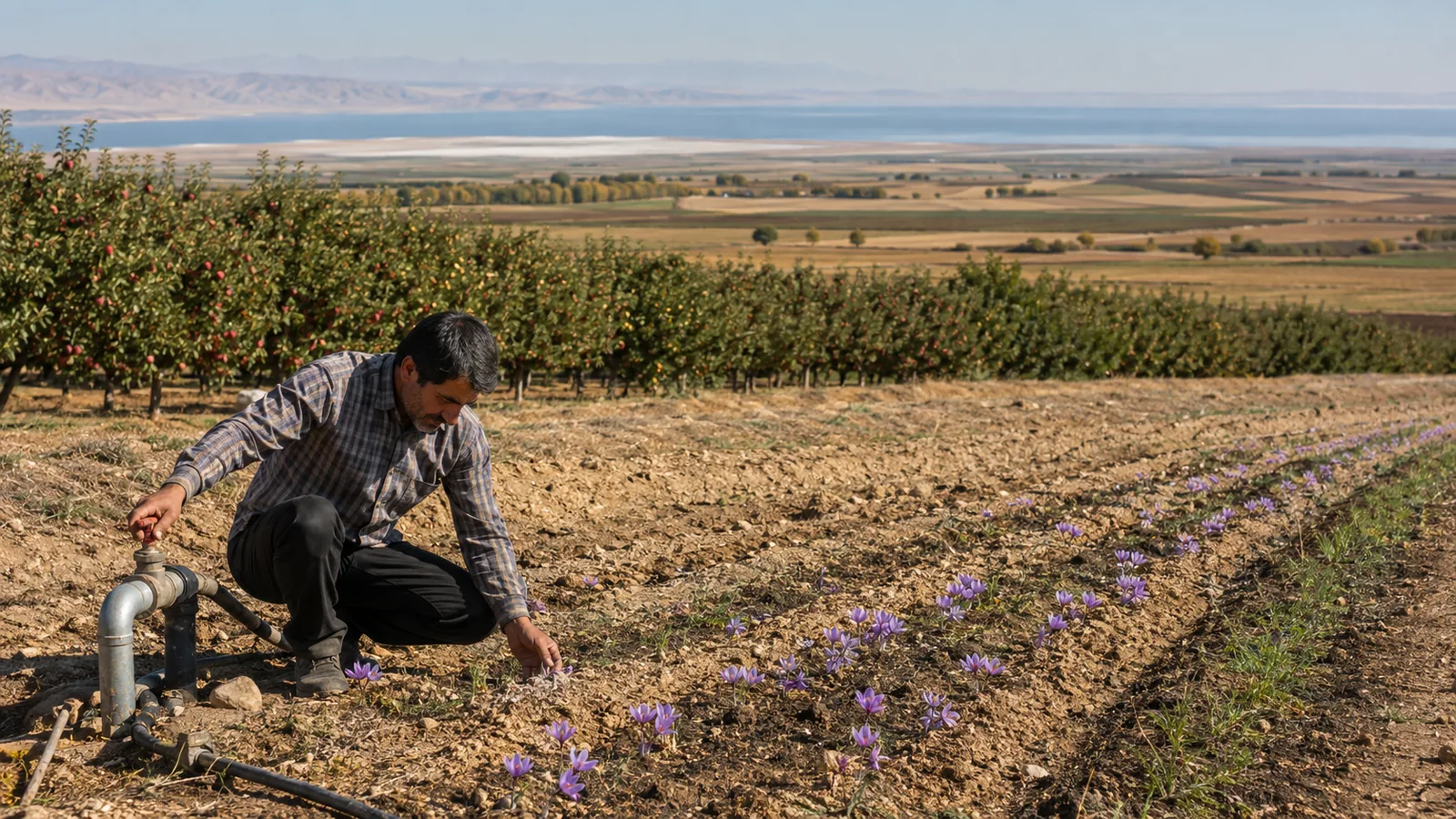
Crops grown in Urmia County, West Azerbaijan, Iran
The crops grown in Urmia County, West Azerbaijan, Iran, are far more varied than saffron. Official local reporting identifies apples as the county’s leading orchard product, alongside grapes and stone fruits. Field agriculture includes wheat, barley, chickpeas, beans, lentils, sugar beet and vegetables, with crops differing across districts and between irrigated and rain-fed land.
A February 2025 county profile described 141,000 hectares of agricultural land and about 1.57 million tons of horticultural, field, livestock, fishery and poultry products. Those broad totals explain why a search for the agricultural products of Urmia, Iran, should not be answered with saffron alone.
The county, province and lake basin are different areas
Urmia County is one administrative area in West Azerbaijan Province. The Lake Urmia basin is a wider watershed that crosses administrative boundaries and includes land in both West and East Azerbaijan. A crop figure for the province cannot automatically be assigned to the county, and a basin-wide crop list is not a list of what grows in every locality.
The historical saffron account is provincial: it quotes Rasoul Jalili, then head of the West Azerbaijan Agricultural Jihad Organization. Its title connects the development with the Lake Urmia basin, while its 48-hectare and 70-kilogram figures refer to West Azerbaijan.
Jalili called saffron “the best alternative and profitable option” for farmers and described it as a strategic plant for escaping the water-shortage crisis. Those were promotional policy claims, not a comparison of farm accounts or measured water use; suitability still has to be proved for each site.
What the 48 hectares and 70 kilograms show
Jalili said saffron cultivation in the province had reached about 48 hectares and that roughly 70 kilograms had been harvested in the previous year. Dividing the two figures gives about 1.46 kilograms per hectare, but that should not be treated as a measured average: the report does not state how much of the planted area was mature and bearing.
Both numbers are historical snapshots. They are useful evidence that the crop had moved beyond isolated trials, not current statistics or a forecast for the next harvest.
Where West Azerbaijan’s saffron was concentrated
The cities or counties named as having the largest saffron areas were Urmia, Naqadeh, Miandoab, Shut, Piranshahr and Salmas. The report does not divide the 48 hectares or 70 kilograms among them, so it cannot support a ranking within that group.
Local conditions also vary. Elevation, frost timing, soil drainage, water quality and the date irrigation begins can make one site more suitable than another even within the same county.
What else is cultivated in the Lake Urmia basin
An official basin agriculture report lists cereals such as wheat and barley; chickpeas, beans and lentils; oilseeds including rapeseed and sunflower; potatoes, onions, tomatoes, garlic and carrots; and orchard crops including grapes, walnuts, greengages, apples, almonds, peaches, apricots and pistachios.
Its medicinal and aromatic group includes Damask rose, saffron, mint, thyme and cumin. Saffron was therefore one part of a broader crop-pattern programme rather than the single answer to the basin’s agricultural and water challenges.
Apples remain central to Urmia’s agriculture
A separate official report on Urmia’s apple harvest described apples as the county’s most important orchard crop and reported more than 450,000 tons for that season. That scale is not directly comparable with a small area of saffron.
Changing a crop pattern has to account for established orchards, storage, processing, jobs and household income. “Lower water use” is one input to the decision, not permission to remove a productive orchard without field and economic evidence.
Saffron uses water; its calendar is the advantage
The original statement calls saffron a crop that does not need irrigation. That is incorrect. Saffron needs moisture at key stages, and the timing and amount depend on rainfall, soil, temperature and the production system.
Its advantage in many Iranian regions is that the crop is dormant through much of summer. Important irrigation and growth periods occur in autumn, winter and early spring, when demand from many summer crops is lower. That seasonal pattern can reduce competition for water, but only actual water accounting can show the saving at a particular farm.
A lower-water crop can still increase basin demand
Replacing a genuinely water-intensive crop on the same land may reduce demand. Expanding saffron onto additional irrigated land can have the opposite effect. A Lake Urmia strategy therefore has to measure total withdrawals, not just litres per kilogram or the reputation of a crop.
Modern irrigation, soil-moisture checks and locally suitable varieties can improve control. They work best alongside limits on cultivated area and protection of the water allocated to the lake.
Climate suitability is more specific than “cold resistant”
The report says saffron grows well where winters are mild and summers hot and dry, and that the plant tolerates cold. It also notes that active growth spans autumn, winter and early spring, when moderate conditions are important.
Those statements describe a broad pattern. Site selection still has to consider severe frost during sensitive stages, drainage, heat during corm dormancy, and whether flowering conditions allow workers to pick and process flowers promptly.
Food and traditional medicinal use
Saffron flowers are processed for their red stigmas, which are dried and used mainly as a culinary spice and colourant. The crop is also classified among medicinal plants and has a history of traditional use.
That classification does not turn the flower into a treatment claim. Scientific or health advice requires evidence about a defined preparation and dose; a provincial crop-development report cannot supply it.
Why “red gold” needs economic context
“Red gold” is a familiar description of saffron’s high value relative to its dry weight. Jalili also described saffron as an important Iranian export that brings foreign exchange into the country.
A high export value does not guarantee profit for every grower. Corms, field preparation, irrigation, harvest labour, stigma separation, drying, grading and access to buyers all affect the return. A farmer should compare net income and water use with a real local alternative rather than rely on the nickname.
Reading the Lake Urmia saffron story today
The 48-hectare area, 70-kilogram harvest and named production locations document an early stage of saffron development in West Azerbaijan. They also show why the crop attracted attention: it shifts much of its water demand away from summer and has a compact, valuable dry product.
The responsible conclusion is narrower than the original promotion. Saffron may fit some farms in the Lake Urmia basin when agronomy, water accounting and markets support it. It is not irrigation-free, and it does not replace the diverse crops grown in Urmia County. For readers searching in Spanish, cultivo de azafran simply means saffron cultivation; the same evidence and cautions still apply.

![Exporting Saffron to Turkey + Price Guide [Complete 0 to 100]](https://img.rowhanisaffron.com/20260827003933/saffron-export-turkey-quality-inspection.webp)



