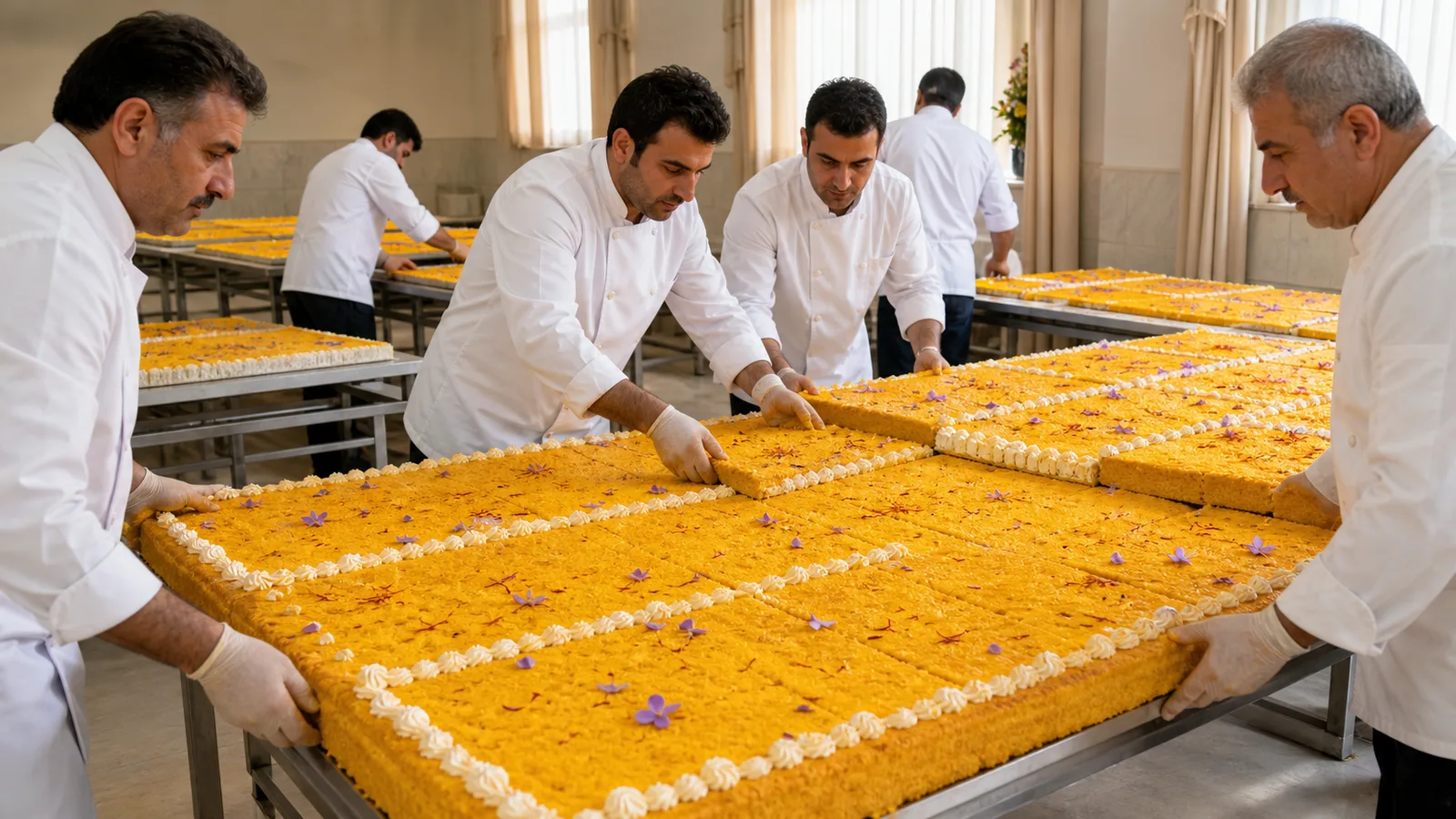
A giant saffron cake weighing a reported two and a half tons was baked in Ghayenat City, Iran, for an Eid al-Ghadir celebration. Local media described it as the world’s largest saffron cake. Its scale was certainly extraordinary: the project brought together 100 people, including 40 pastry chefs, and used one kilogram of saffron.
The surviving report was republished on this site in 2016 and attributed to IRIB News. It does not provide a record certificate or a dependable Gregorian date for the event. For that reason, “world’s largest” is presented here as the contemporary report’s claim, not as an independently verified Guinness World Records title.
A two-and-a-half-ton saffron cake in Qaen
Ghayenat, Ghaenat, Qaen and Qayen are English spellings associated with the same area in South Khorasan. Qaen is widely known for saffron growing, so the crop was more than a flavouring for this celebration. It connected the cake to the place where it was made.
The city council account described a cake weighing approximately 2.5 metric tons. Its footprint was reported as 6 metres by 4 metres. A third dimension is damaged in the old machine-translated text and cannot be stated confidently, so it is not converted into a precise height here.
The design reportedly echoed the Tomb of Bozorgmehr Qaeni, one of the historic places associated with Qaen. That made the finished cake a local landmark in miniature as well as a communal dessert. Iran’s official tourism portal lists the tomb among the city’s notable attractions and describes Qaen as a saffron centre.
The reported ingredients
At this size, the ingredient list reads more like a production inventory than a home recipe. The IRIB-attributed report gave the following quantities:
- 120 litres of saffron syrup;
- 1 kilogram of saffron;
- 800 kilograms of flour;
- 400 kilograms of eggs;
- more than 600 kilograms of sugar; and
- 400 litres of water.
Those figures are retained because they define the scale of the original story, but they are reported quantities rather than an audited formula. They also do not add up neatly to a complete cake recipe. Fats, flavourings, toppings or other materials may not have been listed, and the density of the syrup is unknown.
One kilogram of saffron is an unusually large amount for any single culinary project. In an ordinary kitchen, saffron is used in small quantities and is usually infused before being added so that its colour and aroma spread through the mixture. Here, the 120 litres of saffron syrup would have helped distribute the spice across many separate batches before the sections were assembled.
One hundred people worked on the project
The cake took three days to prepare and bake. The report says 100 people were involved, including 40 pastry chefs from Qaen. Local tradespeople helped provide the raw materials.
That division of labour matters. A 2.5-ton cake cannot be mixed, baked or moved as one ordinary piece. Teams would have had to coordinate batches, trays, cooling, assembly and decoration while keeping the final shape consistent. The original report does not describe the ovens or assembly method, so it would be misleading to reconstruct those details as fact.
The finished cake was unveiled at the Payame Noor University hall in Qaen during the Ghadeer celebration. “PNU Cain” in the old English text is a damaged rendering of that place name, not a separate venue.
Why saffron was central to the celebration
Saffron gives food a golden colour and a distinct aroma, but in Qaen it also represents local agriculture and skilled work. Building the event around a saffron cake allowed organisers to turn an ingredient closely associated with the city into something the community could see and share.
Quality would still matter at this scale. Saffron’s colouring strength and aroma vary with the part of the stigma, drying, storage and authenticity. A kilogram of weak or adulterated material would not behave like a kilogram of carefully dried threads. Our guide to Iranian saffron standards explains how colour, aroma and flavour-related characteristics are assessed.
Was it really the world’s largest saffron cake?
The careful answer is that it was reported as the world’s largest saffron cake. The article preserved here supplies no Guinness application, measurement protocol, witness statement or certificate. Public record categories can also distinguish between weight, area, length and a particular type of cake.
That uncertainty does not erase the event. The reported weight, ingredients, three-day preparation and 100-person team still describe a remarkable local undertaking. It simply means the promotional label and the documented details should not be treated as the same kind of evidence.
A local saffron story, preserved with its limits
The world’s largest cake baking saffron in Ghayenat City of Iran is an awkward English headline, but it is the title under which this story has been indexed. Behind it is a clear account: Qaen pastry chefs and residents made a vast saffron cake for Eid al-Ghadir, shaped it around a local monument and unveiled it at a university hall.
The most reliable way to read the story is to keep its reported numbers, acknowledge what the surviving translation cannot establish, and avoid turning a local media claim into a certified world record. What remains is still worth recording—a celebration in which saffron served as food, regional identity and the organising idea for an unusually ambitious piece of baking.
Sources and notes
- The original Rowhani Saffron post, published in 2016, attributes the event details to IRIB News. No functioning source link was supplied, so its measurements and ingredient quantities are labelled as reported.
- Qayen destination profile, Iran’s official tourism portal: city spelling, saffron association and Tomb of Bozorgmehr Qaeni.
- Guinness World Records example for a measured cake category: included to show why a specific certified category and evidence matter; it does not verify the Qaen claim.

![Exporting Saffron to Turkey + Price Guide [Complete 0 to 100]](https://img.rowhanisaffron.com/20260827003933/saffron-export-turkey-quality-inspection.webp)