


The stock of saffron merchandise boosts the retail business described an attempt to give small saffron producers better access to transparent, standardised trading through Iran’s commodity exchange. “Stock” in the old title means exchange trading and warehouse-backed inventory, not simply keeping more packets on a shop shelf.
Hossein Shirzad, then head of Iran’s Central Organization for Rural Cooperatives, argued that accepted warehouses, quality testing and commodity deposit certificates could reduce some weaknesses of the traditional saffron market. His case was a policy argument, not proof that an exchange automatically guarantees farmers a fair price.
The problem the exchange was meant to address
Shirzad described a fragmented market with weak price transparency, harvest-time price falls, highly variable prices and saffron of uncertain identity or standard. Small producers often sold bulk product through several layers of intermediaries and had little influence over the final export price.
He also criticised limited processing, inconsistent drying and insufficient attention to customer requirements. The report said about 95% of saffron area was harvested manually. Manual picking is normal for saffron; the quality risk comes from uncontrolled handling, delayed separation, poor drying or an undocumented chain of custody—not from hand harvesting by itself.
How a warehouse receipt works
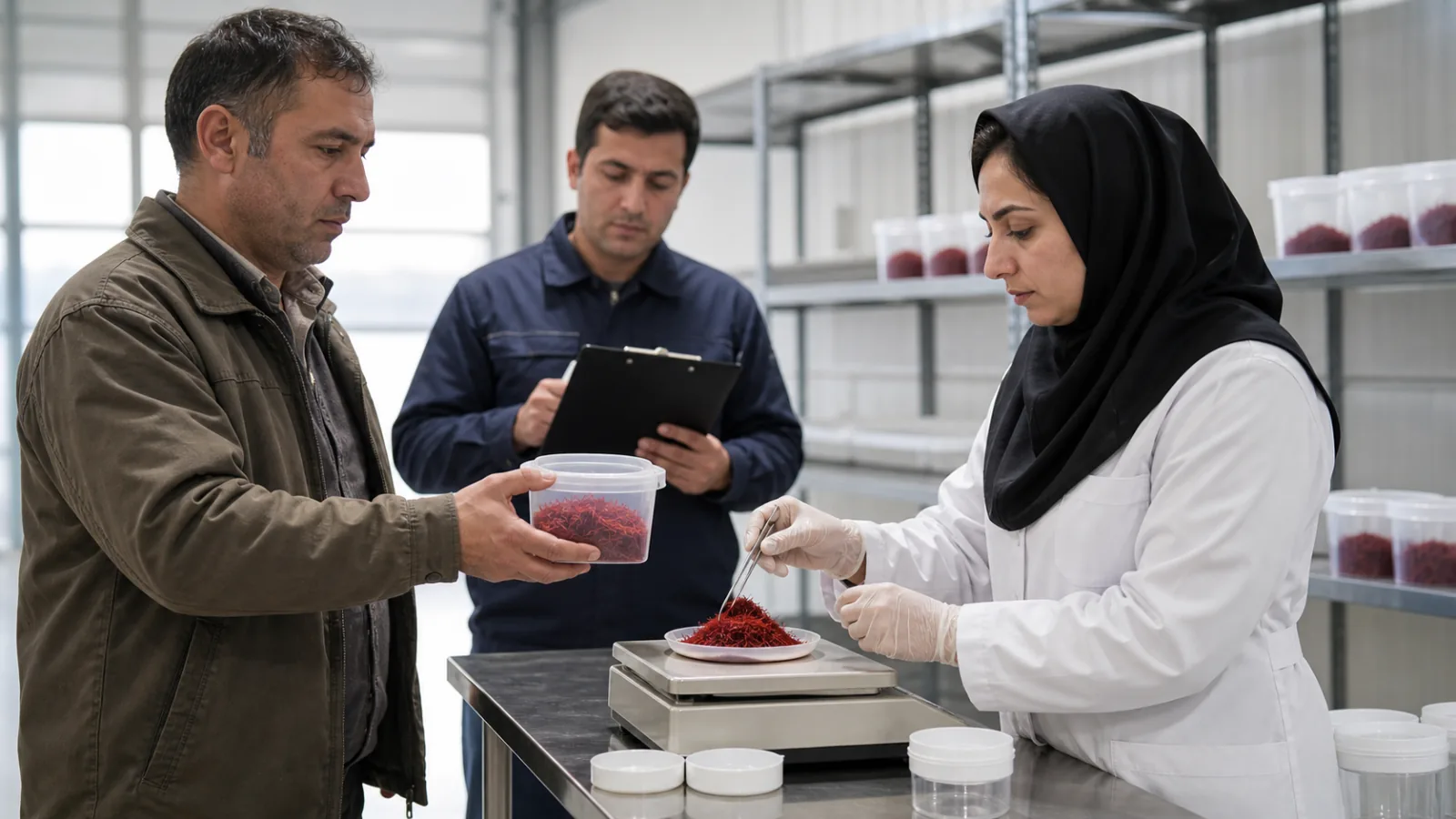
Under the model described, a farmer delivers saffron to a warehouse admitted by the commodity exchange. The lot is weighed, sampled and checked against the warehouse’s approved specification. If accepted, the deposited quantity is represented by an electronic commodity deposit certificate.
The certificate can be traded without physically moving the saffron each time ownership changes. At expiry or withdrawal, the holder can receive product of the specified category under the applicable rules. The warehouse remains responsible for custody, but the certificate does not remove price risk or every operational risk.
An official IANA report on an admitted Torbat Heydarieh saffron warehouse confirms that exchange-traded deposit certificates were used for defined saffron categories. The exact symbols, warehouses and contract rules can change, so a historical article should not present its list as current instructions.
Quality is defined before the trade
Shirzad said the exchange, the national saffron council, rural cooperatives and the standards organisation had agreed product specifications. A sample from each offered lot was to be sent to an approved laboratory; only a lot matching the defined specification would be accepted.
That process makes a traded category more comparable, but “standard” is not one universal grade. The lot still needs an identified type, sampling method, moisture and foreign-matter limits, and chemical values relevant to colour, bitterness and aroma. The ISO 3632-1 saffron specification provides recognised categories and requirements, while an exchange contract may set its own deliverable specification within the governing system.
Testing a sample also cannot repair poor harvesting or drying. Clean separation, controlled dehydration, suitable packaging and traceable storage have to begin before the lot reaches the warehouse.
What price discovery can—and cannot—do
A visible order book can show bids, offers and completed trades under common contract terms. That is more transparent than a chain of private quotations for unlike products, and competition among more qualified buyers may deepen the market.
It does not create a permanently “fair” or “real” price. Exchange prices still respond to supply, demand, quality, season, currency conditions, trading limits, liquidity and who can participate. A thin market can remain volatile, and the displayed price may not match an ungraded cash-market lot.
The article also discussed futures and options as tools for managing price risk. A future commits the parties under the contract terms; an option gives its buyer a right under specified conditions. Neither is a guaranteed income product, and growers need to understand margin, expiry, delivery and loss exposure before using them.
Why certificates may help small producers
For a farmer, a warehouse certificate can separate the decision to store from the decision to sell. It may make a standardised lot easier to trade and, where a bank accepts the instrument and the farmer meets its terms, it may support a financing application.
Those benefits depend on access. A warehouse can help small producers only if minimum lot rules, grading fees, transport, sampling losses, storage charges, account setup and payment timing do not absorb the advantage. More warehouses may reduce distance, but an admitted facility also needs consistent testing, security and oversight.
At the time of Shirzad’s comments, the report named admitted warehouses in Torbat Heydarieh and Mashhad and anticipated more. That is a historical snapshot, not a current directory.
The export problem is larger than trading
Shirzad said Iran’s reliance on bulk saffron exports and a poorly integrated production, supply, processing and export chain prevented domestic companies from establishing stable global pricing power. The figure of 59 active companies belonged to that statement and reporting period; it should not be read as today’s company count.
An exchange can standardise a deliverable lot and improve domestic price visibility. It cannot by itself register brands in target markets, design retail packaging, satisfy each country’s food rules, build distribution, understand customer preferences or provide after-sales trust.
The cooperative organisation therefore sought to connect farmers, buyers, processors, domestic and foreign wholesalers, retailers, exporters and industry groups. Shirzad also called for a stronger research, development and continuous-training link alongside production, trading and processing.
What success should be measured by
The strongest test is not trading volume alone. A farmer-centred evaluation would compare net farm-gate prices, time to payment, grading rejections, warehouse and transport costs, participation by small holdings, price differences by documented quality and the share sold under traceable contracts.
Buyers need their own evidence: repeatable quality, lot traceability, on-time delivery and clear responsibility when a sample or delivered product falls outside specification. Our guide to saffron quality explains the physical and sensory checks that remain relevant beyond the trading certificate.
The exchange model can strengthen saffron trade when it makes product identity, quality and price formation easier to verify. It should be judged by those practical outcomes—not by assuming that a financial instrument alone transfers every part of the value chain back to the grower.

![Exporting Saffron to Turkey + Price Guide [Complete 0 to 100]](https://img.rowhanisaffron.com/20260827003933/saffron-export-turkey-quality-inspection.webp)



