


The shame of the status of saffron qaenat is the severe title inherited by this page. The report beneath it was not an attack on Qaenat saffron or the people who grow it. It recorded a former local representative’s frustration that farmers were doing the hardest work while too much of the crop’s later value was captured elsewhere.
That distinction matters. Qaenat saffron already had a respected identity. The concern was whether traditional cultivation, fragmented processing and bulk trade allowed growers to benefit from that reputation. The speech was historical, but the questions it raised still offer a useful way to examine any saffron value chain: who owns the lot, who verifies its quality, where is it packed, and how much of the final value returns to the farm?
What Javad Heravi said about Qaenat saffron
The original article reported comments by Javad Heravi, then the parliamentary representative for Qaenat and Zirkuh. It said he was dissatisfied with the condition of saffron production in South Khorasan and wanted cultivation, harvesting, flower separation, processing and packaging to become more organised and technically capable.
His central argument was economic. Saffron was valuable, yet the result had not relieved pressure on the people producing it. He said intermediaries captured too much profit and that local growers needed access to the operations that happen after flowers leave the field.
The old English translation repeatedly used the word “industrial.” In context, that should not be read as a demand to replace every skilled hand with a machine or to turn farms into factories. The practical issue is whether suitable equipment, clean facilities, reliable measurements and coordinated marketing can reduce loss while preserving the qualities buyers expect.
Why the field is only the first part of the value chain
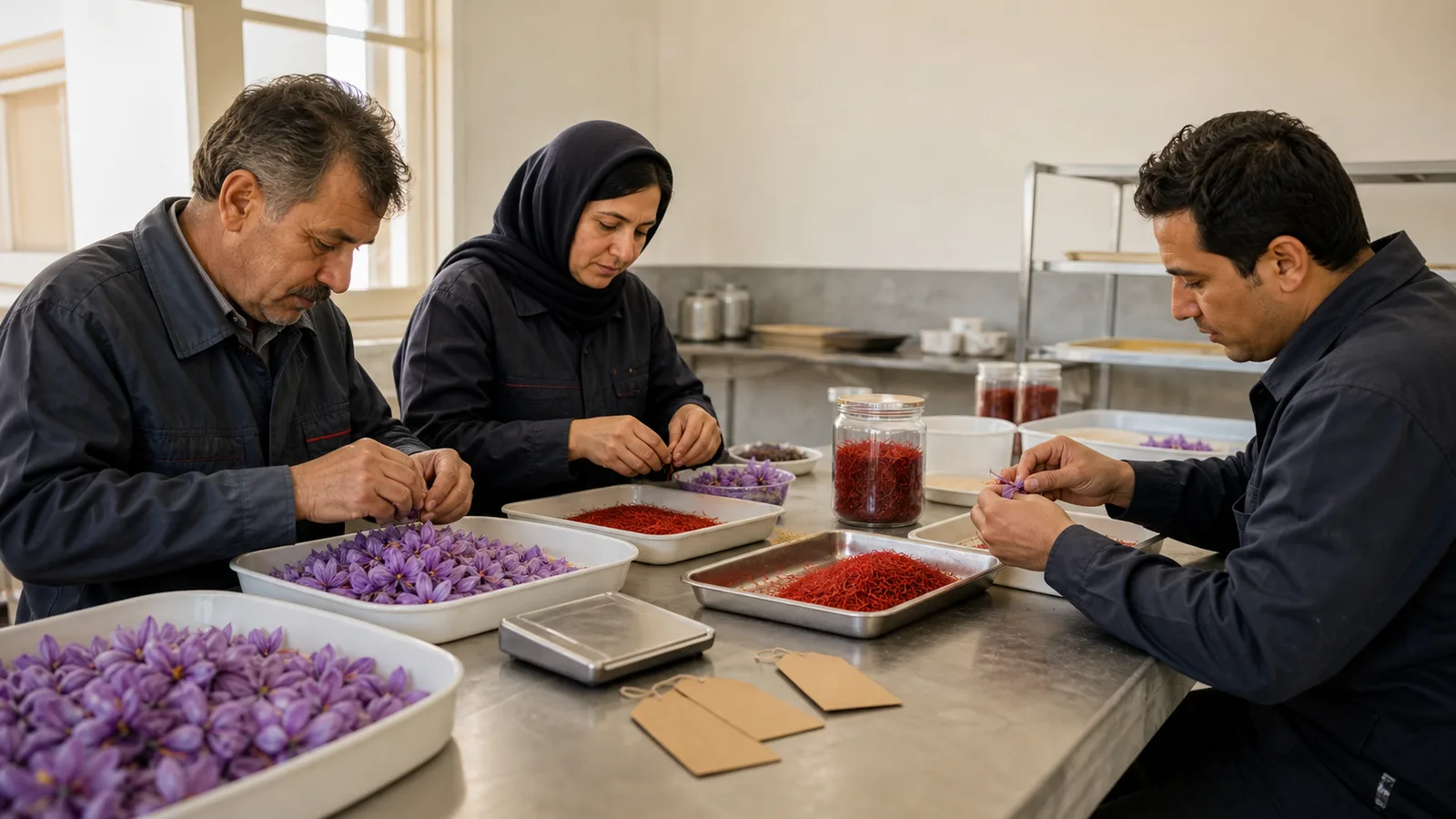
A saffron crop changes hands several times before it reaches a customer. Flowers may be picked by one group, transported by another, separated in a household or workshop, dried, sorted, tested, stored, packed and sold. Value can be added at each stage, but so can delay, contamination, mixing and uncertainty.
When a grower sells fresh flowers immediately, the buyer assumes the risk and controls most later decisions. That arrangement may provide quick payment, but it can also leave the producer unable to benefit from careful drying, a verified grade, documented origin or retail packaging. A farmer does not need to perform every step personally. The important point is access: producers need a fair route into trustworthy local services and transparent prices.
This is why Heravi’s criticism of brokers needs nuance. An intermediary who provides prompt collection, finance, storage or a reliable market can be useful. The problem is an opaque chain in which farmers cannot see grades, deductions, sale terms or the eventual value of their lots.
What better technology should accomplish
Technology is helpful only when it solves a defined problem. For Qaenat saffron, the most useful improvements are not necessarily the largest machines. They are systems that protect the crop during a short, labour-intensive harvest and produce evidence a buyer can trust.
- Timely collection: flowers should move from field to a clean separation area without avoidable heat, compression or delay.
- Hygienic separation: workers need clean surfaces, suitable containers and a workflow that keeps foreign material out of the stigmas.
- Controlled drying: time, temperature, air movement and loading should be repeatable rather than judged by appearance alone.
- Lot identity: material from a known producer and harvest should remain traceable through drying, sampling, storage and packing.
- Useful testing: moisture, purity and agreed quality measures should inform the grade and price, with results available to the owner of the lot.
- Protective storage and packing: the container should protect aroma, colour and cleanliness rather than merely look expensive.
Mechanisation can support some of these jobs, especially sorting, controlled drying, weighing and packing. Saffron flowers and stigmas are delicate, however. A machine that handles more material but damages it, mixes lots or produces inconsistent drying is not an improvement.
Quality and quantity are different goals
The historical report suggested that modern methods could raise both quality and production. Those outcomes require separate evidence. Yield depends on corm health, planting density, field age, soil, irrigation, nutrition, climate, pests and harvest timing. Post-harvest equipment cannot repair a weak field, although it can prevent a good harvest from losing quality.
Likewise, producing more is not automatically better for growers. Extra volume helps only when its cost, quality and market are understood. A sensible investment starts with a baseline: labour hours, flower-to-dry-saffron yield, drying loss, rejected material, test results, energy use and the actual price received. The same measures after a trial show whether a new method earns its place.
This approach also avoids treating tradition as the problem. Local knowledge about flowering, dawn harvests, stigma handling and climate is valuable. Technical control should make that knowledge more consistent and verifiable, not erase it.
Processing and packaging must protect origin
Heravi argued that local units should separate saffron from flowers, process it and package it closer to the producing area. He also alleged that countries including Spain and Turkey bought Iranian saffron and sold it under their own names. The surviving report did not provide trade records for that specific claim, so it should be understood as his warning about anonymous bulk exports, not as a verified description of every shipment.
The underlying concern is clear. If origin information disappears when lots are combined or resold, a growing region cannot reliably carry its reputation to the final pack. A place name on a label is not enough. Origin needs records that connect the farm, harvest, processor, tests and package.
Khorasan saffron later received protection in the international Lisbon system for geographical indications. That registration supports the importance of origin, but a legal name and the day-to-day traceability of an individual lot are not the same thing. Processors and brands still need controls that make the promise auditable.
How more value can remain with growers
A local processing room alone does not guarantee a fairer result. Its ownership, fees, grading rules and sales arrangements matter. A grower-owned cooperative, a transparent service business or a dependable contract buyer can all work; each needs clear records and accountability.
Before sharing a facility, growers should be able to answer practical questions:
- Who owns each lot before and after processing?
- How are service fees and weight changes recorded?
- Which tests determine the grade, and who sees the results?
- Can a grower sell independently after using the facility?
- How are mixed lots identified, and who approves mixing?
- When is the producer paid, and what happens if a buyer rejects the lot?
Those details are less dramatic than a new factory, but they decide whether an investment gives farmers bargaining power or simply creates another middle layer.
A modern reading of the old complaint
The report was published under a national slogan supporting Iranian labour and production. Its language reflected that moment, and it should not be mistaken for a current assessment of every Qaenat farm or business. It also offered no measured comparison between traditional and mechanised systems.
Its durable message is narrower and stronger. A region known for saffron should not lose the story and value of its crop between harvest and sale, or let fragmented trade weaken its position in global markets. Growers need clean post-harvest options, transparent grading, traceable lots, practical testing, packaging that protects the product and market relationships that do not hide the final terms.
FAO’s more recent saffron value-chain work in Iran takes a similar whole-chain view. It brings together farmers, processors, cooperatives and traders and focuses on production, post-harvest management, safety, traceability, marketing and quality integrity. That is a more useful definition of progress than mechanisation by itself.
So the problem described in The shame of the status of saffron qaenat was not a lack of pride in the crop. It was the gap between the reputation of Qaenat saffron and the share of value reaching the people who cultivated it. Closing that gap requires evidence, organisation and trustworthy chain-of-custody records, with technology chosen for the work rather than for show.
Sources and context
- The historical statements attributed to Javad Heravi are preserved from the Tabnak-sourced report originally stored on this URL. Allegations and predictions are identified as his statements rather than presented as current facts.
- FAO: innovation and quality integrity in Iran’s saffron value chain.
- WIPO Lisbon Bulletin: Khorasan saffron geographical indication.
- FAO AGRIS: processing, branding and cooperative factors in Iranian saffron value.

![Exporting Saffron to Turkey + Price Guide [Complete 0 to 100]](https://img.rowhanisaffron.com/20260827003933/saffron-export-turkey-quality-inspection.webp)



