


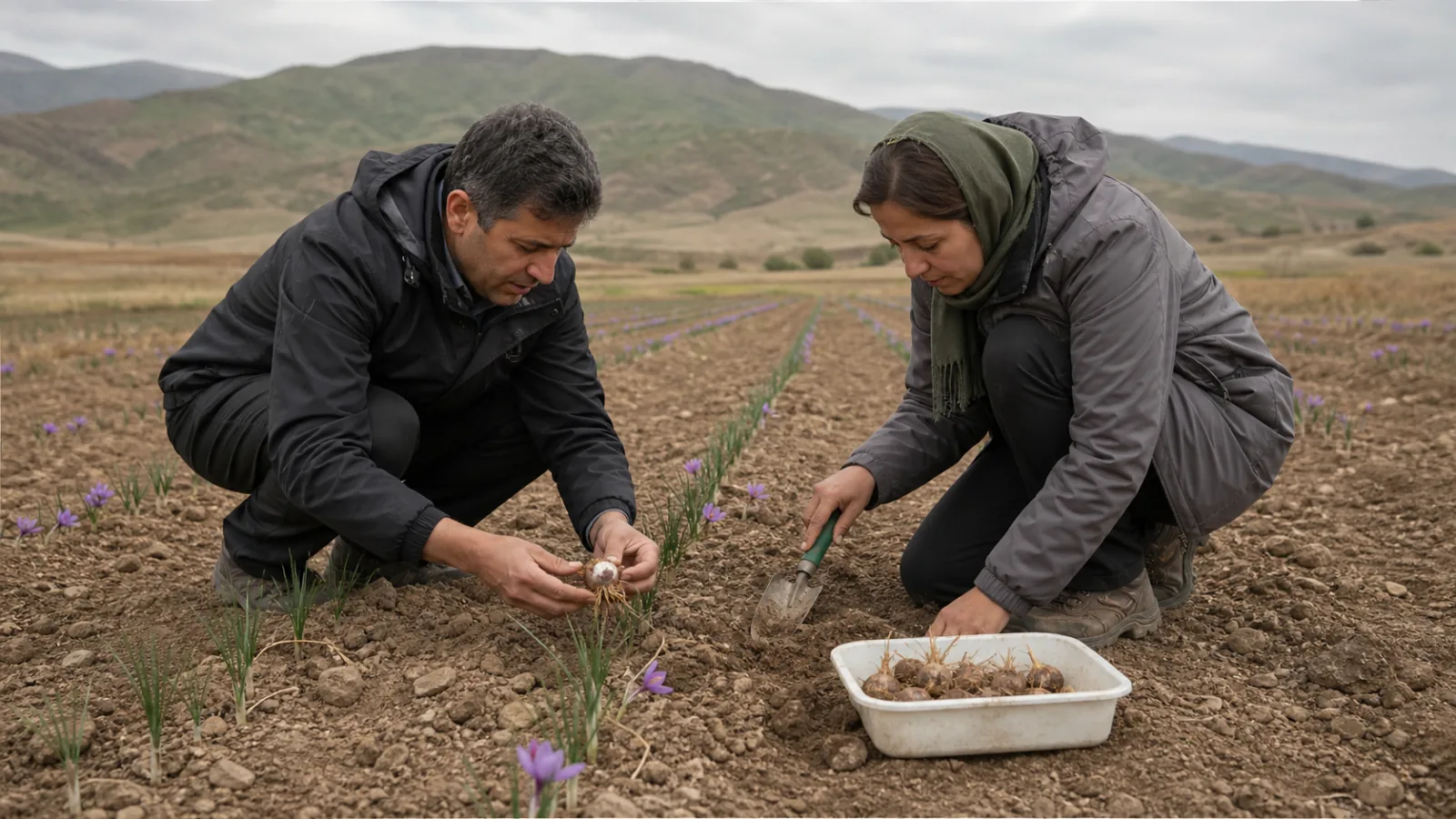
The possibility of large-scale saffron planting in Golestan began with a small field and a sensible condition: expand only if local trials showed that the crop suited the land. That condition matters. Golestan contains humid forest margins, open plains, mountains and much drier eastern districts, so a successful plot in one village cannot prove that saffron will perform across the province.
This page records a proposal discussed during Iran’s ninth parliament, rather than a current planting programme. Abdolkarim Rajabi, who represented Minoodasht, Kalaleh, Maraveh Tappeh and Galikesh, said wider cultivation should depend on the Ministry of Agricultural Jihad’s research and pilot results.
The Minoodasht pilot behind the proposal
The discussion followed an experimental planting in Kalukand village, Minoodasht County. A contemporary account reported that saffron was planted on 1,000 square metres and produced about 300 grams in its first reported harvest. The original version of this article preserved the harvest figure but omitted the area, making the result difficult to interpret.
Three hundred grams from one-tenth of a hectare is evidence that the plants flowered; it is not enough by itself to establish a long-term commercial yield. A saffron field remains in the ground for several seasons, and output can change as the corms develop. Rainfall, drainage, summer soil conditions, disease pressure, labour and post-harvest handling all affect whether a trial becomes a reliable farm business.
Rajabi therefore described pilot cultivation as the first step. If the agricultural studies were positive, more land could be allocated and farmers could be guided toward larger planting in the following season. That is more cautious than the old headline sounds.
Why parts of Golestan may suit saffron
Golestan is often described as a province of varied climates. Its western and central areas can be humid, while eastern and upland districts have different rainfall, temperature and soil conditions. Rajabi argued that some local areas resembled South Khorasan closely enough to justify saffron trials, and he regarded the Gonbad-e Kavus and Minoodasht areas as promising.
Similarity on a climate map is only a starting point. Saffron corms are vulnerable in persistently waterlogged soil, so drainage may be as important as total rainfall. Flowering also creates a short, labour-intensive harvest. Land can look agronomically suitable yet be commercially unsuitable if workers, clean separation space or a dependable buyer are unavailable.
Later research in Vamenan village, another Golestan growing area, compared saffron yield with soil characteristics. Its existence confirms that cultivation moved beyond a single Minoodasht experiment in some temperate mountain districts. It does not support a blanket recommendation for every field in the province.
Why cotton appeared in the debate
Rajabi linked the proposal to problems facing cotton growers. His point was that saffron might offer an alternative where cotton was becoming difficult, not that every cotton field should be converted immediately. The two crops have different planting cycles, labour peaks, market structures and soil requirements.
A responsible comparison would look at the whole rotation and farm budget. Before replacing an established crop, a grower needs evidence on:
- soil texture, drainage, salinity and summer conditions on the actual field;
- the source, health and cost of saffron corms;
- water availability at the times the crop needs it, not just annual rainfall;
- labour for picking and separating flowers during a compressed harvest;
- expected yield over several seasons rather than one trial harvest;
- drying, grading, packaging and access to a credible market; and
- the income and agronomic role that would be lost if cotton were removed.
Our guide to choosing land for saffron cultivation explains the field checks in more detail. Local testing is still necessary; no general article can substitute for a soil analysis and advice suited to the district.
What “large planting” should mean
Large-scale planting should be the outcome of successful smaller trials, not the experiment itself. The useful sequence is straightforward: test several representative sites, record field conditions and costs, follow the crop over multiple seasons, then expand the combinations that remain productive and manageable.
That approach also protects farmers from headline economics. Saffron has a high value per unit of weight, but dried yield is small, harvesting is manual and quality can fall quickly after flowers are picked. Revenue estimates mean little without corm costs, labour, water, field life, losses and the price a particular grade can actually obtain.
The historical Golestan proposal was valuable because it left room for a negative answer. The Ministry’s studies were expected to determine whether conditions justified expansion. That same principle remains useful: a region should not plant saffron because another province succeeds with it; it should plant where local evidence shows that the crop, people and market can work together.
Sources and historical context
- The original Rowhani Saffron report, based on a House of the Nation account, supplied Rajabi’s parliamentary comments, the named constituencies and the conditional expansion proposal.
- A contemporary Minoodasht report recorded the 1,000-square-metre Kalukand trial and its 300-gram harvest.
- The scholarly study indexed by FAO AGRIS, “Regression Analysis for Yield Comparison of Saffron as Affected by Physicochemical Properties of the Soil”, examined Vamenan in Golestan as a newer saffron-growing area.

![Exporting Saffron to Turkey + Price Guide [Complete 0 to 100]](https://img.rowhanisaffron.com/20260827003933/saffron-export-turkey-quality-inspection.webp)



