


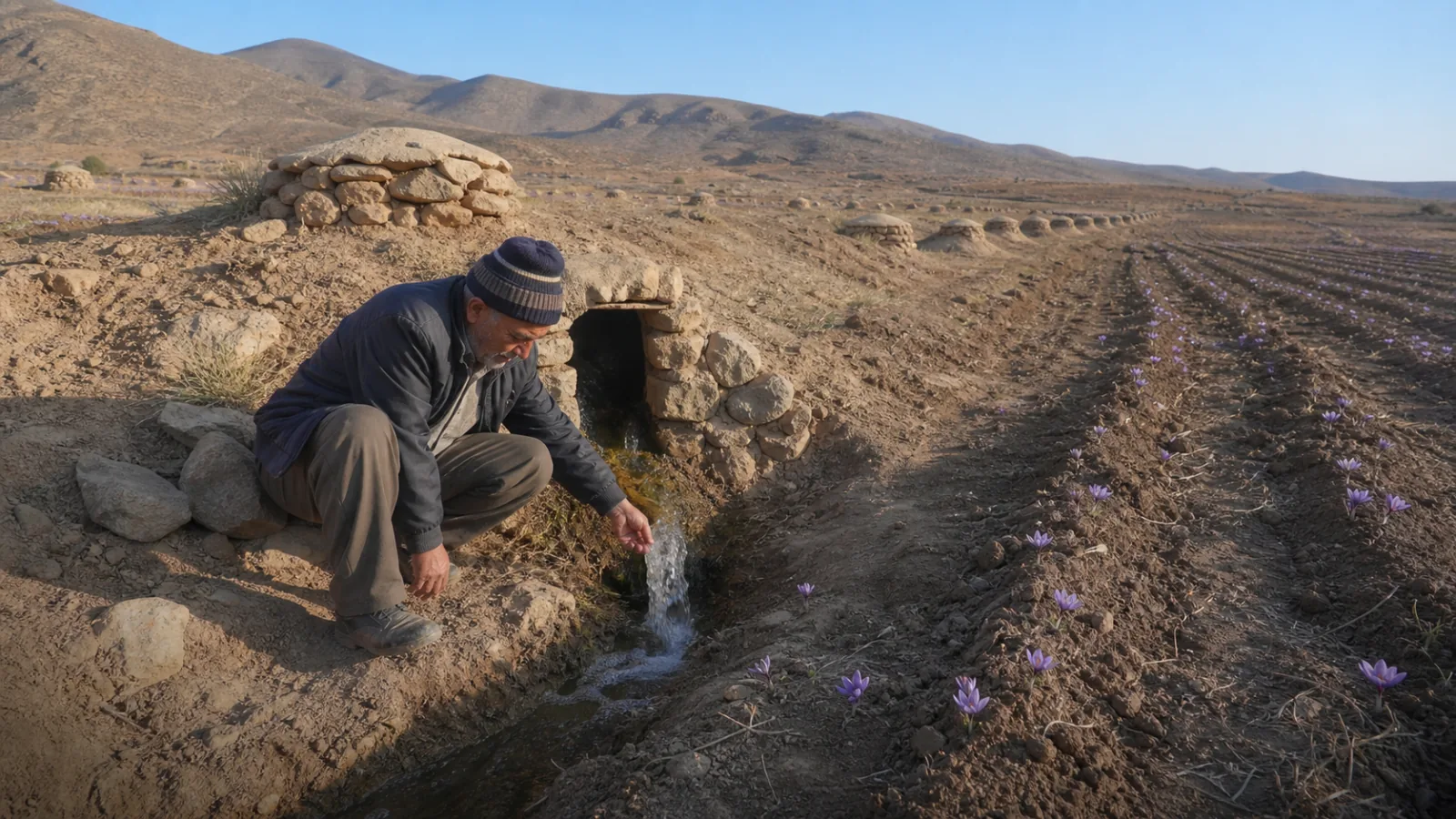
The Qannat-based saffron farming system was registered in FAO in 2018—more precisely, FAO designated the Qanat-based Saffron Farming System in Gonabad as a Globally Important Agricultural Heritage System (GIAHS). The recognition covers a living agricultural system in an arid part of Khorasan Razavi, where communities use gravity-fed qanat water, local knowledge and saffron cultivation to sustain farms and livelihoods.
What FAO recognised in Gonabad
The designation was not an award for saffron as a single crop. FAO recognised the relationship among water, land, people, knowledge and livelihood. Its official GIAHS profile for Gonabad identifies severe water scarcity, a reliable qanat irrigation system, saffron’s comparatively modest water requirement and the system’s contribution to food security, sustainable livelihoods, biodiversity and tourism.
The site is centred in Gonabad County on Iran’s arid and semi-arid central plateau. The domestic announcement highlighted the village of Seno—also written as Senou—as the pilot community in the nomination. That local connection matters: the heritage exists because residents continue to maintain the water system and apply farming knowledge, not because it is preserved as a static exhibit. Our profile of Seno village and its relationship with saffron looks more closely at that community.
What a qanat is
A qanat is a gently sloping underground channel that collects groundwater from an aquifer or the foot of higher ground and carries it toward farms and settlements by gravity. A line of vertical shafts provides access for excavation, ventilation and maintenance. Water normally emerges at an outlet lower down the slope, where surface channels can distribute it.
This is different from describing every irrigation well or canal as a qanat. The underground gallery, gradient, source and maintenance system work together. Gravity reduces the need for continuous pumping, while the underground route can limit some evaporation in a hot, dry environment. It does not create unlimited water. The flow still depends on the aquifer, rainfall and responsible use.
Why saffron and qanats fit the region
Gonabad has no dependable perennial river, and surface flows are seasonal. Farmers therefore developed cropping and water-sharing practices around a limited underground supply. Saffron suits this setting better than many thirsty crops because its irrigation schedule and valuable dried yield allow income from relatively small areas.
The fit is not automatic. Saffron fields still need suitable soil and drainage, healthy corms, timely irrigation and careful harvest and drying. A qanat also requires skilled inspection and repair. If the tunnel collapses, shafts are neglected or withdrawals exceed recharge, both the farming system and the communities that depend on it are placed at risk.
The knowledge is social as well as technical
Qanat agriculture depends on agreements about who receives water and when, who maintains each part of the system and how scarce flow is shared. Experienced specialists understand the tunnel, shafts and gradient; farmers understand their plots, irrigation turns, corm behaviour and the short saffron harvest.
That knowledge moves through families and working relationships. Women participate extensively in flower picking and stigma separation, while many other tasks involve household and community cooperation. The system’s continuity therefore depends on viable farm income and the transfer of practical skills to younger people as much as it depends on the physical channel.
What GIAHS designation means
GIAHS stands for Globally Important Agricultural Heritage Systems. FAO began the initiative in 2002 to identify and support agricultural systems of global importance that combine livelihoods, agrobiodiversity, traditional knowledge, culture and distinctive landscapes. “Heritage” here describes a dynamic system that must keep adapting while its essential relationships are conserved.
FAO’s Scientific Advisory Group assessed the Gonabad proposal and recognised it alongside new sites in Morocco and Spain in November 2018. The FAO announcement reported that the three additions brought the global network to 57 systems in 21 countries. Iranian reports called Gonabad the 55th system, reflecting its stated order among those additions, and the third Iranian GIAHS site at the time.
The designation is also different from UNESCO World Heritage status. UNESCO separately inscribed The Persian Qanat, a serial property comprising eleven qanats, in 2016. FAO’s Gonabad recognition concerns the wider agricultural system built around qanat irrigation and saffron.
Why the designation is valuable
Recognition can make the system easier to explain and support. It gives public institutions, researchers, farmers and visitors a shared reason to document irrigation knowledge, protect the landscape, strengthen local products and consider tourism that respects working farms.
It is not a guarantee that the qanat will keep flowing or that saffron farming will remain profitable. Conservation still requires:
- monitoring water flow and aquifer pressure rather than treating the supply as fixed;
- regular, skilled and safe maintenance of tunnels and shafts;
- fair, workable water-sharing arrangements;
- field practices that protect soil structure, corm health and saffron quality;
- income that rewards farmers for maintaining a heritage landscape;
- documentation and teaching that allow local knowledge to continue.
A living system, not only a historical record
The strongest lesson from Gonabad is not that an old irrigation method survived unchanged. It is that people adapted a gravity-fed water system, shared rules and a high-value crop to a difficult environment—and continue to make that combination work.
FAO’s 2018 designation gives the Qannat-based saffron farming system international recognition, but its future remains local. The condition of the qanat, the confidence of younger farmers, careful use of water and the ability to sell authentic saffron all determine whether this agricultural heritage stays alive.

![Exporting Saffron to Turkey + Price Guide [Complete 0 to 100]](https://img.rowhanisaffron.com/20260827003933/saffron-export-turkey-quality-inspection.webp)



