


Iran’s saffron stock exchange was created to make trading more transparent, standardize the product and give farmers another route to buyers. Its purpose was not to force every crop through an exchange or guarantee a higher price. The early debate around the market shows both sides: an organized warehouse-receipt system can improve price discovery, but testing fees, storage costs, settlement time and farmers’ immediate need for cash can limit participation.
What is Iran’s saffron stock exchange?
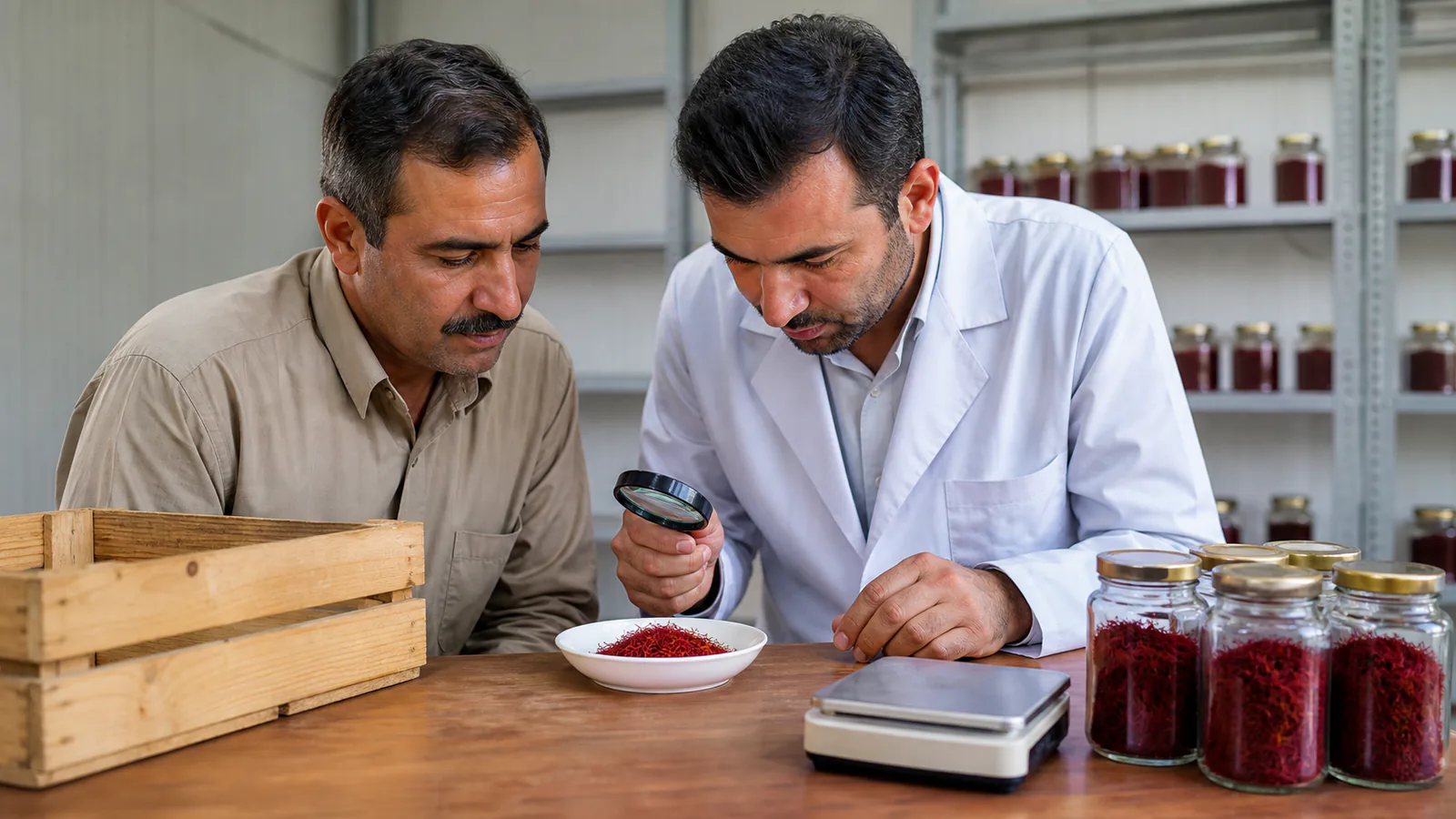
The market described in these reports is a commodity-exchange system built around approved warehouses and tradable commodity deposit certificates. A grower or owner delivers saffron to a participating warehouse. The lot is sampled and checked against the required standard; if it qualifies, the warehouse issues a receipt representing the stored product. That receipt can then be offered through an authorized broker.
Iranian agricultural reporting on the exchange’s launch described the same process: qualifying saffron was placed in an exchange-controlled warehouse, a certificate was issued for the net stored weight, and offers and bids were recorded in a formal market. See the launch explanation from IANA.
The original goals
Seyyed Hamidreza Javadi, then a Khorasan Razavi agricultural market official, described price transparency as the central goal. Khorasan Razavi already had production, rural cooperatives, warehouses and other infrastructure, so it was a logical place to organize the market. The proposed benefits were:
- recording bids and offers in a visible market;
- creating comparable quality standards;
- giving farmers an alternative to the buyer standing at the farm gate;
- reducing opportunities for opaque brokerage;
- storing eligible saffron under defined conditions;
- and making a daily reference price easier to observe.
The official account linked the exchange with earlier guaranteed-purchase efforts intended to protect farmers from weak bargaining positions. It also said use of the exchange would not be compulsory. That distinction matters: an additional selling channel can strengthen choice even if it never replaces direct cash trade.
How a warehouse receipt can create value
Saffron is a small, valuable product whose condition and grade are not obvious from a headline price. A warehouse-receipt system can separate the physical handling of the spice from the moment its ownership is traded. Once a lot has been checked and stored, the certificate can identify a known quantity and standard without moving the same package for each transaction.
That can reduce repeated transport, make offers more comparable and give buyers greater confidence in what a contract represents. It can also preserve a record of market volume. If the system is trusted and actively used, those records improve price discovery beyond informal reports of what one broker may have paid.
Quality still needs precise definition. Passing one exchange standard does not mean every accepted lot is identical, and a certificate is not a substitute for the specifications an exporter or food manufacturer may require. The market works best when its grade, sampling and dispute procedures are clear.
Why many farmers still preferred cash buyers
A report published roughly a year after launch presented the objections. One farmer said buyers were plentiful at the beginning of harvest and paid cash immediately, so he saw little reason to deliver the crop to the exchange. Gholamreza Miri, then deputy head of the National Saffron Council, said he had not received official reports showing meaningful trading volume and doubted that the mechanism suited a commodity that could easily be sold for cash.
This is not proof that the exchange failed for every participant. It identifies a basic adoption test: a new route must be more useful than the route people already have. If a farmer needs money on harvest day, an eventual transparent price may not compensate for extra travel, paperwork or waiting.
Testing, storage and transaction costs
The critical report said a seller had to pay for testing and standardization, then pay storage costs for each day the saffron remained in the warehouse. Contemporary launch information confirms that evaluation and storage charges were built into the process, though the amounts and rules in that old notice should not be treated as current.
Those services are not unnecessary: sampling protects the buyer, and proper storage protects an expensive spice. The practical question is who bears the cost and whether the benefit exceeds it. A small producer delivering a modest lot may feel a fixed or minimum charge more sharply than a large trader. Clear fee schedules, nearby intake points and the ability to aggregate qualifying lots can improve access.
Settlement time and price risk
The critical article also described concern about the time between delivery and receiving funds. Its translated text refers to delays that could expose a farmer to a changing price, while official launch material described settlement within two working days after a trade. These may reflect different stages of the full delivery, evaluation, sale and settlement process rather than a single agreed timetable.
A careful evaluation should measure every interval separately:
- delivery to sampling;
- sampling to acceptance or rejection;
- receipt issuance to sale;
- and sale to cleared payment.
Until a receipt sells, the owner remains exposed to the market. Even after sale, a slow or uncertain payment is costly to someone who must pay harvest labor. Publishing typical completion times—not only the fastest theoretical timetable—helps farmers compare the exchange with an immediate cash offer.
Does an exchange remove dealers?
No market design can simply remove every intermediary. A broker, warehouse, tester, cooperative, processor or exporter may perform a useful function. The real objective is to make each function and charge visible, allow competition, and prevent one participant from controlling information.
Miri argued that the physical cash market still influenced the exchange reference price, so the platform could not claim complete independence from speculators. That criticism is reasonable as a warning, but it does not make public trading data worthless. Exchange and physical prices can influence each other. Transparency improves when the published figure includes actual volume, grade and contract terms rather than being presented as one universal price of saffron.
How to judge whether the system helps farmers
The fairest test is not whether officials or critics liked the exchange. It is whether growers could use it on workable terms. Useful performance measures include:
- the number and size distribution of participating growers;
- accepted and rejected quantities by stated reason;
- the total cost from delivery to payment;
- typical time to inspection, sale and settlement;
- trade volume and concentration among buyers;
- the difference between exchange and comparable local cash prices;
- and farmer access to approved warehouses and brokers.
A high quoted price with tiny volume does not organize the wider market. Nor does a low participation rate prove the concept has no value; it may identify a fee, access or timing problem that can be corrected.
The purpose and the limitation
The purpose of Iran’s saffron stock exchange was to turn an opaque, quality-variable cash trade into a more standardized and observable market. Its strongest tools are certified storage, documented grades and visible bids and offers. Its limitation is equally clear: farmers will use those tools only when the full route is affordable, fast and easier than selling to the buyer already at the farm gate.
The official promise and the farmers’ criticism belong in the same account. Together they show that transparency is not created by opening a trading screen. It is created when the market’s information is credible and the people who grow saffron can realistically participate.

![Exporting Saffron to Turkey + Price Guide [Complete 0 to 100]](https://img.rowhanisaffron.com/20260827003933/saffron-export-turkey-quality-inspection.webp)



