


The need to define a mechanism to guarantee the supply of saffron is really a need for clear rules: who qualifies as a farmer, which lots are accepted, where they can be stored, how quality and ownership are recorded, and what any public price support covers. Without those details, an exchange or guaranteed-purchase programme can be difficult for growers to use and easy for intermediaries to exploit.
The concern behind the original proposal
Gholamreza Miri, then identified as vice-chairman of Iran’s National Saffron Council and chairman of the Mashhad Saffron Sellers’ Union, supported measures that would help farmers offer saffron through the commodity exchange. He added two conditions: farmers needed practical training, and the system needed enough capacity and safeguards to serve them.
The 2019 report put annual saffron production in Khorasan Razavi at roughly 400 tonnes but said the exchange-linked system could store only about seven tonnes. The translated sentence omits the unit, yet the contrast plainly concerns a small certified-storage capacity relative to provincial output. Both figures are historical and should not be used as current production or warehouse totals.
Miri also warned that a trader could buy saffron privately and re-enter it into a farmer-support scheme while presenting the supply as a farmer’s own crop. His objection was not to ordinary trade. It was to an intermediary capturing a benefit designed for the producer.
Guaranteed supply and guaranteed purchase are different
A supply mechanism explains how eligible saffron reaches a recognised market: registration, testing, grading, storage, sale and settlement. A guaranteed-purchase programme adds a public commitment to buy qualifying product under defined conditions, often at a stated support price. A commodity exchange provides bids, offers and transaction rules; it does not by itself guarantee that every lot will sell or that a price will rise.
Those functions can work together, but they should not be blurred. Farmers need to know whether they are entering an open market, depositing saffron for later sale or offering it to a public buyer. The applicable price, fees, timing, quality standard and right to withdraw may differ in each route.
How farmer identity and lot ownership should be protected
A credible mechanism should connect four records: the producer, the farm or production basis, the physical lot and the warehouse or transaction record. That does not require exposing personal information publicly. It does require an auditable chain that prevents the same crop from being claimed twice or an ineligible trader from receiving a farmer-only benefit.
Useful controls include:
- verified producer registration and a documented authority for cooperatives or agents acting on a farmer’s behalf;
- a unique lot number assigned before or at warehouse intake;
- recorded weight, saffron form, quality result and any deduction;
- a receipt showing ownership and the conditions for sale, transfer or withdrawal;
- an audit trail linking the receipt to the final transaction and payment;
- clear sanctions and an appeal route when identity, grade or payment is disputed.
The system should still allow legitimate traders to participate in the ordinary market. The safeguard belongs around the targeted subsidy or guarantee, not around every resale of saffron.
Storage capacity is part of market access
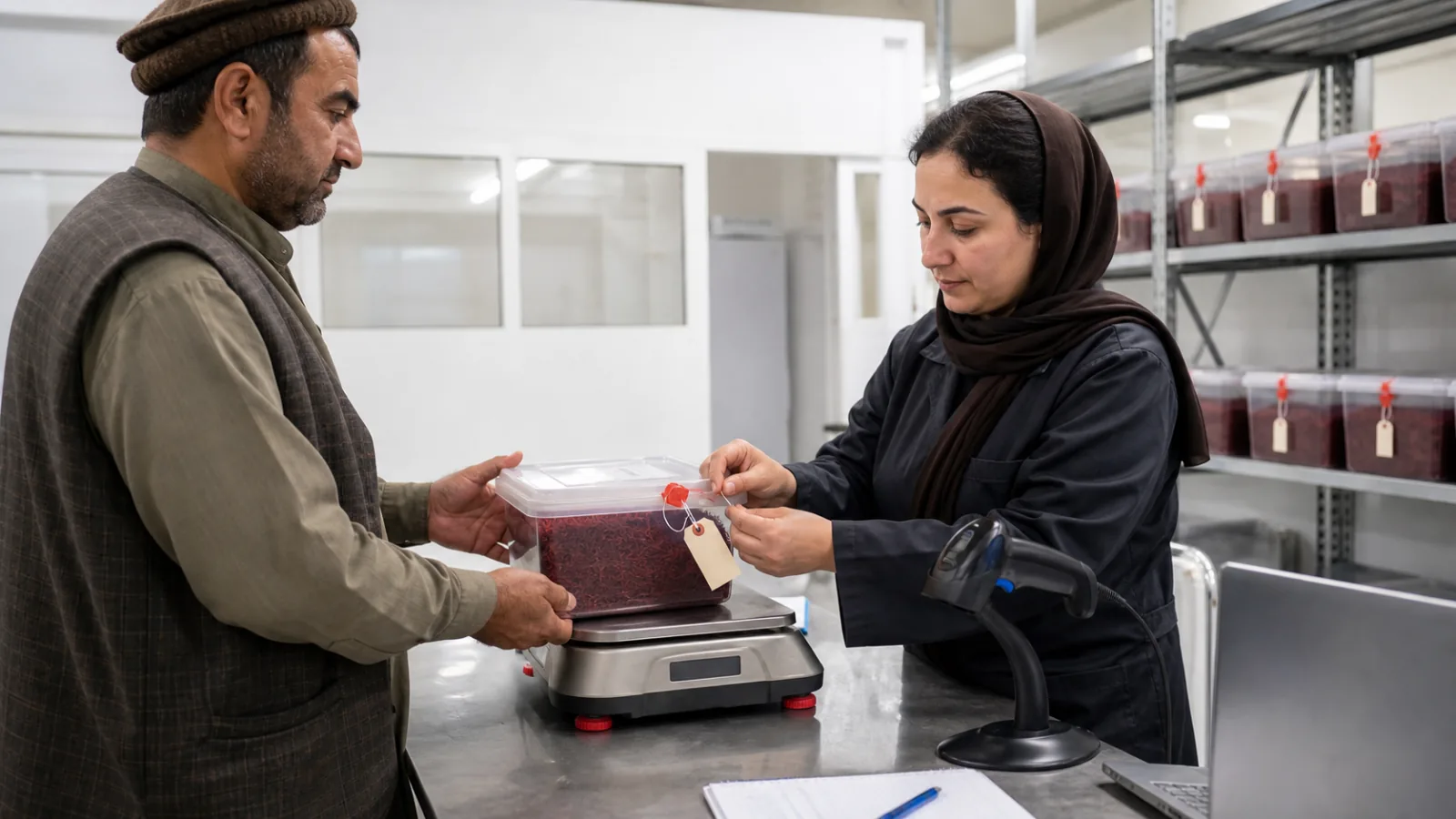
Telling farmers to use an exchange is of little value if the nearest approved warehouse is full, distant or too costly. Capacity must be measured not only in tonnes but also by location, intake speed, testing capability, insurance, security and the ability to preserve separate grades or identity where required.
A regulated warehouse receipt records a stated quantity and quality held in an approved facility. The FAO’s guide to warehouse-receipt finance emphasises that reliable grading, certification, market transparency and trustworthy warehouse operation are essential. A recent World Bank explanation of warehouse receipts also notes their potential to give a depositor proof of stored crop and, where a suitable financial system exists, possible collateral for finance.
Storage is not a promise of a better price. Saffron prices can fall, and fees, financing costs or quality loss can exceed any later gain. Every receipt should therefore show charges, deadlines, insurance and disposal rules in language the depositor understands.
Farmers need practical choice and training
Miri argued that a farmer should be able to offer saffron when it suited the farm rather than at a single imposed moment. That requires predictable intake windows, published capacity and help with the account, sample and documentation process. Cooperatives can aggregate small lots when their authority, fees and allocation of proceeds are transparent.
Training should follow the farmer’s actual transaction. It should explain how the lot will be sampled, what happens if the grade is lower than expected, when ownership changes, how orders and fees work, and when money reaches the seller. Derivatives education is a separate subject; our overview of saffron on the commodity exchange explains the distinction among physical trade, certificates, futures and options.
Price support needs a published crop-year rule
The original proposal called for officials to state a saffron price for the crop year so farmers could be confident that a public purchase would not fall below it, while ordinary transactions would continue to reflect supply and demand. For such a floor to be credible, the announcement would need to identify the eligible grade, period, quantity, buyer, delivery point, payment deadline and budget.
A floor that ignores quality or market conditions can encourage the wrong product, exhaust capacity or shift benefits away from the intended farms. A floor announced without timely payment can be worse than no promise. Publication, independent oversight and a record of accepted and rejected lots are therefore part of the mechanism, not administrative extras.
The historical export and price claims
Miri said about 85% of Khorasan Razavi’s saffron was exported and argued that the sector needed stable market rules with price discovery through supply and demand. He also referred to a roughly 100% price rise associated with exchange-rate changes compared with an earlier harvest. The translated report corrupts the comparison as “the 2009 harvest by 96 percent”; it likely refers to Iranian crop year 1396, but the wording does not support a reliable calculation.
These claims should remain attributed to the 2019 interview. Exchange-rate depreciation can lift the local-currency value of an export, yet higher nominal prices do not automatically mean higher real income. Production costs, inflation, grade, commissions, rejected lots and the timing of payment all affect what a farmer actually retains.
Minimum requirements for a workable mechanism
A saffron-supply system is ready only when an eligible grower can understand it and complete the full journey from intake to payment. At minimum, it needs sufficient approved storage, consistent testing, traceable ownership, transparent fees, published support rules where applicable, accessible training, timely settlement and independent complaint handling.
The goal is not to remove traders or to promise a particular market price. It is to make sure that a benefit intended for the farmer reaches the farmer, while a documented saffron lot can enter a transparent market without avoidable delay or uncertainty.

![Exporting Saffron to Turkey + Price Guide [Complete 0 to 100]](https://img.rowhanisaffron.com/20260827003933/saffron-export-turkey-quality-inspection.webp)



