


Torbat Heydarieh was described as one of the main centers of saffron production in Khorasan Razavi, with 8,500 hectares under cultivation and a reported share of about 12% of the province. The same parliamentary briefing put 117,000 provincial households in the saffron economy. A separate seasonal report then recorded a province-wide production fall of roughly 30%, attributed mainly to cold weather, and described ten guaranteed-purchase centers set up to support growers.
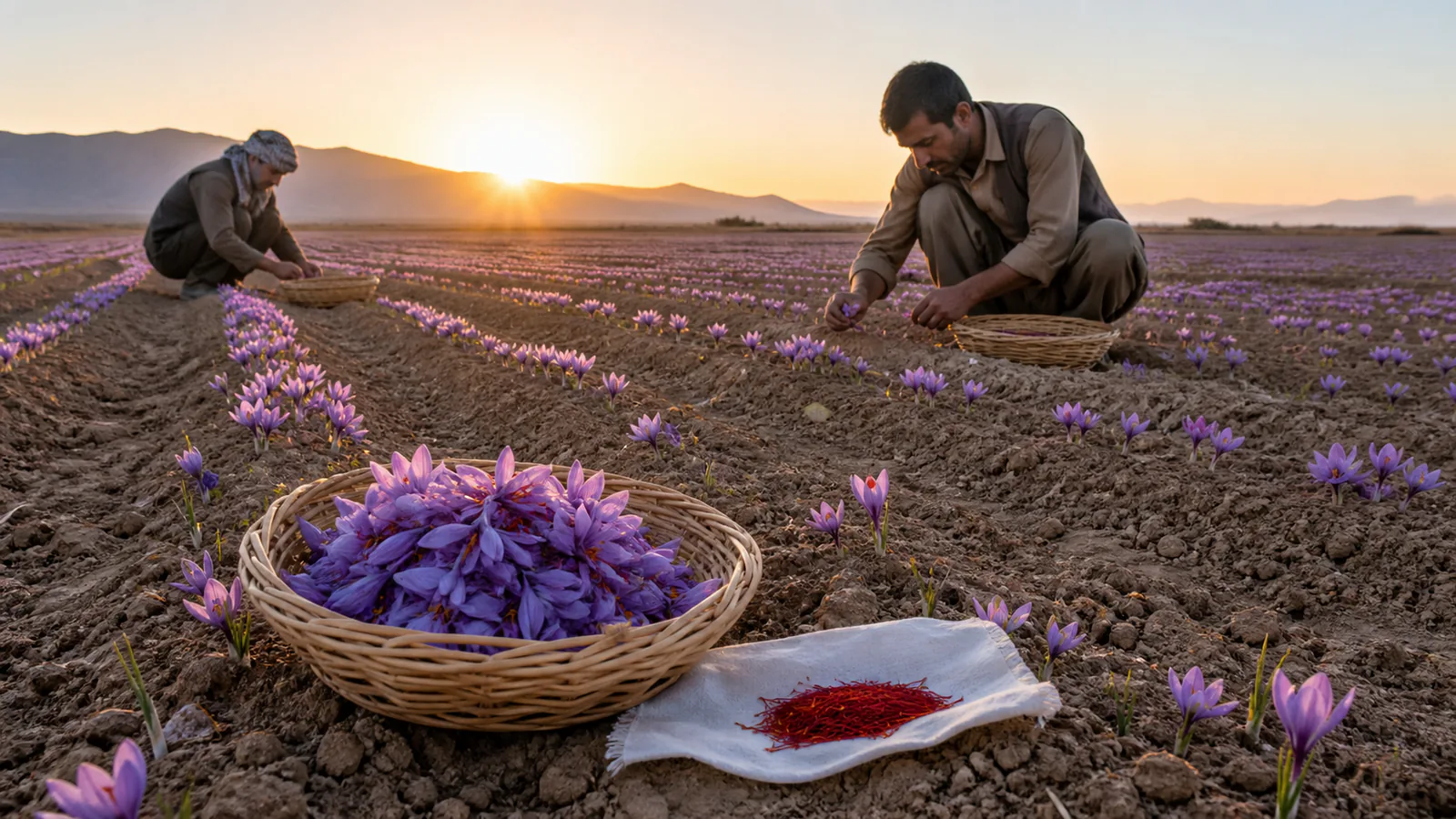
These figures come from dated public statements rather than a current agricultural census. Read together, however, they show why production volume is only one part of the story. Farm income also depends on yield, research, harvest labor, quality control, purchasing arrangements, and access to export markets.
Torbat Heydarieh’s role in Khorasan Razavi saffron production
At a parliamentary saffron conference, Torbat Heydarieh representative Saeed Bastani cited 82,000 hectares of saffron land across Khorasan Razavi and 8,500 hectares in Torbat Heydarieh. The report characterized the local figure as about 12% of the province. Those two rounded hectare totals do not produce exactly 12% when divided, so the percentage is best treated as the speaker’s reported estimate, not a newly calculated statistic.
The same account referred to 12,000 hectares in Zaveh and described that area as another major share of provincial capacity. It also placed 15,000 to 17,000 of the province’s saffron-growing households in Torbat Heydarieh. Of roughly 17,000 agricultural producers in the county, it said about 90% were involved in saffron.
The figure with the clearest wider significance is 117,000 households engaged in saffron cultivation across the province. It captures the amount of livelihood tied to a crop that must be picked and separated in a short harvest window. That statistic is also the subject for which this page has earned an external reference, so it remains intact and clearly attributed.
Why the report called for a stronger production system
Bastani’s central argument was that saffron needed a defined chain from field to sale. He did not present guaranteed state purchasing as a complete market solution. Instead, he argued that cooperatives could fill a temporary gap while research, quality assurance, trading infrastructure, and private commerce became more capable.
Yield variation illustrated the problem. The report contrasted farms producing around 2 kilograms per hectare with exceptional plots said to reach as much as 35 kilograms. It also described 4 kilograms per hectare as a familiar working yield. These figures should not be read as a promise that every farm can reach the upper value. Soil, corm health, field age, irrigation, weather, planting density, labor, and post-harvest handling all affect the result.
The practical request was for a scientific support package that farmers could use, alongside better research into saffron corms and production methods. Our guide to planting and harvesting saffron explains the field sequence; the historical report adds the policy question of how that knowledge reaches thousands of growers consistently.
The reported 30% production drop
In another season, Mojtaba Mazrouei, then identified as director general of Khorasan Razavi Agricultural Jihad, said provincial saffron production had fallen by almost 30% compared with the previous year. He attributed much of the reduction to cold conditions in the fields.
The report associates the fall with the year 1396 in the Iranian calendar. It does not provide the underlying tonnage, a district-by-district breakdown, weather measurements, or a published methodology. For that reason, the 30% figure belongs here as an attributed historical estimate rather than a current production benchmark.
Its value is in showing the exposure of a concentrated growing region to one poor season. When a large number of households depend on the same crop, a weather-driven yield decline can quickly become a purchasing, cash-flow, and market problem.
Ten guaranteed saffron purchase centers
Mazrouei also announced ten guaranteed-purchase centers operating with rural cooperatives in provincial villages. Their role was to receive saffron from farmers under the support program. He said credit for payments had been secured, with collection and registration in the information system needing to be completed before claims could be paid.
That detail connects directly with Bastani’s production-chain argument. A purchase center can give growers an organized outlet during a difficult season, but it still needs transparent grading, reliable records, timely payment, and a route for the purchased saffron after collection. Without those pieces, a support price alone does not create a durable value chain.
Training, mechanization, and better planting material
The provincial plan included training classes delivered through local Agricultural Jihad offices. The stated aim was to improve planting, field maintenance, and harvesting through more systematic instruction.
Mazrouei also emphasized mechanized cultivation and the selection of high-quality saffron corms. Mechanization does not mean that every delicate harvest task can be automated. Flowers still require fast, careful handling. It can, however, refer to more consistent soil preparation, planting, field operations, and processing equipment where local conditions make those investments practical.
Corm quality matters because poor or diseased planting material can weaken a field before the first flower appears. “High quality” should therefore mean healthy, correctly handled material suited to the farm’s conditions, not simply a larger corm sold with a marketing label.
From local production to export value
The parliamentary discussion moved beyond hectares and yields to the way saffron was sold. Bastani argued that Iran needed stronger technology, research, packaging, and market coordination to capture more of the product’s final value. He referred to commodity-exchange trading as a way to improve domestic price discovery and quality assurance, and described an international exchange as a future ambition.
He also criticized tariff and foreign-exchange obstacles that made direct exports harder and encouraged some traders to route goods through Afghanistan for access to markets such as India and China. The exact rules have changed over time, so those comments describe the policy environment of the report, not today’s customs advice.
The durable lesson is simpler. A region can grow a large share of the world’s saffron and still leave value on the table if quality is inconsistent, farmers cannot finance the harvest, payments are delayed, or exporters face unstable rules. Torbat Heydarieh’s reported share matters because it gives the region both an opportunity and a heavy responsibility: farm support and market development have to work as one system.
How to use these historical figures
- 8,500 hectares and about 12%: Bastani’s reported estimate for Torbat Heydarieh within Khorasan Razavi.
- 117,000 households: the reported number engaged in provincial saffron cultivation.
- Nearly 30% lower production: Mazrouei’s year-on-year estimate for a cold-affected season.
- Ten centers: the reported guaranteed-purchase network operated with rural cooperatives.
None of these numbers should be substituted for a current crop-year bulletin. They belong together as a historical picture of scale, seasonal risk, and the institutions meant to connect Khorasan Razavi’s saffron fields with a functioning market.

![Exporting Saffron to Turkey + Price Guide [Complete 0 to 100]](https://img.rowhanisaffron.com/20260827003933/saffron-export-turkey-quality-inspection.webp)



