


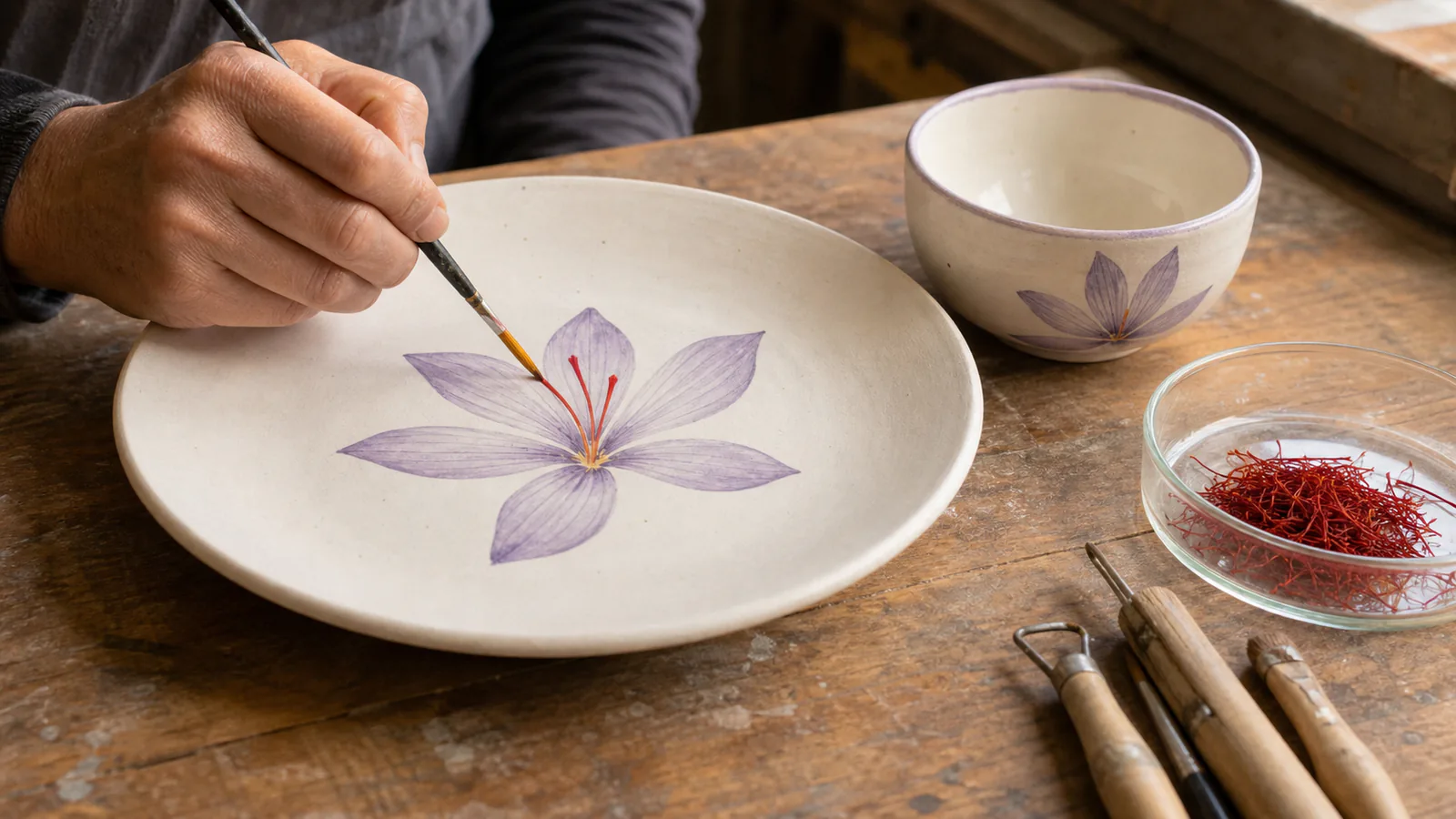
Using a saffron symbol on Gonabad pottery was proposed as a way to connect two parts of the region’s identity: its traditional craft and its qanat-based saffron farming. At the ceremony described in the original report, officials argued that a recognisable floral motif could help Gonabad communicate its heritage to visitors and buyers.
The idea was not simply to decorate a pot. A useful local symbol would point back to a living agricultural system, the people who maintain it and the saffron economy that supports rural livelihoods. The same remarks also exposed a harder truth: cultural recognition and attractive packaging have limited value if farming no longer covers its costs.
Why saffron belongs in Gonabad’s visual identity
Gonabad’s saffron is tied to qanats, underground channels that carry groundwater by gravity to farms in an arid landscape. The UN Food and Agriculture Organization designated the Qanat-based Saffron Farming System in Gonabad as a Globally Important Agricultural Heritage System in 2018.
FAO describes the system as important to water management, biodiversity, food security, livelihoods and tourism. It also notes saffron’s symbolic value and the role of local knowledge passed between generations. A saffron flower or thread motif on locally made pottery can therefore tell a real place-based story, provided the design is used with care and does not imply a certification the item has not earned.
FAO’s official Gonabad GIAHS profile explains the agricultural system and its cultural setting.
The proposal made at the Seno ceremony
At a ceremony in Seno village, Mohammad Tahmasebi, identified in the report as a deputy agriculture official, urged local producers to engrave or incorporate a saffron symbol into Gonabad pottery. His argument was that repeated, recognisable use could help the motif become associated with the city.
Alireza Razm Hosseini, then described as governor of Khorasan Razavi, said the recognition of Gonabad’s qanat-based saffron system reflected residents’ stewardship of inherited knowledge. He called for Seno to do something distinctive and discussed a village-empowerment proposal in which public support would be matched locally. These were proposals reported from the event, not a record that a funding programme was subsequently implemented.
The meeting also included broader comments about greenhouse development. Tahmasebi cited a historical estimate of 25 million tomans of income per 1,000 square metres and referred to 5,000 billion tomans in provincial greenhouse facilities. Those figures are preserved as dated remarks; they are not current investment guidance and were not specifically a forecast for saffron pottery or qanat-grown saffron.
A symbol should support the place, not replace it
A well-designed Gonabad saffron symbol can help customers recognise where an object and its story come from. It can also encourage visitors to connect pottery, farms, qanats and village experiences rather than viewing each in isolation.
But an emblem is not the same as a protected designation, quality certificate or official geographical indication. Producers need clear rules about who may use it, what it represents and whether it identifies origin, materials, craftsmanship or simply a decorative theme. Without those rules, inconsistent use could weaken the trust the symbol is meant to build.
Banai linked heritage branding to the saffron value chain
Hamid Banai, then representing Gonabad and Bajestan in parliament, called for a permanent secretariat for the qanat-based saffron cultivation system in Seno. He said recognition alone was insufficient: Gonabad saffron needed branding and development across the chain, while universities could contribute to productivity and help more value reach farmers.
In a companion report, Banai expanded the economic side of that argument. He said a sharp fall in saffron prices had made production uneconomical and reported that the Ministry of Agriculture-Jahad had agreed to a guaranteed purchase at prices intended to favour producers. He argued that a purchase price should cover the product’s full costs, not only the immediate cost of production.
These were his claims and policy position at the time. The archived report does not provide the purchase schedule, eligibility rules or evidence that the proposed terms were implemented. They should not be used as a description of today’s Iranian support system.
Why farmer economics matter to branding
A regional brand promises continuity. If farmers cannot earn enough to maintain fields, qanats and careful harvesting, that continuity is at risk. Banai’s comments therefore connect directly to the pottery proposal: the symbol needs a healthy local production system behind it.
He also argued that branded packaging and international saffron exhibitions could improve overseas sales and reduce reliance on intermediaries. Packaging can preserve quality and communicate origin, while exhibitions can introduce buyers to producers. Neither measure automatically removes legitimate traders, however. Intermediaries may provide aggregation, logistics, finance or market access; the practical objective is a transparent chain in which each service is useful and growers retain a fair share of value.
The stalled national plan and development fund
Banai said Iran’s comprehensive national saffron plan had moved between government and parliament since 1390 in the Iranian calendar without final approval. He also said a proposed saffron development fund for Khorasan Razavi had not been established.
Those statements describe the status reported at the time, not the status today. They nevertheless explain the frustration behind the speech: local branding was being discussed while larger questions about purchasing, finance and national coordination remained unresolved.
What responsible use of the saffron symbol would require
For the motif to strengthen Gonabad’s identity, it should be connected to facts a buyer can understand:
- the pottery’s actual maker and place of production;
- the meaning of the saffron motif and its relationship to Gonabad;
- the qanat-based farming heritage recognised by FAO;
- clear separation between a decorative symbol and an official certification; and
- fair permission and benefit for local artisans and farming communities.
Gonabad also sits within the wider cultural landscape of the Persian qanat. UNESCO’s World Heritage listing includes Qasabeh Gonabad among the component qanats. That UNESCO listing and FAO’s agricultural-heritage designation are related parts of the region’s story, but they are not interchangeable labels.
UNESCO’s Persian Qanat record provides the World Heritage context.
A coherent identity has to work from farm to workshop
The strongest version of the proposal is modest and practical. Pottery carries a carefully governed saffron motif. The motif leads people to the real farming heritage. Tourism and sales return value to local craftspeople and growers. Quality, origin and claims remain transparent.
Seen that way, the saffron symbol is a doorway into Gonabad’s story, not the whole solution. The long-term work still includes viable farm prices, maintained qanats, productive fields, authentic products and institutions capable of protecting the shared identity.

![Exporting Saffron to Turkey + Price Guide [Complete 0 to 100]](https://img.rowhanisaffron.com/20260827003933/saffron-export-turkey-quality-inspection.webp)



