


The National Saffron Council’s brand-development plan linked Iranian saffron branding to the entire value chain. The idea was broader than choosing a name or designing a package. A credible national brand would have to connect farm productivity, consistent quality, traceability, processing, packaging and export strategy.
That connection matters because a buyer experiences the finished saffron, not the institutions behind it. If quality varies, origin is unclear or exporters sell mainly as anonymous bulk product, a national identity cannot carry much value. The council described in the original report was intended to bring public bodies and private-sector organisations into one framework to address those gaps.
What the National Saffron Council was meant to do
Gholamhossein Shafei, then identified as a senior Iran Chamber of Commerce official and head of the Mashhad Chamber, described the council as a coordinating and supervisory body for the saffron supply chain. Its purpose was to align cultivation, processing and trade rather than allow each stage to work in isolation.
The structure described in the report included government representatives from trade, industry and agriculture bodies in Khorasan, alongside private organisations such as exporters’ associations and chambers of commerce. That public-private mix was intended to combine policy authority with the practical experience of farmers, processors and exporters.
The report did not establish that every proposal was implemented, and its list of members should not be treated as a current organisational chart. It records the model being advocated: shared standards, coordinated investment and a common direction for Iranian saffron.
Why Iranian saffron branding begins on the farm
A companion report added the production problem that the branding discussion could not solve by marketing alone. It put Iran’s saffron area at about 130,000 hectares and said yields in some locations had fallen from roughly 4 kilograms per hectare to 1.5 kilograms. The report linked the decline to weak water and soil management.
Those are attributed figures from the source, not current national statistics. They still illustrate a durable principle: origin branding becomes fragile when farmers cannot produce a consistent crop efficiently. Yield by itself is not a quality score, but unstable farm performance can affect income, investment and the ability to apply careful harvest and post-harvest practices.
Manouchehr Maleki, identified as a Khorasan Razavi Chamber of Commerce representative, called for a structured strategy involving all relevant participants. The goal was to improve productivity while reducing dependence on raw bulk exports. This joined the farm question to the brand question: more of the crop’s value should be created and recognised before it leaves Iran.
The 6-kilogram yield target needs context
Gholamhossein Sarban, described in the source as a provincial agriculture official, proposed raising yields to 6 kilograms per hectare through farmer education and better practices. That number was a target, not a guaranteed result or a suitable benchmark for every field.
Soil, corm health, climate, field age, irrigation, nutrition, pests and harvest timing can all influence an individual farm. Training can help growers make better decisions, but a responsible programme would diagnose local conditions instead of prescribing one input plan everywhere.
The production report identified irrigation, soil nutrition and pest control as connected parts of the solution. It also called for greater financial support and more stable, transparent pricing for farmers. These measures were proposals in the report; they should not be read as evidence of a current guaranteed-price scheme.
Quality integrity gives a brand something to promise
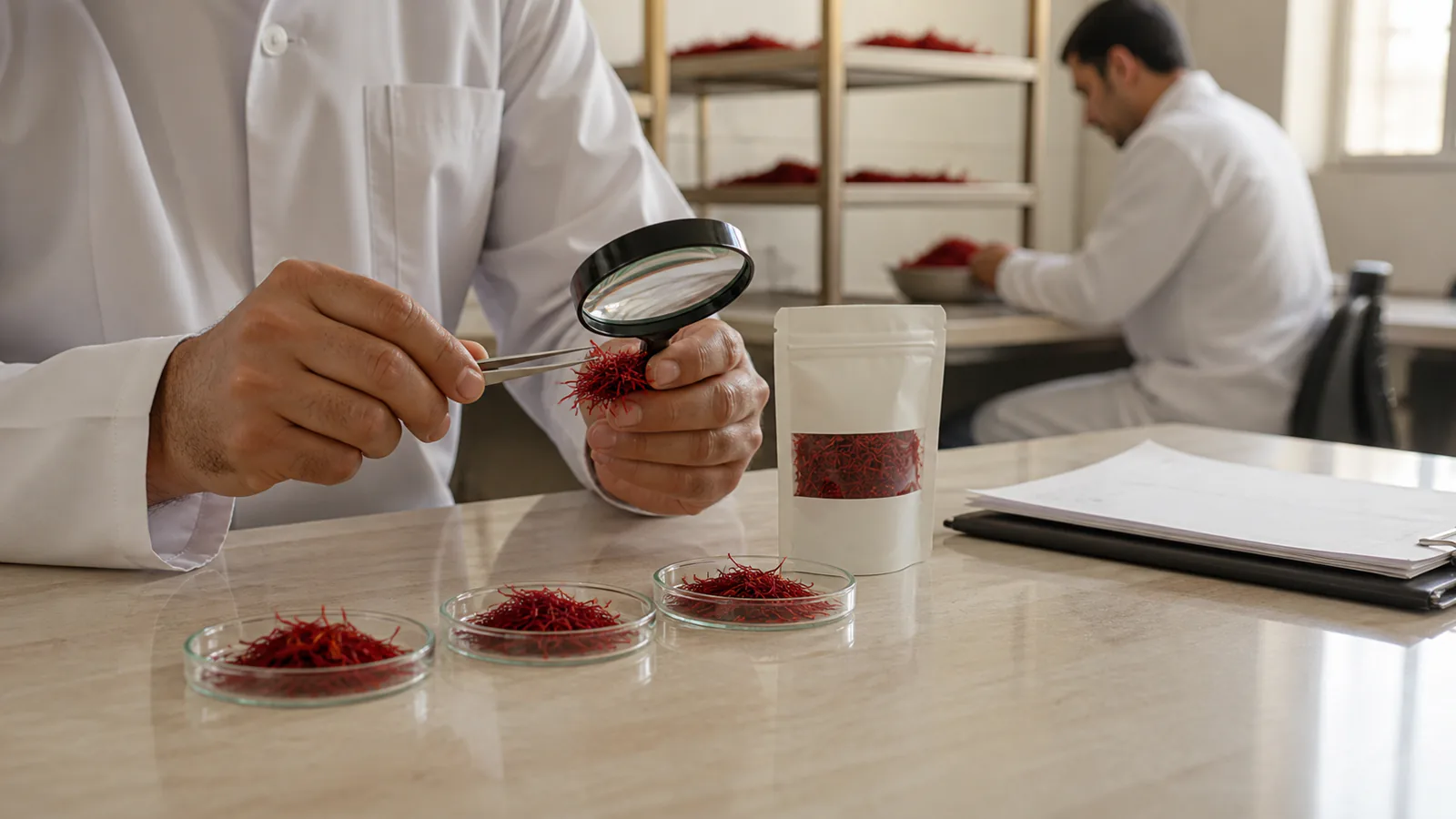
The strongest version of Iranian saffron branding is a verifiable promise about what is in the package. That requires appropriate harvest handling, drying, storage, testing and traceability. Packaging then protects the product and communicates the information a buyer needs; it cannot compensate for poor material inside.
This remains a live value-chain priority. In 2024, the UN Food and Agriculture Organization and Iran’s Ministry of Agriculture-Jahad began a project focused on saffron authenticity, transparency, traceability and food-supply-chain management. The project brought together producers, distributors, researchers and regulators rather than treating branding as a stand-alone advertising task.
FAO’s project announcement explains that current authenticity work is intended to strengthen consumer trust and Iran’s position in the global market.
From bulk exports to recognisable value
The council wanted Iranian saffron to compete as an identified product rather than disappear into another company’s supply chain. Doing that requires several practical layers:
- a consistent definition of the quality promised under the brand;
- testing and records that support claims of origin and authenticity;
- processing and packaging that preserve colour, aroma and cleanliness;
- clear rules governing who may use shared national or regional marks; and
- export planning based on the requirements of each target market.
A brand without those controls risks becoming a slogan. Conversely, standards without clear market communication may fail to return more value to growers and processors. The original council proposal tried to join both sides.
Packaging innovation is useful when it solves a buyer’s problem
The production report also called for innovation in processing and packaging. Useful innovation can mean tamper evidence, protection from moisture and light, convenient portion sizes, traceability or formats suited to a particular customer. It does not have to mean elaborate or wasteful packaging.
FAO’s 2025 value-chain work similarly emphasised improved production, post-harvest handling, safety, traceability, modern marketing and digital branding. It described Iran as producing 85–90% of the world’s saffron and noted the crop’s importance to smallholder livelihoods in Khorasan Razavi and South Khorasan.
FAO’s national saffron value-chain update shows why the council’s core idea remains relevant: quality integrity has to run from cultivation to export.
What a successful national saffron brand would achieve
Success would not be proved by unveiling a logo. It would be visible in repeatable product quality, trustworthy origin information, stronger buyer confidence and a greater share of value remaining with the people who grow and prepare the saffron.
The council’s brand-development agenda therefore depends on production-side work. Farmers need locally appropriate guidance and viable economics. Processors need sound handling and testing. Exporters need consistent specifications and market knowledge. Public bodies need enforceable, transparent rules. When those pieces support one another, Iranian saffron branding can represent evidence-backed quality rather than a promotional claim.

![Exporting Saffron to Turkey + Price Guide [Complete 0 to 100]](https://img.rowhanisaffron.com/20260827003933/saffron-export-turkey-quality-inspection.webp)



