


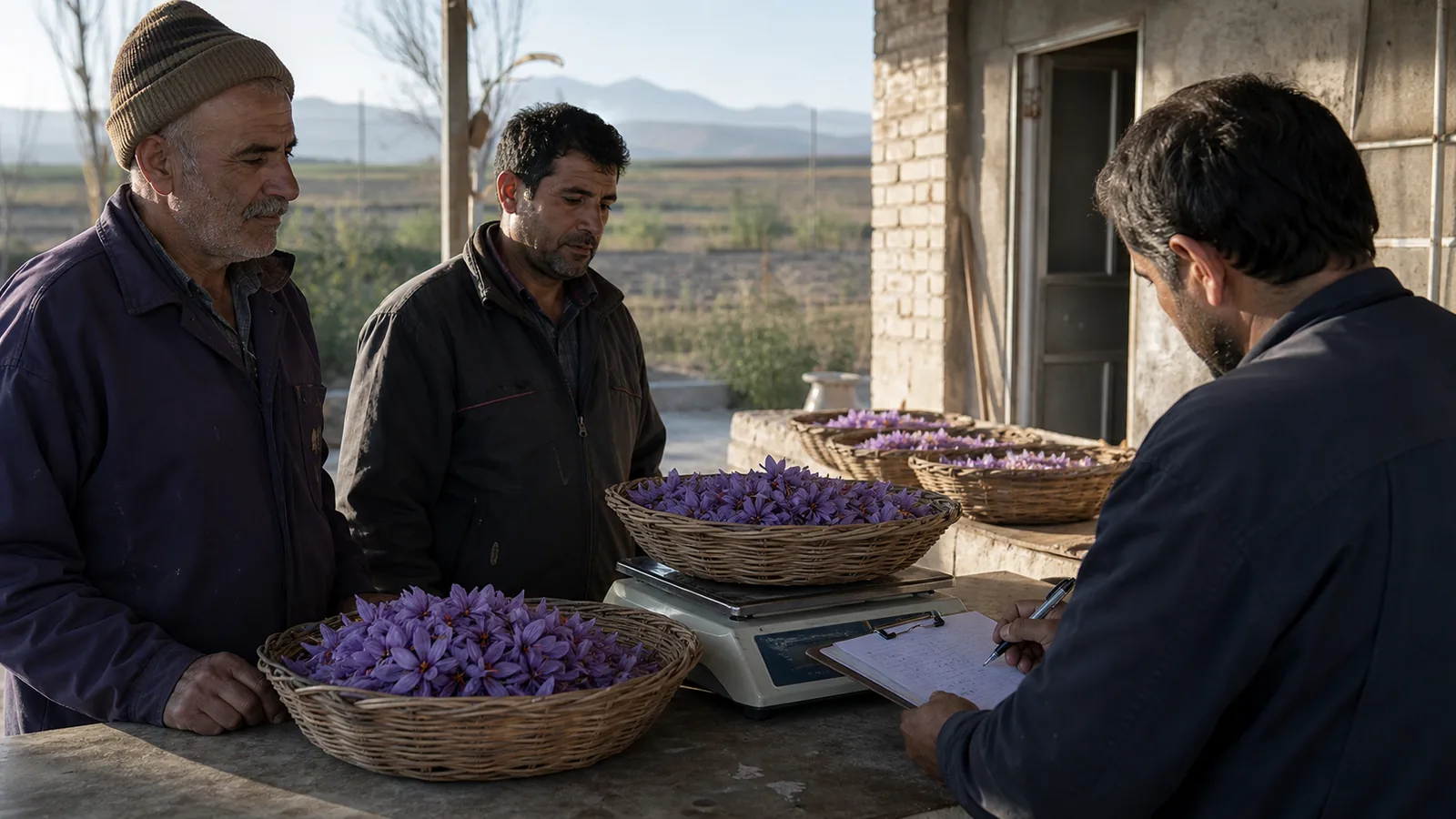
Zaveh’s saffron growers faced two pressures in the historical season covered here: a sharp fall in the reported flower price and weather-related damage that contributed to an estimated 30% drop in Khorasan Razavi production. Provincial officials responded with a support-purchase programme, while local leaders argued that production alone would not stabilise farmers’ income without stronger processing, quality control and market demand.
The archived reports contain useful figures, but they do not identify the reporting year in the body and several percentages do not match the stated acreages. They should be read as a dated account of one difficult season, not as current prices, current production or a forecast for the next harvest.
Why lower saffron prices hurt Zaveh growers
Mahmoud Sadeghi, then governor of Zaveh, said saffron supply was running ahead of demand. He reported that the price paid for saffron flowers had fallen to one third of the preceding year’s level. The article does not state the unit, market, grade or exact dates behind that comparison, so it cannot be converted into a reliable price series.
That distinction is important. Fresh flowers, separated stigmas and dried saffron are different products with different units and costs. A grower may face a low flower price during a crowded harvest window even when retail dried-saffron prices look much higher. Labour for picking and rapid separation still has to be paid, and a flower cannot simply wait for a better market.
Sadeghi said Zaveh’s colder conditions brought flower picking from mid-October, with the main harvest under way by early November. These are local seasonal observations from the archived report, not universal planting dates.
The acreage and harvest forecast in context
The Zaveh report put Khorasan Razavi’s saffron area at 84,000 hectares. It attributed 8,500 hectares to Torbat Heydariyeh and 12,000 hectares to Zaveh, where officials forecast about 40 tonnes of dried saffron from that season’s crop.
The original percentages need correction. On the stated provincial denominator:
- 8,500 hectares is about 10.1% of 84,000, not 12%; and
- 12,000 hectares is about 14.3% of 84,000, not 17%.
The phrase “more than 50,000 hectares in Zaveh” appears to describe a broader land-area figure, but the translation does not define it. It should not be treated as saffron acreage. The 40-tonne forecast across 12,000 hectares implies roughly 3.3 kilograms of dried saffron per hectare, although the archived article did not later report whether that forecast was achieved.
What officials said caused the 30% provincial decline
Reza Namani, then head of the Khorasan Razavi Rural Cooperative Organization, attributed the estimated 30% reduction to several pressures rather than one cause. He said rising saffron-corm prices encouraged some growers to lift corms before the harvest, reducing the area that reached flowering. He also cited the stage of the corm-production cycle, broader climatic conditions and recent rain damage in Torbat Heydariyeh and Zaveh.
The report does not provide field measurements that divide the loss among those causes. “30% reduction” is therefore the official provincial estimate for that season, not a controlled attribution or a permanent decline in the region’s productive capacity.
FAO’s current work with Iran likewise treats climate pressure and water scarcity as value-chain challenges, alongside post-harvest quality, traceability and market competition. Its 2025 saffron quality and value-chain programme brings growers, cooperatives, processors, traders and technical specialists together rather than treating farm output as an isolated number.
How the support-purchase plan was meant to help
Namani said the Rural Cooperative Union began a guaranteed saffron purchase at 50,000 tomans above the market price. The archived wording does not identify the grade, weight unit, purchase date or base-market quotation. It supports the existence of a premium policy, but not a present-day price comparison.
A purchase programme can give growers another buyer during a weak market, but its practical value depends on transparent grading, accepted quantities and payment timing. A related Khorasan report shows why these details matter: our account of payments to Khorasan Razavi saffron growers distinguishes the number of farmers fully settled from the percentage of contract value paid at an earlier stage.
For the Zaveh programme, a useful record would identify the daily market benchmark, premium per kilogram, accepted grade, delivered weight, payment date and share of participating growers. Without those fields, “above market” cannot be audited later.
Quality improvement in Bardaskan
The provincial report also described a saffron quality-improvement project in Bardaskan. Namani assessed the local implementation positively and hoped it would be extended because Bardaskan was an established production area.
The source does not explain the project’s tests, training or measured results, so this article does not infer them. At a minimum, quality work should connect a representative lot to its grower, harvest and drying conditions, laboratory result and commercial grade. That lets better handling translate into evidence a buyer can use, rather than a general promise of “improved quality.”
The proposed four-year licensing process
Namani further said agricultural union groups were issuing exploitation licences and that all farmers and producers were expected to hold one within a four-year process. This was a historical policy statement. It is not proof that the timetable was completed or that the same rule applies today.
Anyone who needs a current licence or eligibility answer should check with the relevant Iranian agricultural authority or rural cooperative. A blog archive should not convert an old proposal into present legal advice.
What would make the Zaveh market more resilient
Sadeghi’s broader point was that production must be matched by the capacity to manage demand. For growers, that means more than increasing hectares. Timely flower collection, careful stigma separation and drying, defensible grading, storage, processing and access to buyers all affect how much of the final value stays in the producing area.
The two reports fit together as one account of that pressure. Zaveh had a large crop area and a 40-tonne forecast, yet growers faced a reported collapse in flower prices. At the same time, Khorasan Razavi expected a 30% production decline and introduced premium support purchasing. The durable lesson is not that either lower supply or higher output automatically fixes income. Farmers need a transparent chain from field conditions and measured yield to tested quality, sale terms and payment.

![Exporting Saffron to Turkey + Price Guide [Complete 0 to 100]](https://img.rowhanisaffron.com/20260827003933/saffron-export-turkey-quality-inspection.webp)



