


Payments were completed for 2,939 of the 9,504 Khorasan Razavi saffron growers recorded in this support-purchase programme—about 30.9% of participating farmers. The settlement covered growers who had delivered less than 2.5 kilograms, after about 300 billion rials was allocated.
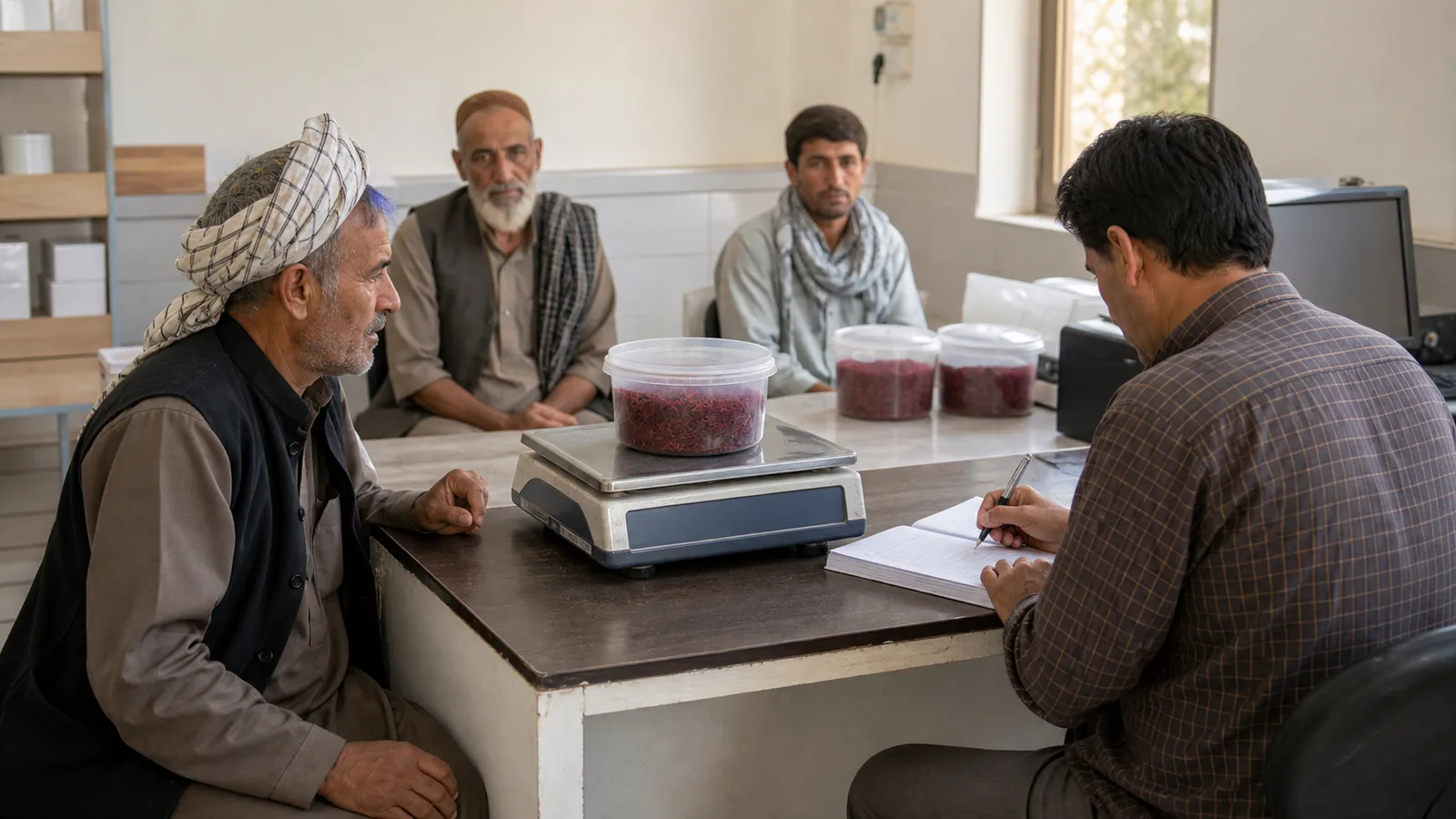
A separate report from Taybad shows how heavily one county used the same kind of programme. It also exposes why purchase and payment figures need dates and definitions: Taybad’s stated one-third share, 11,500-kilogram total and 30/70 payment schedule cannot all be compared directly with the province-wide snapshot unless they refer to the same cut-off date.
What the 30% payment figure actually means
Iraj Naseri Moghaddam said 9,504 farmers had delivered saffron to the Rural Cooperative Organization’s purchasing centres. After the allocation of roughly 300 billion rials, 2,939 small suppliers—those delivering under 2.5kg—had been fully settled.
The old English headline calls these “claims of 30% of the growers.” It is clearer to say that accounts for roughly 30% of the participating growers were paid. The report does not say that 30% of the programme’s total money or saffron weight had been settled.
Naseri Moghaddam said officials were seeking further allocations for the remaining farmers in the following weeks. That was a stated plan, not evidence that every later claim was paid.
The province-wide purchase programme
The report says 68 tonnes and 825 kilograms were purchased in less than two months, from November 28 to December 20 in its unnamed reporting year. Eighteen support-purchase centres operated across 17 saffron-producing counties in Khorasan Razavi.
The article was written during the coronavirus pandemic—mistranslated as an outbreak of “coronary heart disease.” Budget pressure was part of the explanation for delayed payments. That context belongs to the historical programme and should not be read as a current payment status.
The provincial crop figures were also substantial. The report put saffron at 90,000 hectares and 320 tonnes in the current season, compared with 87,750 hectares and 298 tonnes in the preceding one. It said about 129,000 agricultural workers or farmers were active in provincial saffron production. These are dated administrative figures, not 2026 estimates.
How the four purchase grades were priced
Accepted saffron was divided into four named grades with a price per kilogram:
- Negin: 105 million rials;
- semi-Negin: 95 million rials;
- grade-one Pushal: 90 million rials; and
- ordinary Pushal: 82 million rials.
The old translation rendered semi-Negin as “pseudo-saffron” and Pushal as “straw.” Those are translation errors, not additional product types. The prices are historical programme rates and must not be presented as today’s market.
A grade-based purchase is useful only when sampling and classification are consistent. The Codex saffron standard CXS 351-2022 now provides an international baseline for saffron styles, quality classes, contaminants, hygiene, packaging, labelling and analysis. Local commercial names still need a documented specification and representative sample behind each decision.
Taybad’s contribution to support purchasing
Baqer Khodadadi, then head of the Taybad Rural Cooperative Office, said one third of saffron delivered to the Khorasan Razavi organization came from Taybad farmers. He reported 11,500 kilograms of dried saffron purchased in the county since the support plan began.
Khodadadi said Taybad and nearby Bakharz operated purchasing centres and that Taybad could accept up to 300kg of dried saffron per day. He described participation at about 50% of local farmers in the plan’s second year.
According to his account, last year’s purchases were 7 tonnes and the current-year expectation was more than 14 tonnes. Taybad itself had 6,850 hectares under saffron and produced more than 20 tonnes annually in that reporting period.
Why the Taybad and province totals do not automatically reconcile
If Taybad’s 11.5 tonnes were compared directly with the province’s 68.825 tonnes, the share would be about 16.7%, not one third. The two articles were published in different periods and do not state a common programme year or cut-off date. The one-third claim could refer to an earlier intake stage, a subset of centres or a different reporting window.
The evidence does not support choosing one explanation. A reliable combined report would publish, for the same date:
- kilograms delivered, accepted and returned by county;
- the number of participating growers;
- weight and value by grade;
- amount paid, amount outstanding and scheduled payment date; and
- whether each figure is cumulative, annual or daily capacity.
The 30/70 Taybad payment schedule
Khodadadi said that after final appraisal, approved saffron was classified and sent to the provincial Rural Cooperative centre. Farmers then received 30% of the appraised value, with the remaining 70% due within the contract period.
This is different from the destination article’s “30% of growers paid” statistic. One describes the share of a farmer’s contract value paid at an initial stage; the other counts small-delivery growers whose accounts were fully settled. Combining them would create a false payment rate.
The report says the remaining 70% would be paid “in a short time,” but does not give the contract deadline or later settlement result. A farmer evaluating such a programme needs the actual date, not a relative phrase.
What the programme should preserve beyond purchase volume
Fast, documented payment matters because saffron growers face labour and household expenses around harvest. Quality records matter because a grade determines price. County records matter because Taybad’s contribution can disappear inside one provincial total.
FAO’s current Iran programme treats farmers, cooperatives, processors and traders as one value chain, with emphasis on quality, post-harvest handling, traceability and marketing. The same principle applies to public purchasing: every accepted lot should connect grower, tested grade, weight, price, payment and later storage or sale.
The headline figure was real within its historical snapshot: 2,939 small suppliers, about 30% of the recorded Khorasan Razavi growers, had been paid. Taybad adds the missing local picture. It was a major participant with 6,850 hectares, more than 20 tonnes of production and up to 300kg of daily intake, but its shares and payment promises need dated ledgers before they can be compared with province-wide totals.

![Exporting Saffron to Turkey + Price Guide [Complete 0 to 100]](https://img.rowhanisaffron.com/20260827003933/saffron-export-turkey-quality-inspection.webp)



