


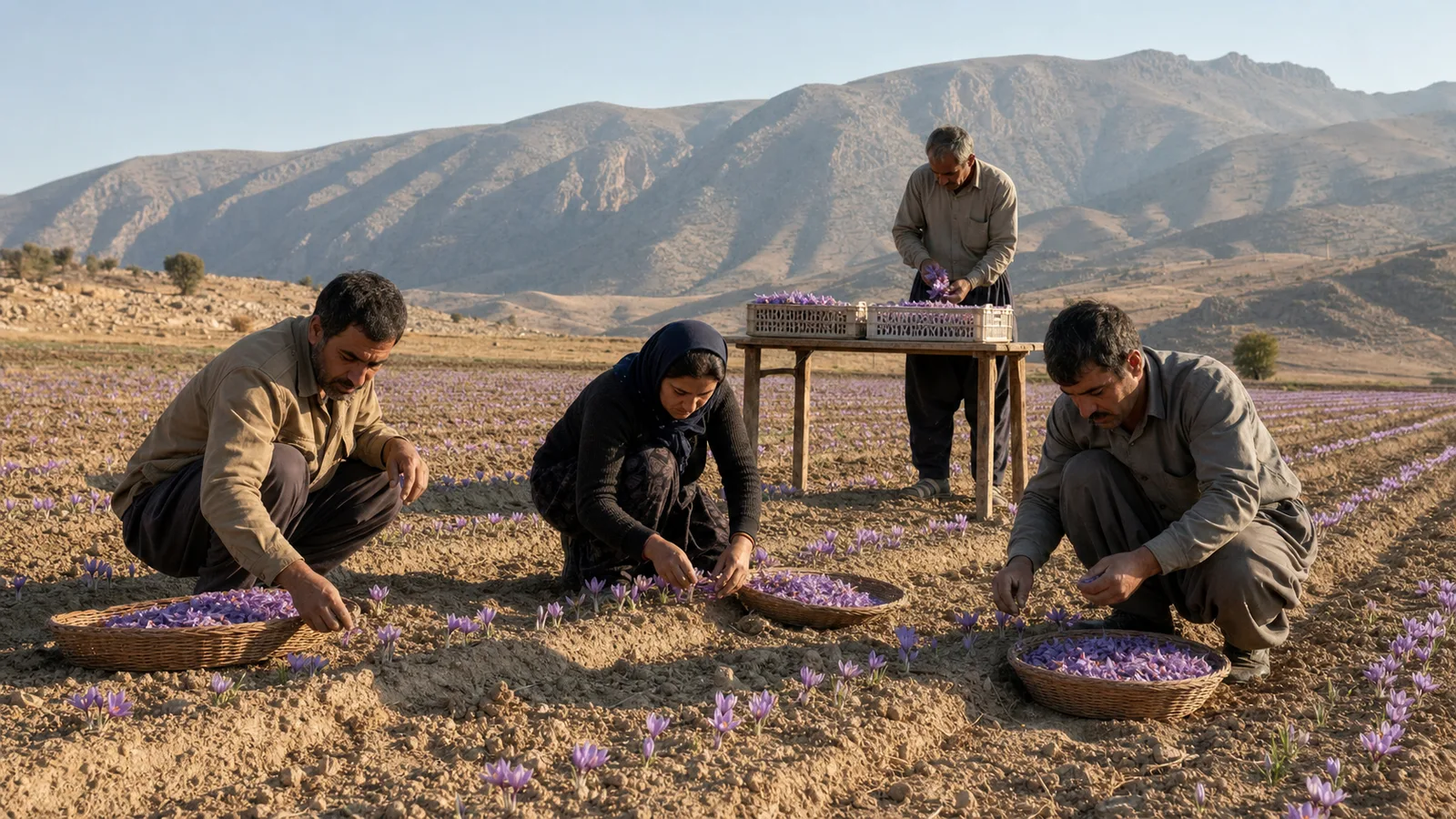
Lorestan’s saffron harvest was forecast to rise by 15 percent after the province reported about 1,100 kilograms from 380 hectares. The historical announcement described an average near three kilograms per hectare, a planting window in June and September, and harvest from late November to mid-December. Aleshtar held the largest reported concentration, with 150 hectares.
The forecast is most useful when read alongside other regional records. Yazd reported a five-percent decline, Pakdasht documented the labour and corm inputs behind just 36.5 hectares, and Golestan separated mature fields from young ones. Together, these reports show why a percentage headline needs acreage, field age, harvest method and post-harvest capacity behind it.
What Lorestan’s 15-percent forecast was based on
Alireza Ahmadvand, then horticulture director for Lorestan’s agricultural organization, reported 380 hectares and 1,100 kilograms in the preceding season. Three kilograms per hectare across 380 hectares would equal 1,140 kilograms, close enough to the stated total to reflect rounding or field-to-field variation.
The program included both rain-fed and irrigated saffron land. It placed planting in two local periods, June and September, and harvest from late November into mid-December. Officials said high corm prices were a barrier and that financial facilities were available to growers.
The promised 15-percent increase was a forecast, not a verified result. Applying it to the prior 1,100-kilogram total would imply about 1,265 kilograms, but the archive does not provide the final harvest needed to confirm that number.
Lorestan’s wider medicinal-plant and supply-chain plan
A related report placed saffron within more than 2,800 hectares of medicinal plants across Lorestan. Abdolreza Bazdar, then head of the provincial agricultural organization, repeated the 380-hectare saffron area and 1,100-kilogram harvest.
The province also unveiled what it described as the country’s first online saffron production supply chain. Led by local young people, the initiative was intended to connect planning, planting, crop care, farmer training and harvest with processing, packaging, export and recycling. The important idea was continuity: a field is not economically secure merely because it produces flowers. Growers need a dependable route through drying, testing, packaging and sale.
A claim that Lorestan saffron was categorically better than Khorasan saffron is not repeated as fact. The archive names colour, aroma and taste but supplies no laboratory report, sample design or test values. A regional comparison requires representative lots and a named standard such as ISO 3632-1.
Yazd: 2,400 kilograms and a five-percent decline
Yazd’s historical report recorded 2,400 kilograms of dried saffron from 540 hectares, roughly 4.4 kilograms per hectare across the reported area. It was five percent lower than the preceding season. The archive said cultivation was concentrated in two named areas transcribed as Mahabad and Tabas; because the place names may be mistranslated in the English source, they are not used to imply a current administrative boundary.
Farmers planted corms in September and October, left fields in place for three to seven years, and harvested from late November to mid-December. The claim that useful production begins only in the third year is best understood as a local economic observation: some corms may flower earlier, but a young field and a mature field should not be compared as if they have the same productive capacity.
The source also mentioned aromatic oil, mucilage and wax as possible saffron-derived materials. Those are processing possibilities, not automatic by-products of an ordinary dried-stigma operation. Any extraction business needs a defined raw material, process, safety controls and buyer.
Pakdasht: one report published twice
Two assigned source posts preserve near-identical accounts of saffron in Pakdasht, Tehran Province. They are consolidated here once so the destination does not repeat the same section.
Mahmoud Amiri, then local agriculture director, reported 36.5 hectares and a 17-year cultivation history. The largest farms were in Kahrizak village in the Sharifabad district. Pakdasht ranked second within Tehran Province’s reported 188 hectares and was described as the province’s only city licensed to produce mother corms. Twelve producers were active, and 420 square metres of the total area used a new greenhouse system while the rest was managed traditionally.
The reports listed 219,000 kilograms of corms annually, 10 kilograms of flowers per hectare and 16 grams of saffron per kilogram of corm. Those units do not reconcile into a credible production total and may reflect translation or labeling errors. They are retained as disputed archive measurements, not converted into a yield recommendation.
The stated “9,125 temporary workers” is more coherently read as 9,125 person-days: the same report gives 250 person-days of employment per hectare, and 36.5 multiplied by 250 equals 9,125. That describes seasonal labour demand, not necessarily 9,125 different individuals.
Pakdasht’s planting period ran from June through September and harvest from November into December. One duplicate version added a county land base of 56,800 hectares, including 15,792 hectares under crops and horticulture. Those broad land figures provide context but do not make all open land suitable for saffron.
Golestan: separating mature and immature fields
Golestan’s report provides the clearest explanation of field age. It recorded about 235 hectares, mainly in Azadshahr’s mountain villages of Vamenan, Kashidar, Sibchal and Nerab, with a target of 400 hectares by the end of the sixth development plan. Roughly 65–70 percent of the fields were said to be more than three or four years old; the remainder were first- and second-year plots not yet counted as fully productive.
The report paired approximately 1,100 kilograms of output with an average yield claim of eight kilograms per hectare and occasional fields up to 20. Eight kilograms across all 235 hectares would be far higher than 1,100 kilograms. Restricting the average to mature fields narrows the difference but still does not prove the claim. The figures should therefore remain historical observations, not a regional yield promise.
A cooperative in Vamenan handled processing and drying under a provincial brand. Officials advised growers to obtain corms from inspected, fungus-free fields inside the province, citing concern about importing soil-borne problems. The plant-health principle is sound; the source does not establish that all outside corms are contaminated or that local origin alone makes a lot clean.
Likewise, the statement that no toxic substances were used cannot be generalized to every Golestan field without farm records. Responsible claims require documented inputs, traceability and testing.
How to evaluate a regional harvest forecast
Before relying on a percentage increase, check the underlying measures:
- total planted area versus the area that actually flowered;
- field age and corm density;
- dry-stigma output, not flower weight or corm weight;
- weather and irrigation during the crop cycle;
- person-days available during the short harvest;
- drying, testing and packaging capacity;
- whether the figure is a target, estimate or completed result.
Lorestan’s 15-percent projection was plausible as a planning figure, but the final harvest is the evidence that matters. The comparison with Yazd, Pakdasht and Golestan shows how easily acreage and yield can be misread when immature fields, ambiguous units or unverified quality claims are mixed into a short news report.
References: FAO: Iranian qanat-based saffron farming; FAO AGRIS: corm weight, density and saffron yield; ISO 3632-1:2025 saffron specification. All provincial figures are identified as historical records from the six posts consolidated into this article.

![Exporting Saffron to Turkey + Price Guide [Complete 0 to 100]](https://img.rowhanisaffron.com/20260827003933/saffron-export-turkey-quality-inspection.webp)



