


A local statement predicted that saffron cultivation in Aradan would reach 60 hectares by the end of the stated year. It was a target announced by the city’s governor, not a confirmed final area, so the figure needs to be read in its original context.
What the 60-hectare prediction meant
Mojtaba Borbour, identified in the report as governor of Aradan, said saffron cultivation was expected to increase to 60 hectares. The surviving English copy does not give the starting area, the number of growers, expected production or a later result.
Without those details, “60 hectares” measures an ambition rather than an outcome. It should not be presented as the city’s current saffron area or as proof that every proposed field was planted.
A forecast needs a dated follow-up
The most useful follow-up would separate land already planted from land merely planned, then distinguish young fields from mature bearing fields. Those categories affect both output and the labour required at harvest.
Current agricultural records would also need to show how much dry saffron was produced, average field age and the reporting year. Area alone cannot tell a grower, buyer or policymaker whether the programme worked.
Why Aradan might assess saffron
Aradan lies in Semnan province, where water and site suitability shape crop choices. Saffron’s active growing season falls mainly outside the hottest summer period, which can make it worth evaluating where a dependable autumn-to-spring water schedule is available.
The FAO’s account of Iran’s qanat-based saffron system places the crop within a landscape of severe water shortage, reliable irrigation and accumulated local knowledge. It does not mean saffron succeeds without water or without testing the field.
Sixty hectares are not one uniform farm
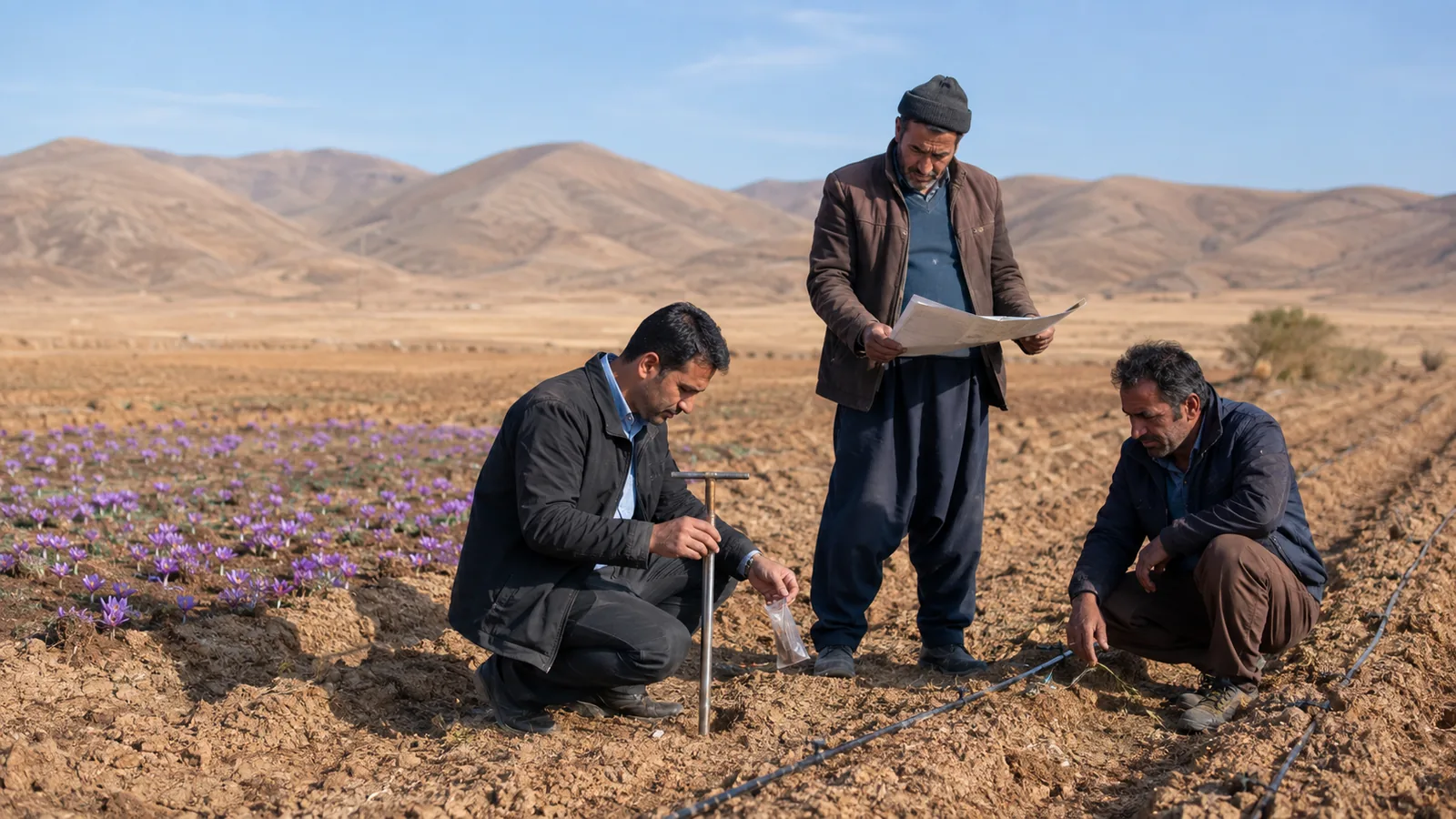
Soil texture, drainage, salinity, elevation, winter cold and access to healthy corms can differ across a city’s agricultural land. A sound expansion programme would screen each plot rather than apply a province-wide assumption.
Small trial areas provide evidence before greater expense. Growers can record flowering dates, corm survival, dried yield, labour hours and quality, then decide whether a larger planting makes sense under their own conditions.
Labour and processing must grow with the field area
Saffron flowers emerge over a short season and must be picked promptly. More hectares require enough people for early harvesting, clean transport, stigma separation and controlled drying. A land target without a labour plan can create a bottleneck precisely when the crop is most vulnerable.
Storage, grading, lot records and access to buyers also belong in the calculation. These steps determine how much of the field’s potential becomes consistent, saleable saffron rather than merely a harvest estimate.
The wider statement was about unity and security
The 60-hectare forecast appeared inside a broader speech rather than a detailed agricultural report. Borbour said the country needed unity and cohesion and described the Aradan administrative council, the presence of Semnan provincial and city officials, and their support as signs of unity and integrity.
He also said enemies of the Islamic Republic sought division and disruption, referred specifically to the United States, and described national security as valuable. He thanked God Almighty for that security. These were political remarks surrounding the meeting; they do not supply evidence for the saffron forecast.
Aradan’s location is clearer than the historical note
The original copy identifies Aradan as a city in Semnan province. It also contains an awkward translated sentence saying Aradan had once been the centre of Garmsar, followed by wording about the “ruler of the time.” The English text is too unclear to support a precise historical claim.
That fragment is retained here as a limitation rather than silently corrected. A local administrative history would be needed before explaining the earlier relationship between Aradan and Garmsar in firmer terms.
What would make expansion responsible
Before pursuing a 60-hectare target, planners would need verified suitable land, healthy corm supply, irrigation schedules, trained growers, harvest labour, clean processing space and an outlet for the dried crop. The sequence matters: planting first and solving the rest later increases avoidable risk.
A phased programme could publish results from each season and expand only where field records support it. That approach protects growers from treating a public target as a guaranteed business case.
How to read the prediction today
The lasting fact in the report is narrow: Aradan’s governor predicted that saffron cultivation would reach 60 hectares by the end of that year. The page does not establish whether the target was reached, what was harvested or how the crop performed.
Anyone assessing saffron cultivation in Aradan now should use current city and provincial data. The historical forecast is useful as a marker of local interest, while present decisions require evidence from actual fields, water, labour, processing and markets.

![Exporting Saffron to Turkey + Price Guide [Complete 0 to 100]](https://img.rowhanisaffron.com/20260827003933/saffron-export-turkey-quality-inspection.webp)



