


A Zaveh agriculture report recorded an annual harvest of 40 tons from 12,100 hectares of saffron farms. Although the English headline says “dried saffron flowers,” the usable dry product is the separated stigma; the report appears to mean about 40 tons of dry saffron, not whole flowers dried intact.
What the 40-ton saffron harvest represented
Mahmoud Izadi, then head of the Zaveh Agricultural Jihad Office, said the county produced an average of 40 tons of dry saffron each year. He placed its saffron cultivation area at 12,100 hectares, roughly 10% of Iran’s area at the time and about one-eighth of the provincial total.
Those shares and the 40-ton amount belong to the report’s period. Area, bearing fields and yields vary from season to season, so they should not be read as a current forecast. The exact headline remains useful as a historical search reference, while the article separates its awkward wording from what farmers actually harvest and sell.
The area and output imply about 3.3 kilograms per hectare
Dividing 40,000 kilograms by 12,100 hectares gives an average of about 3.3 kilograms of dry saffron per hectare. That result is plausible beside an official national account that placed Iran’s average at 3.2 kilograms per hectare during an earlier period.
It is still only a broad calculation. Not every planted hectare necessarily bears flowers in the same year, and a county total can combine young, mature and declining fields. A farm should compare its own dry weight with its bearing area, then record corm age, irrigation, soil condition and harvest timing before drawing conclusions about performance.
Zaveh’s saffron economy reached well beyond the farm
Izadi associated the stated cultivation and production with employment for 2,700 people. About 60% was described as direct employment and the rest as indirect.
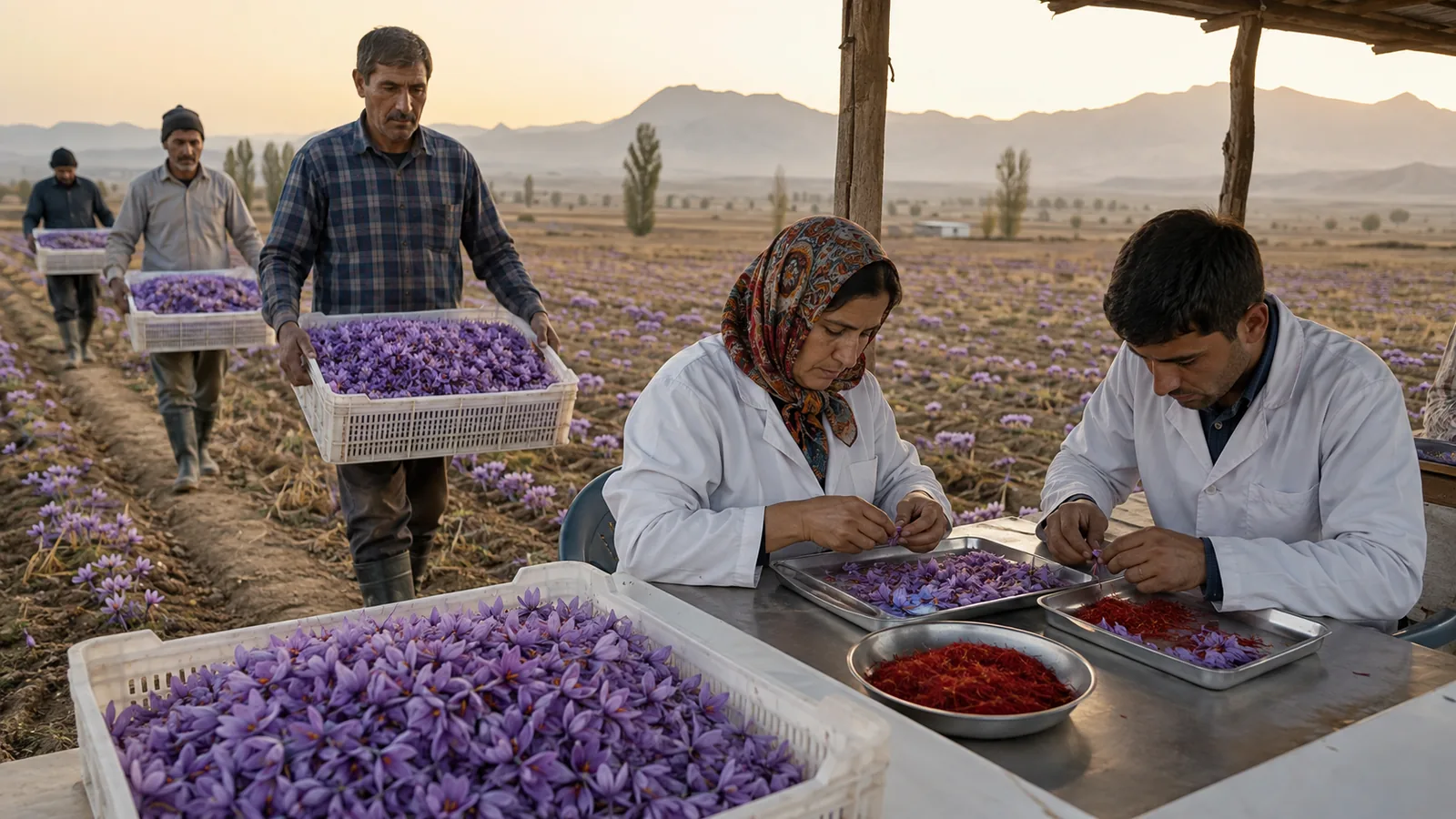
The report does not define whether these were permanent jobs, seasonal workers or employment opportunities. Saffron’s labour demand is concentrated: flowers must be picked promptly, and the stigmas then need to be separated, dried and stored carefully. That short peak can involve many people without representing the same number of year-round positions.
About 90% of local farmers were said to grow saffron
The claim that almost 90% of Zaveh’s farmers were mainly saffron growers shows how deeply the crop shaped local work. It should not be interpreted as saying that every household depended on saffron alone; farms often combine crops, livestock or other income.
Heavy dependence also concentrates risk. Weather, labour shortages, water quality and a weak market price can affect much of the county at once. Better drying, grading, traceability and access to more than one buyer can therefore matter as much as expanding the planted area.
Harvest and cleaning created the sharpest labour pressure
One sentence in the surviving translation is incomplete. It says saffron had not caused production workshops to close, then refers to a lack of workers during harvesting and cleaning. The safest reading is that other local workshops faced labour pressure when workers moved into the saffron harvest, not that saffron itself permanently closed them.
This is a scheduling problem rather than a reason to suppress the crop. Growers can stagger field work where conditions allow, arrange picking teams before flowering begins and make the receiving and stigma-separation workflow ready in advance. Any local business relying on the same seasonal workforce also needs to plan for those weeks.
Mechanisation remained the unresolved problem
Izadi said several devices had been built, but none had met expectations or reached mass production. The statement did not identify the machines or their trials, so it cannot establish that every form of mechanisation failed.
Saffron presents a difficult engineering problem. A field machine has to work close to the soil without damaging flowers or corm beds, while the delicate stigmas still require clean handling. A prototype may succeed in one row spacing or soil condition and fail in another. Commercial readiness depends on repeatable field results, maintenance, cost and whether the machine saves labour at the exact moment it is scarce.
Zaveh also had an automatic planting device
The report separately mentioned a fully automatic saffron planting device in the county. That claim is not necessarily inconsistent with the wider concern: planting, flower picking and stigma separation are different operations.
A planting machine can be useful if it places sound corms at a suitable depth and spacing without excessive damage. Its value should be judged against emergence, field uniformity, labour saved and the cost of preparing land for the machine. The article’s source does not provide those test results, so the device remains a reported local capability rather than proof of a solved production system.
Research in Zaveh focused on yield as well as machinery
An official account of a national saffron conference in Dowlatabad, Zaveh described research on raising yield from four to eight kilograms per hectare. That was a research objective, not a promise that every field could double its crop.
A second official national-plan report stressed irrigation and mechanisation as tools for improving quantity and quality per unit of land. Both accounts support testing a whole production method rather than judging success by hectares alone.
Pressurised irrigation can improve control, not remove water risk
Izadi recommended pressurised irrigation to improve efficiency and productivity. Its practical advantage is control: a well-designed system can apply water more evenly and reduce some conveyance losses.
The result depends on design, pressure, filtration, maintenance, soil and water quality. Poor distribution can leave one part of a saffron field stressed and another too wet. Growers still need locally appropriate irrigation timing and should check soil moisture and plant response rather than relying on the equipment label.
How to read the Zaveh harvest report today
The report captures a county where saffron occupied 12,100 hectares, produced about 40 tons of dry product and shaped both farm work and seasonal labour. It also records the limits of that scale: an incomplete mechanisation solution, competition for harvest workers and a need to use water more efficiently.
Its most useful lesson is not the headline number by itself. Zaveh’s future results depend on yield from bearing fields, careful harvest and cleaning, equipment that survives real farm tests, and irrigation measured in the field. Those are the figures a current assessment should collect before comparing a new season with the historical 40-ton harvest.

![Exporting Saffron to Turkey + Price Guide [Complete 0 to 100]](https://img.rowhanisaffron.com/20260827003933/saffron-export-turkey-quality-inspection.webp)



