


North Khorasan was described as Iran’s third-largest saffron producer in a provincial report built around 3,997 hectares and 20 tons of output. Those figures documented a strong period of growth, but the ranking and every supporting number belong to that reporting year rather than the province today.
Why North Khorasan was ranked third
Abdullah Yousefi, then head of the North Khorasan Agricultural Jihad Organization, said the province ranked third nationally in both saffron cultivation area and production. The official account of his statement says cultivation rose from 343 hectares in the year 1386 of the Iranian calendar to 3,997 hectares.
The rank is meaningful as a dated comparison. National positions can change as area, weather and yields move in other provinces, so “third largest” should not be treated as a permanent title.
The area, output and yield do not align exactly
Yousefi reported 20 tons of saffron and an average yield of six kilograms per hectare. Dividing 20,000 kilograms by 3,997 hectares gives about five kilograms per hectare, not six.
The difference could reflect rounding, a smaller bearing area or figures gathered at different points, but the report does not explain it. The responsible reading is to retain all three numbers and show the inconsistency rather than silently forcing them to match.
Farooj carried most of the reported production
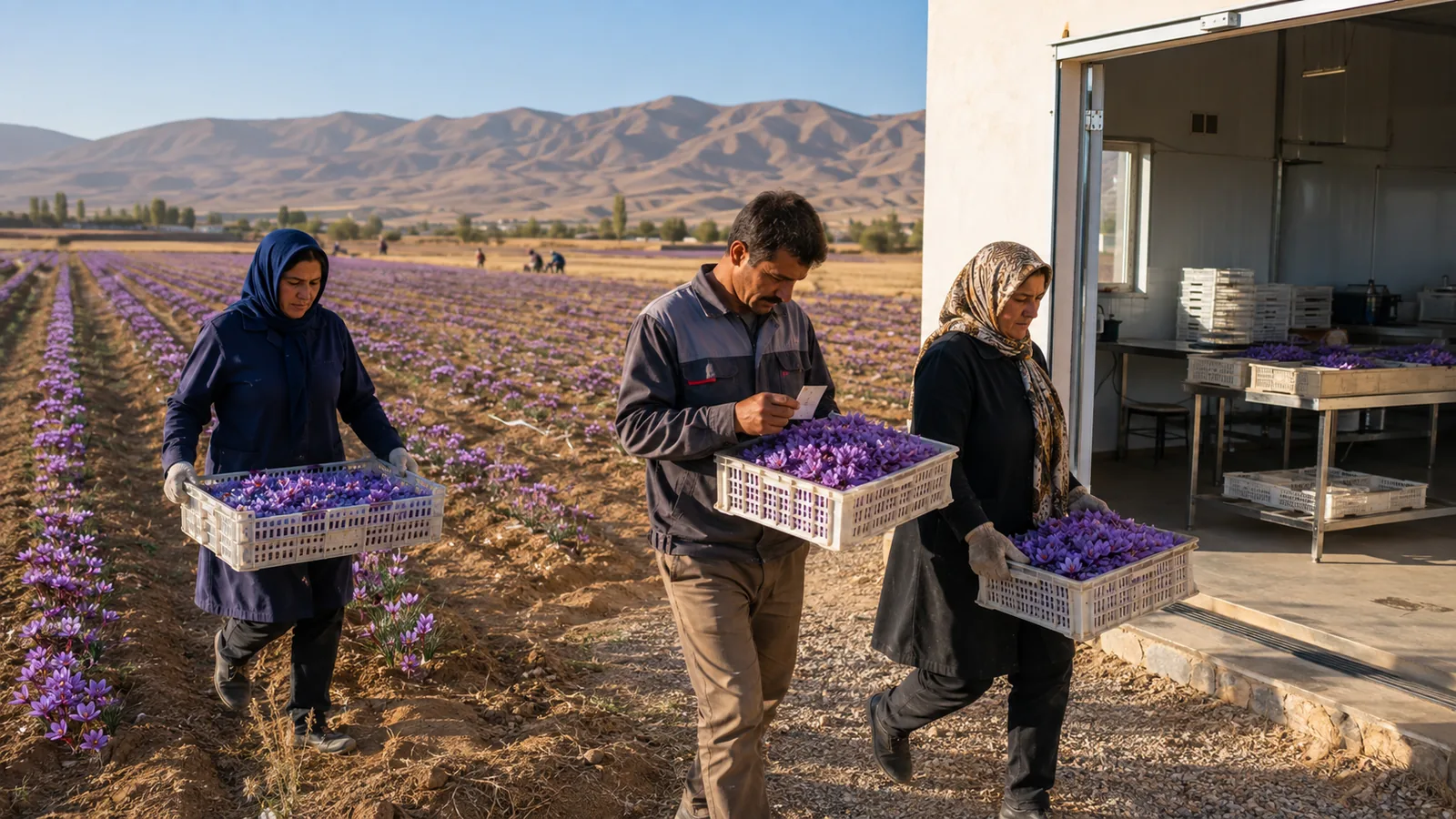
Saffron was said to be cultivated in eight cities or counties across the province. Farooj ranked first with 2,453 hectares and annual output of about 14 tons, while Shirvan and Esfarayen held the second and third production positions.
Farooj therefore accounted for well over half of the stated provincial area and roughly 70% of its reported output. That concentration matters for harvest labour, processing and buyer access; provincial totals do not describe each locality equally.
The economic value was a snapshot, not a current price
The report valued North Khorasan’s saffron production at 1,800 billion rials and said it represented 17% of the total value of horticultural products. Both figures depend on the prices and accounting used at the time.
They should not be converted into current income without the original valuation date and method. Farm returns also depend on dry yield, quality, labour, corm costs, processing losses and the price a grower actually receives.
The employment wording needs caution
Yousefi said each hectare created one direct job through planting, crop care, harvesting and processing, plus about 180 to 200 indirect and seasonal “jobs.” The second number is unusually high if it means distinct people employed for a year.
It may describe seasonal work opportunities or person-days rather than full jobs, but the source does not define the unit. The statement should remain attributed and should not be used to calculate employment without clarification.
Why the crop was promoted under water pressure
The stated reasons included climate change, drought, reduced water resources, adaptation to arid and semi-arid regions, and lower water demand than other local products. Yousefi also noted that saffron’s main water-use period falls when many other crops are not competing for irrigation.
That seasonal advantage is not the same as having no water requirement. A field still needs suitable water quality, correct timing, drainage and enough moisture for corm and leaf growth. Comparisons should be made against a real local crop and measured at farm level.
Replacing water-intensive orchards is not a simple swap
The report listed the possibility of removing and replacing high-water-use orchards with saffron. Such a change can carry permanent costs: established trees, existing income, soil condition and the household’s risk all have to be considered before an orchard is removed.
A trial on available land is safer than treating saffron as an automatic substitute. Mechanised planting, easier maintenance and high economic value were also listed as benefits, but equipment, field layout and labour still need to suit the farm.
Processing capacity was small beside reported output
North Khorasan was reported to have five saffron processing and packaging units with annual capacity of 3.4 tons. Compared with the stated 20 tons of production, that named capacity covered only part of the crop.
The figures do not tell us how much saffron was processed elsewhere, handled by unlisted facilities or sold without local packaging. They do show why a value-chain plan mattered: growing more saffron does not automatically create local processing value.
Export potential depended on consistent lots
Export was presented as another advantage. In practice, an exporter needs traceable origin, clean separation and drying, repeatable grades, suitable packaging and records that connect each lot to its producer and handling conditions.
Five small units could contribute to that system if their processes and records aligned. Without consistency, a provincial reputation cannot guarantee the quality of each shipment.
Iran’s global-share figures were time-bound
Yousefi said Iran held 90% of the world’s saffron cultivation area and produced 89% of global output. These were the percentages stated in the historical report, not permanent world-market shares.
Global estimates vary by year and method, and production outside Iran changes. Current market analysis should use one dated international dataset rather than repeating the old percentages without attribution.
Support covered more than planting inputs
The organization’s measures included expert supervision and consultation during planting, crop care and harvest; transfer of technical knowledge; a saffron value-chain development plan; distribution of agricultural inputs; cultivation tools; finance and facilities; and supportive purchasing.
That range is important. Healthy corms and tools help establish a field, while advice, harvest practice, processing and a reliable route to market determine whether the crop remains productive and saleable.
How to read the third-place claim today
The report captures a period when North Khorasan’s saffron sector had expanded sharply, with Farooj as its centre and Shirvan and Esfarayen following. It also reveals unresolved measurement questions around yield, employment and processing capacity.
To assess the province now, use current dated figures for planted and bearing area, dry output, local yield, processing capacity, prices and exports. The historical third-place ranking remains useful context, while present performance has to be demonstrated with present evidence.

![Exporting Saffron to Turkey + Price Guide [Complete 0 to 100]](https://img.rowhanisaffron.com/20260827003933/saffron-export-turkey-quality-inspection.webp)



