


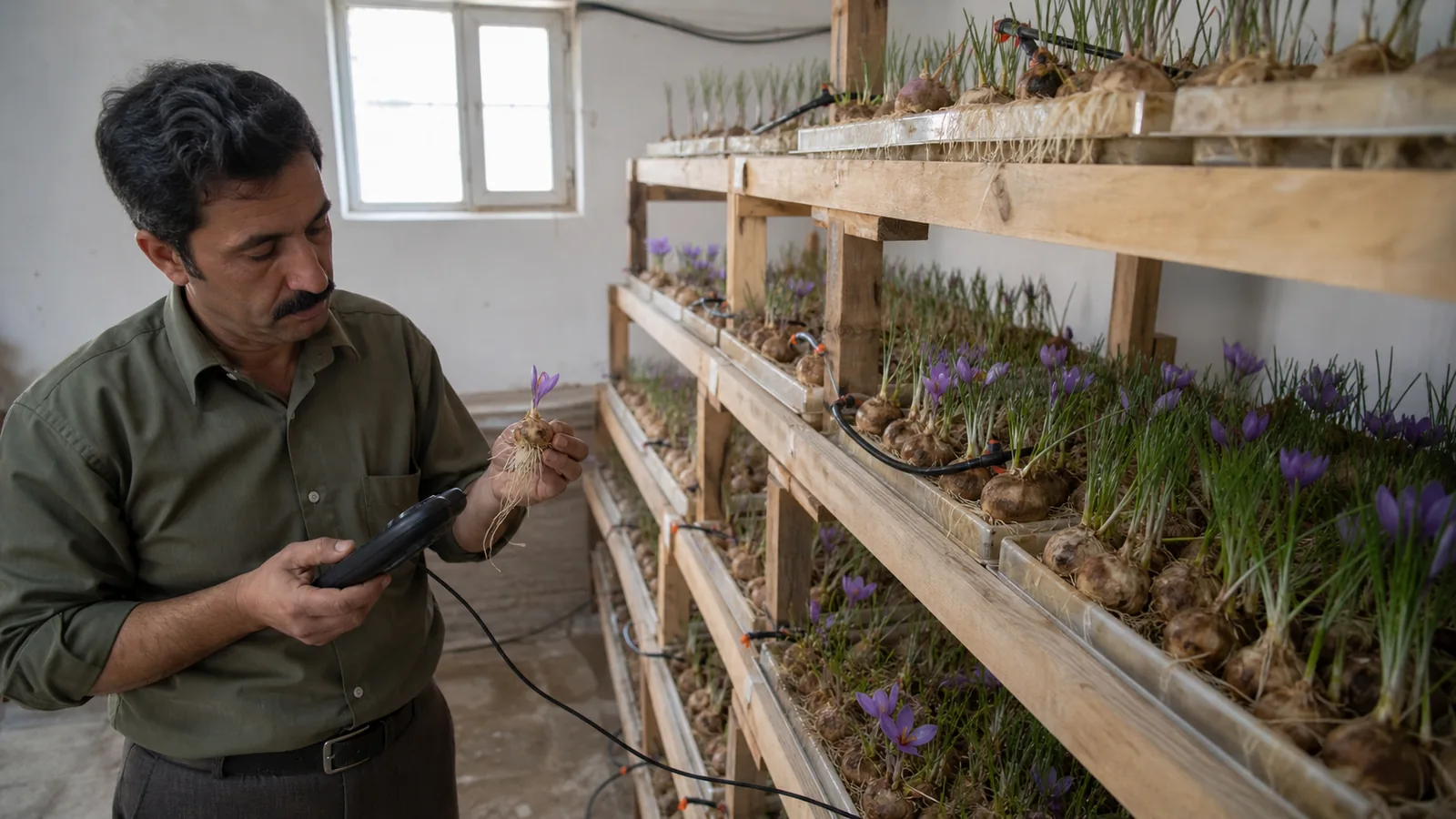
A small saffron cultivation trial in Maku, Iran, placed corms on wooden racks and used controlled moisture instead of a conventional field. The grower reportedly started with 100 kilograms of corms, invested 50 million rials and expected a little over 100 grams of dried saffron from the first harvest. It was an interesting pilot, but an expected harvest is not the same as a measured yield or a proven business return.
The distinction matters because indoor, greenhouse, hydroponic and aeroponic saffron are often presented as if they were one method with guaranteed results. They are not. Research shows that saffron can be grown in carefully controlled soilless systems, yet it also shows how much management those systems require. A flower emerging from a corm indoors does not, by itself, demonstrate a profitable crop cycle.
What happened in the Maku saffron trial
The archived report identifies the grower as Ali Golabi and describes the project as a first local attempt to produce saffron without ordinary soil cultivation. Corms were brought from Mashhad and arranged on wooden tiers in a small, purpose-built space. Moisture was supplied around the racks, and the corms were kept for a five-month production period.
Some wording in the original English version was badly translated. “Scallion,” “onion” and “silver” all referred to saffron corms; “Macaque” referred to Maku. The report also calls the method “water vapour” cultivation without describing nutrient delivery, root development, temperature control or how the corms were managed after flowering. That is not enough information to label the setup a complete aeroponic or hydroponic system.
The numbers should also keep their original status:
- 100kg was the reported starting weight of the corms;
- 50 million rials was the stated investment;
- more than 100g was an expected first harvest, not a verified final yield; and
- the article did not report operating costs, selling price, daughter-corm production or a second season.
Those missing figures prevent a serious profitability calculation. The trial is best understood as a local experiment, not a ready-made investment model.
Soilless saffron is real, but the system has to be complete
Protected saffron cultivation is a legitimate research field. In a greenhouse experiment at the University of Almería, researchers grew saffron in perlite and tested different nutrient-solution strengths. The treatment affected nutrient uptake and the production of larger replacement corms. Their peer-reviewed study on soilless saffron focused on both plant nutrition and corm yield, not simply whether the original corm flowered.
Another research team developed a controlled hydroponic system using selected, disinfected corms, temperature preconditioning, regulated light and irrigation. The contained-environment saffron study compared cultivation recipes across two crop years. That level of control is very different from placing corms in a humid room and assuming the flowers will create a profitable enterprise.
A credible indoor system therefore has to explain the whole biological and commercial cycle: how corms are selected, how flowering is induced, how roots receive water and nutrients, how disease is controlled, how daughter corms develop, what happens after harvest and how yield and quality are measured over time.
Why a first bloom can give the wrong impression
A saffron corm is a living storage organ. Its condition, size and previous growing environment strongly influence flowering. That makes a first indoor display visually persuasive, but it does not answer the harder questions about future corm health, repeat yields, labour, energy use or net income.
This is where some training advertisements went too far. A separate archived report said people enrolled in expensive greenhouse or aeroponic saffron courses, in some cases using loans, then complained to the local Jihad Agriculture Organization when the promised profit did not appear. The chairman of the Iranian Saffron Science Society was quoted asking the Ministry of Jihad Agriculture to act against instructors making unscientific and unsupported promises.
That historical warning should not be turned into the opposite claim that every soilless project is fraudulent. The research above demonstrates that controlled systems can produce saffron. The problem is a guaranteed-profit pitch that omits its protocol, evidence, costs and risks.
How to assess an indoor saffron proposal
Before paying for equipment or a course, ask for results that can be checked rather than photographs of flowering racks. At minimum, a proposal should provide:
- the cultivar or corm source, health status, average weight and diameter;
- the number and weight of corms placed in the system;
- temperature, humidity, light, irrigation and nutrient protocols;
- fresh-flower count and dried-stigma yield per corm, square metre and kilogram of starting corms;
- quality testing for the dried saffron;
- daughter-corm number, size and disease losses at the end of the cycle;
- energy, labour, equipment, replacement-corm and drying costs; and
- measured results from more than one season.
Ask whether the numbers come from an independent trial, a commercial harvest or a seller’s forecast. A return calculation should use an achievable selling price and include failed corms, depreciation and unsold product. “Up to” figures and one successful rack are not a substitute for a complete ledger.
How it compares with field cultivation in Iran
The warning article used about 86,000 hectares of conventional saffron cultivation in Khorasan Razavi as its benchmark. That is a historical figure, not a current acreage estimate, but the comparison is useful: established field production rests on a full annual cycle, regional knowledge and existing harvest and trade networks.
FAO recognises the qanat-based saffron farming system in Gonabad for the way it connects low-water cultivation, local livelihoods and traditional knowledge. Readers planning a crop can also compare the stages in our practical guide to saffron cultivation methods. Indoor systems may change the growing environment, but they do not remove the need for sound corm management, timely harvesting, careful drying and a viable market.
What the Maku story does—and does not—prove
The Maku project showed that a motivated grower could build a small protected setup and bring Mashhad corms to flowering in a different part of Iran. Its 100kg starting lot, 50-million-rial investment and forecast of more than 100g provide a useful snapshot of the experiment.
It did not publish a final harvest, quality analysis, cost breakdown or multi-year outcome. Nor did the report document enough of the growing system to reproduce it responsibly. Anyone considering soilless saffron should treat the project as a starting question: not “Can a corm flower indoors?” but “Can this documented system maintain healthy corms, deliver tested saffron and earn a return after every cost?”

![Exporting Saffron to Turkey + Price Guide [Complete 0 to 100]](https://img.rowhanisaffron.com/20260827003933/saffron-export-turkey-quality-inspection.webp)



