


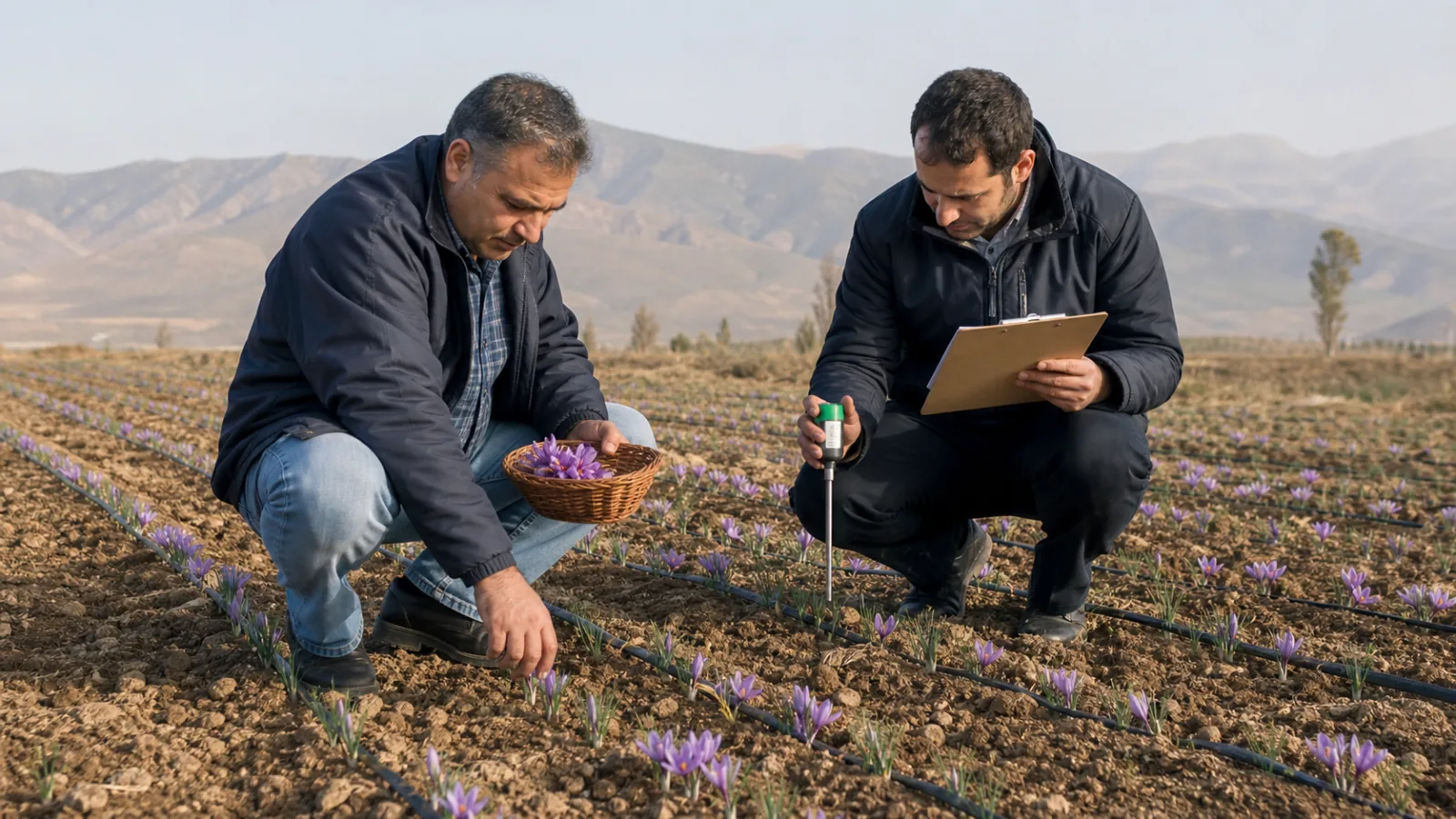
The cultivation of saffron in Iran is growing in the city of Alborz was a 2019 report about saffron expansion in Nazarabad County, within Alborz Province. It recorded 42 hectares across the province and more than 30 hectares in Nazarabad, while presenting saffron as a possible response to water pressure. Those are period figures and plans, not a current acreage statement or a guarantee that saffron is profitable on every local farm.
What the Alborz report actually said
The source quoted Iraj Almasi, identified as the director of Agricultural Jihad in Nazarabad. Automatic translation later rendered his surname as “Diamonds,” but both references concern the same official.
Almasi said 42 hectares in Alborz Province had gone under saffron cultivation that year. More than 30 hectares—over 70 percent of the stated provincial area—were in Nazarabad. He hoped the local area would more than double in later years.
The distinction between city, county and province matters. The headline uses “city of Alborz,” while the body describes Alborz Province and identifies Nazarabad as the concentration of cultivation. The URL and historic title remain unchanged, but the geography should not be blurred in the article itself.
Why farmers in Nazarabad considered saffron
The official connected saffron expansion to Iran’s water crisis and described the crop as having relatively low water requirements. Saffron’s seasonal pattern can make it attractive in dry regions, but “low-water” does not mean no irrigation. Establishment, autumn flowering and vegetative growth still depend on water arriving at useful times.
Almasi also emphasized that a planted field could be harvested for up to seven years, reducing the need to buy and plant corms every season. He linked the product’s value, storage potential and traditional medicinal reputation to local interest.
Those points need practical limits. A field can remain productive for several seasons, but daughter corms multiply and crowd the soil. Yield can change as the stand matures, while weeds, disease, nutrition and harvest labour affect cost. Historical or traditional health use also does not justify a claim that ordinary saffron treats a disease.
Water use must be measured locally
A crop-pattern decision should compare total water, timing, pumping energy and economic return with realistic alternatives. Rainfall, soil texture, drainage, irrigation method and water salinity can differ within Alborz Province.
Iranian field studies show why generic statements are insufficient. Research in a semi-arid environment found that lower irrigation levels could reduce flower and dry-stigma yield, particularly after the first season. Other work has shown that irrigation method changes yield and water-use efficiency. The result from another province is evidence to test a question, not a schedule for Nazarabad.
A useful farm record includes water applied at each irrigation, flower count, dry stigma yield, field age and corm density. That lets the grower see whether saffron is producing more value per unit of scarce water rather than merely using fewer irrigations.
Understanding a field that lasts up to seven years
The “seven years” in the original story describes a possible lifespan for a planted saffron stand. It is not the lifespan of one unchanged bulb. Saffron grows from a corm, and new daughter corms replace the planted mother corm.
Keeping a field in place spreads the original land-preparation and planting work across several harvests. At the same time, corm multiplication can create crowding, smaller replacement corms and uneven flowering. Farmers need annual records to decide when the cost of maintaining an old field outweighs the expense of lifting, sorting and replanting healthy material.
What “high quality” should mean
Almasi said saffron from Nazarabad had a distinctive aroma and that tests by the standards organization indicated high quality. The report does not identify the laboratory, sample dates, methods, lot count or numerical results, so that statement must remain attributed to the official.
A buyer needs evidence tied to the actual lot. ISO 3632-1:2025 specifies requirements for dried saffron in filament, cut-filament and powder forms. ISO 3632-2:2010 provides the related test methods. Contracts and destination markets may add limits for moisture, residues, microbiology, packaging or other characteristics.
Aroma is important, but sensory impression alone cannot establish purity, safety or origin. A credible quality claim names the product form, lot, sample, test method, result and date.
Harvest and storage determine the final product
Nazarabad growers can lose value after a successful field season if flowers are crushed, stigmas remain too long before separation or drying varies from one batch to the next. Clean containers, prompt handling and controlled drying are part of cultivation economics.
ISO 21983:2019 provides current guidelines for harvesting, transporting flowers, separating stigmas, drying and storing saffron before packing. Following a documented process makes it easier to investigate why two fields or two drying batches produced different results.
The financing figure cannot be treated as US dollars
The original translation said that in the Iranian year 1397, Nazarabad’s Agricultural Jihad management provided “more than 300 million USD” from a rural-development credit or employment fund to expand saffron cultivation. That currency is not credible in context, and the source gives no underlying Persian unit or loan document.
The safe record is that the official reported more than 300 million in financing units through a rural-development facility. It should not be converted into dollars, rials or tomans without the original notice. The existence, recipients, repayment terms and effect of the facilities also require programme records.
Profit depends on more than the crop price
Saffron has high value per unit of dry weight and can be stored more easily than many fresh crops. That does not create an automatic high margin. The farmer must account for corms, land preparation, irrigation, weed control, concentrated flower-picking labour, stigma separation, drying, testing, packaging and sales.
The comparison should use several yield and price cases. A projected retail price is not the farmgate return, and a mature field’s yield should not be assigned to a new planting. The buyer’s grade and product-form requirements need to be known before expansion.
How to judge saffron growth in Alborz
The 42-hectare figure and Nazarabad’s share provide a useful 2019 baseline. To show genuine progress, later reports should keep planted area separate from productive area, identify the crop year and publish dry yield, field age, water use and saleable quality. A doubled area is not necessarily an improvement if yields fall or buyers reject inconsistent lots.
Expansion is strongest when growers can obtain sound corms, test soil and water, schedule labour, dry flowers consistently and sell against a clear specification. That is the practical meaning of growing saffron cultivation in Alborz Province: not just more hectares, but more reliable value from each field and each measured unit of water.

![Exporting Saffron to Turkey + Price Guide [Complete 0 to 100]](https://img.rowhanisaffron.com/20260827003933/saffron-export-turkey-quality-inspection.webp)



