


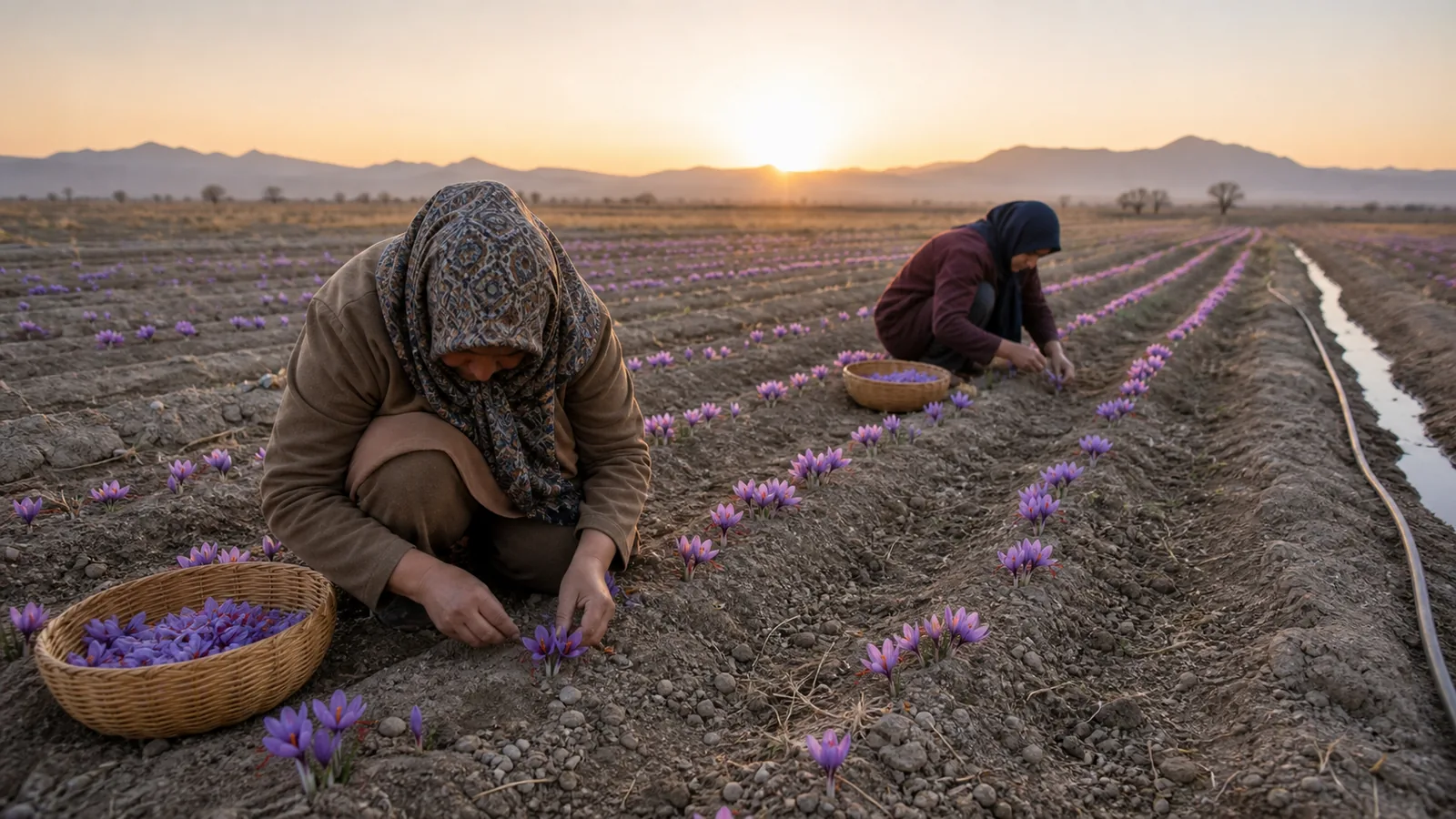
Rafsanjan saffron production grew from a reported 10 hectares to 35 hectares in two years. The local Agricultural Jihad director said the area had risen by nearly 20 percent in the most recent year covered by the report and could ultimately expand at least tenfold. Rafsanjan was therefore an emerging saffron district within Kerman province, not one of the province’s three largest centres at that time.
These are historical official figures, not current production statistics. They answer why Rafsanjan appears in searches about Iranian saffron: the county, better known for its pistachio economy, was deliberately testing saffron as a lower-water alternative crop and building a place within Kerman’s wider saffron programme.
Official figures for saffron cultivation in Rafsanjan
Hossein Rezaee, then director of Agricultural Jihad in Rafsanjan, said saffron area had increased from 10 to 35 hectares over two years. A rise from 10 to 35 hectares is a 250 percent increase across the full period, or 3.5 times the original area. His separate “nearly 20 percent” statement referred to the latest year within that two-year span, not the whole change.
The report said Rafsanjan had capacity to expand its saffron area at least tenfold. That was a development estimate rather than land already planted. If measured from the 35-hectare base, tenfold capacity would imply about 350 hectares, but the source did not provide a schedule, funded programme, or later result confirming that scale.
Is Rafsanjan known for saffron?
Rafsanjan is widely associated with pistachios, but the official report documents genuine saffron cultivation rather than a purely experimental pot or greenhouse project. Thirty-five hectares is modest beside Iran’s major saffron regions, yet it is enough to require organised planting material, irrigation, field management, harvest labour, and drying.
The best description is that Rafsanjan was an expanding secondary saffron area within Kerman province. It should not be presented as Iran’s main saffron capital, and the article does not claim that local output surpassed established centres such as Zarand or the major producing regions of Khorasan.
Why water use mattered in Rafsanjan
Rezaee placed saffron within a programme to increase alternative crops. The report gave annual water use as about 2,500 cubic metres per hectare. A province-wide account used a range of 2,500–3,000 cubic metres, which shows that the number was a planning estimate rather than a fixed requirement for every field.
Actual irrigation demand depends on rainfall, soil, field age, planting density, irrigation method, temperature, and farm management. Saffron’s seasonal cycle can make it attractive in dry areas, but describing it as a lower-water crop does not make any acreage increase automatically sustainable. Water allocation still has to match the aquifer, farm, and local climate.
The old English article also said saffron “will cost three dollars per cubic meter.” The source does not identify whether that amount meant water cost, crop value, or revenue generated per cubic metre, and no exchange-rate basis is supplied. It is therefore too ambiguous to use as an economic claim.
Harvesting creates intense seasonal work
The Rafsanjan report said 180–200 workers were used for every hectare when flowers were harvested. Read literally, that would imply thousands of people working simultaneously on 35 hectares. Agricultural reporting commonly expresses this kind of labour as worker-days or person-days across the picking and stigma-separation period.
The defensible point is that saffron creates concentrated seasonal employment. Flowers must be collected quickly during a short bloom, and the three stigmas in each flower are separated by hand before careful drying. The 180–200 figure should not be described as permanent jobs or a fixed headcount present in one field at one time.
Rafsanjan in the Kerman province saffron map
A province-wide report by Kerman horticulture director Lotfali Zadeh recorded saffron cultivation in 12 counties: Zarand, Kuhbanan, Baft, Shahr-e Babak, Bardsir, Sirjan, Rabor, Ravar, Bam, Kerman, Rafsanjan, and Anar. The older machine translation turned Baft into “Textile” and Anar into “Pomegranate”; both are place names here.
Zarand, Kuhbanan, and Baft ranked first, second, and third by planted area in that report. Rafsanjan was part of the provincial network but outside the top three. This distinction gives the page a clear regional purpose and avoids confusing it with a general article about all saffron production in Iran.
Province-wide area and production forecast
The Kerman source said the province had 822 hectares under saffron in the previous year and added 200 hectares in early Mehr, approximately late September to early October. That implies a reported total near 1,022 hectares after the increase.
Officials forecast 3,600 kilograms of saffron by the end of Aban, approximately late November. Dividing 3,600 kilograms by 1,022 hectares gives about 3.5 kilograms per hectare, but that is only an indicative calculation. Newly planted hectares may not have been bearing, and the report did not separate productive from young fields. It would therefore be misleading to present 3.5 kilograms as an official provincial yield.
Climate and field age affect the comparison
The provincial account described saffron as a perennial suited to areas with relatively mild autumns and winters and hot, dry summers. Kerman’s counties vary in altitude and temperature, so one cultivation calendar or yield should not be applied unchanged across the province.
Field age also matters. New saffron stands do not immediately perform like established fields, while older, crowded corm beds may eventually need lifting and replanting. A sound comparison between Rafsanjan and Zarand, Kuhbanan, or Baft would need bearing area, field age, dried output, corm density, and the same crop year—not acreage alone.
What the Rafsanjan record establishes
- Local saffron area rose from 10 to 35 hectares over two years.
- The latest year within that period was reported as nearly 20 percent higher.
- Officials saw theoretical capacity for at least a tenfold expansion, but did not report that expansion as completed.
- Planning estimates put annual water demand near 2,500 cubic metres per hectare locally and 2,500–3,000 province-wide.
- Harvest required substantial seasonal labour, but the quoted 180–200 figure should be understood as labour input rather than permanent workers per hectare.
- Rafsanjan was one of 12 Kerman counties growing saffron, while Zarand, Kuhbanan, and Baft held the three largest areas in the provincial report.
A focused source for Rafsanjan saffron production
This page is specifically about Rafsanjan’s official area-growth report and its place within Kerman. It is not a general guide to growing saffron, a current price page, or a claim that Rafsanjan is Iran’s largest producer.
The durable finding is straightforward: Rafsanjan moved from 10 to 35 hectares as part of an alternative-crop strategy, while the broader province expanded beyond 1,000 reported hectares and forecast 3.6 tonnes. Any current assessment should use a newer Agricultural Jihad or statistical source, because the figures preserved here describe the years of the original reports.

![Exporting Saffron to Turkey + Price Guide [Complete 0 to 100]](https://img.rowhanisaffron.com/20260827003933/saffron-export-turkey-quality-inspection.webp)



