


Projection of production of 400 kg of saffron in Kermanshah Iran was a 2019 forecast based on a young provincial crop: 211 hectares had been planted, but roughly half of that area was new and not yet producing. The estimate works as a period planning figure, not a current output total and not evidence that every planted hectare yielded saffron that season.
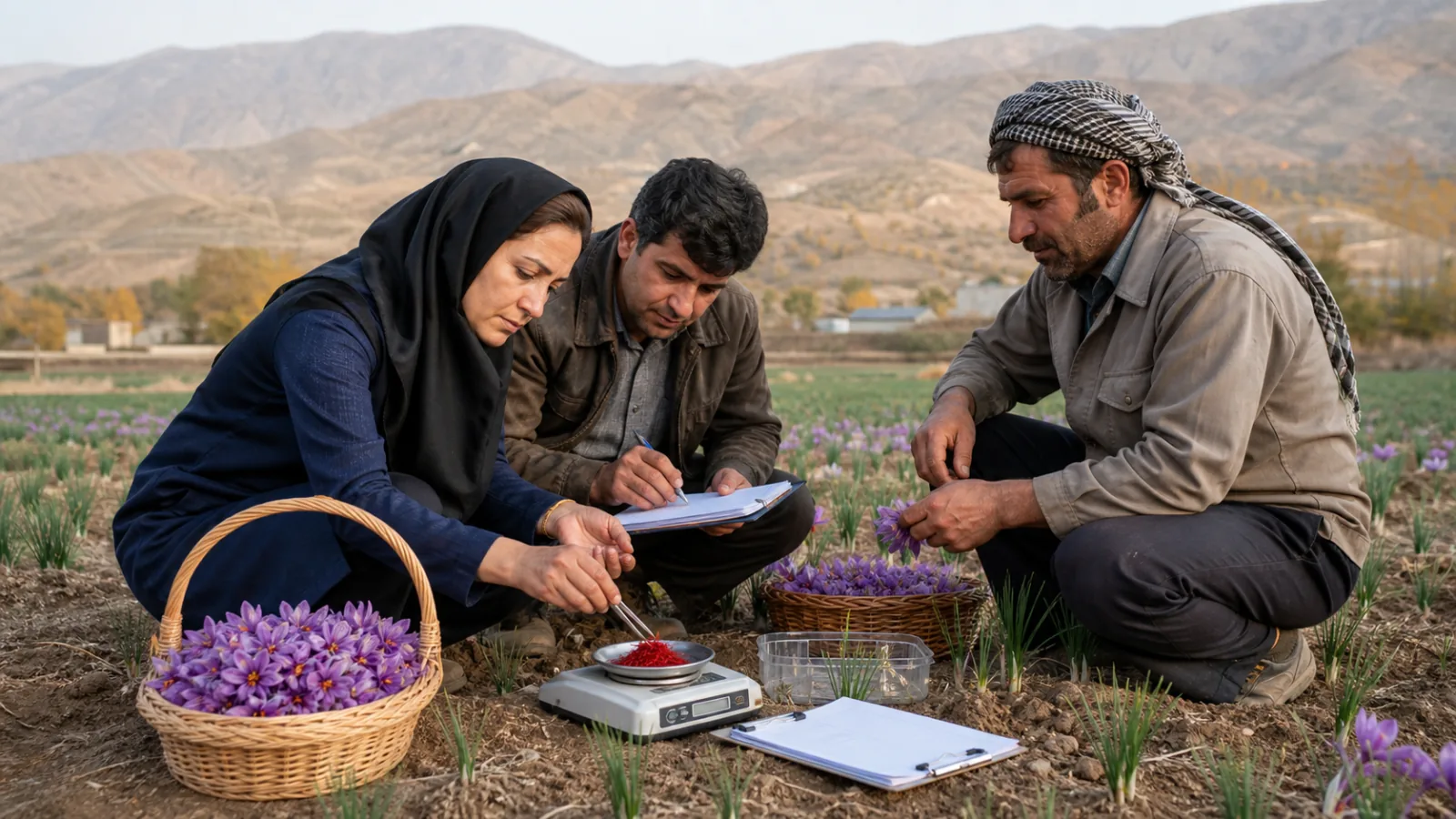
The figures behind Kermanshah’s 400 kg forecast
The original report quoted Khosrow Shahbazi, then head of Agricultural Jihad in Kermanshah Province. He said organized saffron cultivation in the province had been developing since 2011.
According to Shahbazi, 105 hectares had been planted by the previous year and another 106 hectares were added in the current year, bringing the stated total to 211 hectares. He reported an average dry-saffron harvest of 4 kilograms per hectare and forecast provincial production of 400 kilograms.
He also explained why the simple calculation of 211 hectares multiplied by 4 kg/ha would be wrong: the new fields had not yet entered production. A 400-kilogram forecast at a 4 kg/ha average implies about 100 productive hectares, close to the older 105-hectare area. That internal consistency does not prove the final harvest, but it clarifies what the forecast was measuring.
Planted area is not productive area
Saffron is a perennial crop grown from corms. A new field may produce some flowers, yet its performance normally differs from a mature stand. Daughter corms multiply underground, planting density changes and yields can rise or fall as the field ages.
A provincial production report should therefore separate:
- total area containing saffron corms;
- new area planted during the crop year;
- area actually harvested;
- field age or establishment class;
- fresh flowers and dry stigma weight; and
- forecast, revised estimate and final measured output.
Without those labels, rapid expansion can make average yield look artificially low, or a production forecast can be mistaken for a completed harvest.
What the 4 kg/ha average means
Four kilograms of dry saffron per hectare was Shahbazi’s stated provincial average at the time. It should remain attached to the reporting period and measurement method. Field age, corm size, planting density, climate, water, weeds, disease, picking labour and drying all affect the result.
Dry weight also needs a defined product. Whole red stigmas, mixed stigma and style, and material at different moisture levels are not directly comparable. A provincial average is useful for planning only when each contributing report uses the same denominator and product definition.
Our saffron production statistics guide keeps the period, area type and dry-product definition visible rather than combining unlike numbers.
The claim of up to 30 kg per hectare
Shahbazi said Kermanshah’s conditions created potential for saffron yield as high as 30 kilograms per hectare. That is far above the 4 kg/ha average cited in the same report. No trial design, farm record, field age, plot size or laboratory measurement was supplied for the higher number.
“Potential” should not be presented as a normal commercial expectation. A very high result from a small, intensively managed plot cannot automatically be scaled to a province. Before using 30 kg/ha in an investment plan, a reader would need replicated local evidence, a clear harvest denominator and the dry-saffron specification.
The gap between 4 and 30 kg/ha is itself useful. It shows why development programmes should focus on measured constraints and repeatable improvements instead of multiplying planted area by a best-case yield.
Does Kermanshah have suitable saffron conditions?
The official described provincial conditions as appropriate for saffron. Within Kermanshah, however, elevation, winter cold, soil drainage, rainfall and irrigation access vary. Suitability has to be assessed at field level.
A trial should record corm origin and size, soil texture and salinity, planting date and density, irrigation, flower count, dry stigma yield and daughter-corm performance. Several seasons are more informative than the first flowering because saffron fields change as they mature.
Published Iranian research has shown that climate and management both influence saffron yield across environments. That supports local testing; it does not provide a universal Kermanshah recipe.
Comparing Kermanshah and Khorasan quality
Shahbazi said saffron produced in Kermanshah was equal in quality to saffron from the Khorasan provinces. The article provides no sample count, laboratory, test results or product-form comparison, so the claim remains an attributed assessment.
Origin alone does not determine the grade of an individual lot. Harvest timing, stigma separation, drying, storage and sampling can create substantial variation within one region. A fair comparison uses representative lots processed and tested under comparable conditions.
The current ISO 3632-1:2025 saffron specification covers dried saffron in filament, cut-filament and powder forms. A commercial buyer may add requirements for moisture, residues, microbiology, packaging or traceability. “Equal to Khorasan” is not a specification by itself.
Why post-harvest handling matters to a young region
New growers can produce good flowers and still lose value if blooms wait too long before separation or if drying is uneven. Shared training and processing capacity may help where individual farms have small volumes.
ISO 21983:2019 gives current guidelines for harvesting, flower transport, stigma separation, drying and storage before packing. Lot records should connect the field and harvest date to the drying batch and final package.
Those records become especially important when a regional quality reputation is still forming. One weak mixed lot can obscure good work by several farms.
The two packaging workshops
The report said two saffron packaging workshops were operating in Kozaran and Niloufar Sarab. English spellings vary for these localities, and the source gives no workshop names, licences, capacities or current operating status.
Packaging close to production can retain more local value if the facility controls hygiene, net weight, moisture protection, lot identity and accurate labelling. A workshop does not improve saffron automatically; it must keep good lots separate and match the destination market’s requirements.
How to assess later growth
Shahbazi expected provincial saffron production to increase significantly as development plans continued. Later performance should be compared with this 2019 baseline using final harvest data, not a new forecast.
The most useful report would show older and new area separately, dry output by field age, median as well as average yield, water use, tested quality and the volume packed locally. It would also identify whether growers had confirmed buyers before new fields were established.
Kermanshah’s 400-kilogram projection was therefore more than a headline number. Read carefully, it documented a transition: about 105 older hectares, 106 new hectares, an average benchmark of 4 kg/ha and a province trying to build packaging capacity. Preserving those distinctions is the only way to judge whether the expansion later delivered durable value.

![Exporting Saffron to Turkey + Price Guide [Complete 0 to 100]](https://img.rowhanisaffron.com/20260827003933/saffron-export-turkey-quality-inspection.webp)



