


The saffron harvest in Bahabad, Yazd, was the setting for the city’s first provincial Red Gold Festival, created to introduce visitors and buyers to a growing local crop.
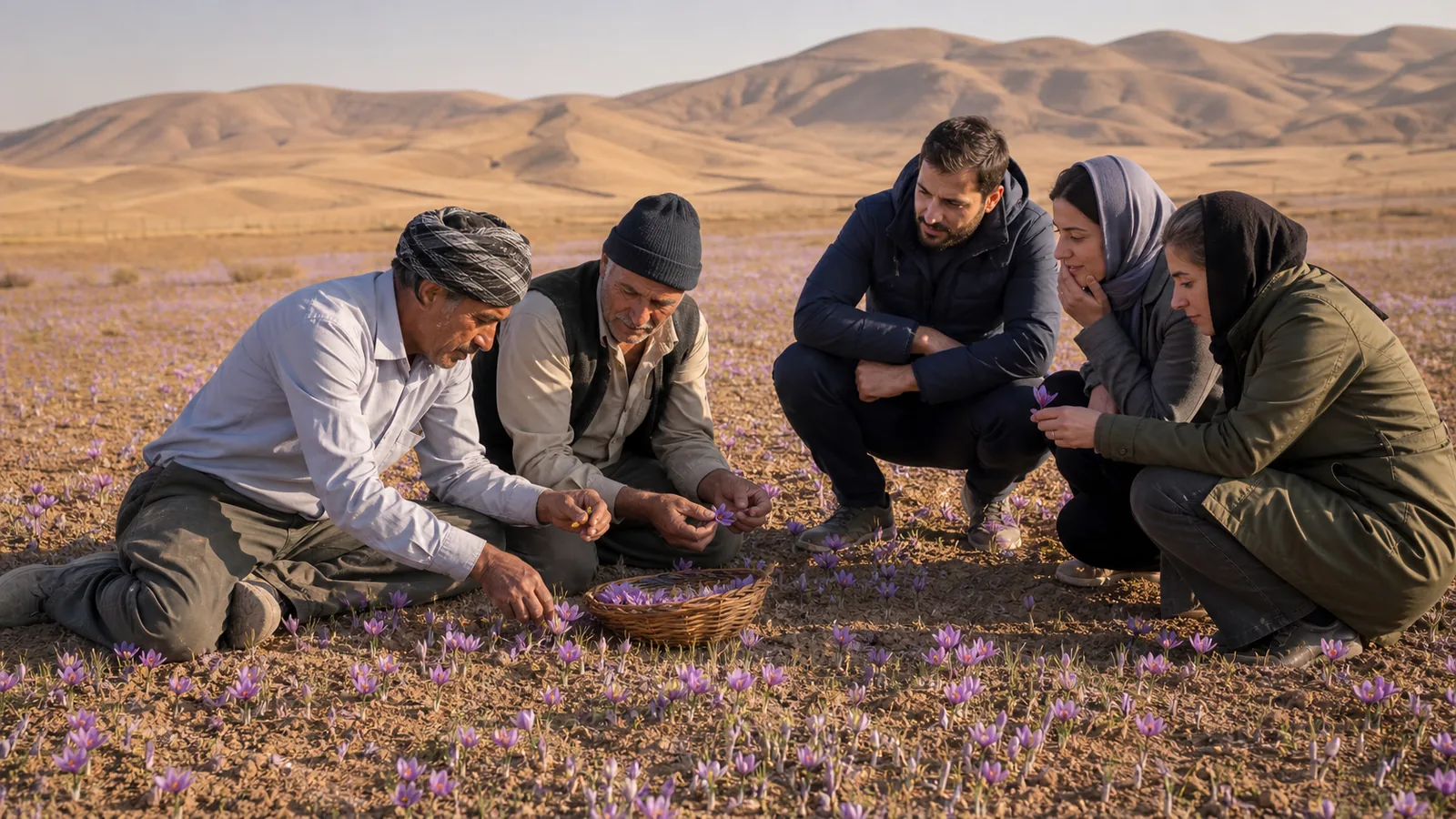
This is a historical event account, not an announcement for the coming season. The archived notice names Thursday, November 11, but does not supply a year. Its useful record is what the festival intended to show: saffron fields, hand harvesting, local products and the opportunities and limits of cultivation in an arid province.
Why Bahabad held a red gold festival
Ali Akbar Rahmatian, then director of Agricultural Jihad in Bahabad, announced the first provincial saffron festival as the harvest began on farms around the city.
He said the event was designed to familiarize the public with Bahabad’s agricultural capacity, especially its ability to produce saffron of suitable quality. It was also intended to encourage a crop he described as profitable and relatively low in water demand.
The festival was organized with the Agricultural Jihad Organization of Yazd Province and the Governor of Bahabad. Farmers and provincial executive officials were invited to the meeting hall of Allameh Mullah Abdullah on Thursday, November 11.
What the 270-hectare figure meant
Rahmatian reported 270 hectares of saffron cultivation in Bahabad and described the city as the centre of saffron production in Yazd Province. That figure belongs to the period of the festival announcement and should not be presented as the current planted area.
A later IANA report on saffron cultivation in Yazd, published in 2020, recorded 400 hectares in Bahabad. The same source reported 835 hectares across Yazd Province and 2.5 tonnes of dried saffron in the preceding year. The later numbers show expansion; they do not change what the original 270-hectare festival report said.
How the Bahabad saffron harvest works
Saffron flowers close to the ground and the harvest window is short. Pickers collect the blossoms by hand, usually early in the day, before separating the red stigmas from the remaining flower. Drying has to follow with close control because excess moisture or rough handling can reduce quality.
A harvest visit therefore involves more than looking at a purple field. It can show the labor behind a small weight of finished spice, the speed required during flowering and the difference between a fresh blossom and properly dried threads.
Anyone entering a working field needs the grower’s permission. Visitors should keep to the route provided, avoid stepping between the rows without guidance and remember that the baskets and flowers are part of a farmer’s income.
Harvest tours and farm visits
The side program announced for the festival included special saffron-harvest tours and visits to local farms. Those activities connected the meeting-hall program with the place where red gold is actually produced.
For farmers, a well-managed visit can introduce customers to the difference between growing, picking, separating and drying. For visitors, it replaces the idea of saffron as an anonymous expensive powder with a clear view of the crop and the work required to prepare it.
The archived article does not record the number of tours, their routes or attendance. It also does not establish a current annual schedule. Anyone planning a visit now should confirm harvest timing and access with local organizers rather than relying on the old November 11 notice.
Saffron products, jam and packaging
An exhibition of saffron products was another part of the program. The announcement specifically mentioned jam-making and packaging industries, presenting the harvest as the beginning of a value chain rather than its end.
A jar of jam, a food-service pack and a small container of threads serve different buyers. Each needs appropriate hygiene, ingredients, labeling, shelf-life control and a realistic market. Packaging can protect the spice and preserve Bahabad’s identity, but decoration alone does not make a product valuable.
Rahmatian called for broad participation in introducing Bahabad’s saffron to domestic and foreign customers. The useful route to that goal is consistent quality supported by clear origin, careful post-harvest handling and packaging suited to the destination.
Why saffron suits a water-constrained province
Saffron is often promoted as a low-water crop, especially when compared with more water-intensive alternatives. That description is relative. The corms still need suitable soil, drainage and irrigation at the right points in the growth cycle.
The 2020 IANA report placed Yazd’s saffron expansion in the context of two decades of drought and policies encouraging less water-demanding crops. It also noted that a saffron field is a multi-year commitment: corm density, field age and local management influence yield over time.
Profitability is equally specific to the farm. Establishment material, labor, water, yield, quality and the selling route all affect the result. A festival can introduce an opportunity; it cannot replace a farm budget and local agronomic advice.
What the festival preserved about Bahabad
The first Red Gold Festival joined three parts of Bahabad’s saffron story: the beginning of harvest, public access to farms and the effort to sell more than an unnamed bulk crop. Its 270-hectare figure captured an early stage that later official reporting showed had grown.
The strongest reason to keep this account is not to advertise an expired Thursday event. It records how a Yazd farming community used the saffron harvest, field tours and local products to explain its red gold to farmers, officials and potential customers.

![Exporting Saffron to Turkey + Price Guide [Complete 0 to 100]](https://img.rowhanisaffron.com/20260827003933/saffron-export-turkey-quality-inspection.webp)



