


The “red gold” in this Iranian desert harvest is madder, known locally as ronas—not saffron and not rhubarb. Madder is a perennial dye crop whose roots contain red-producing pigments, including alizarin. The archived report follows its harvest in Yazd province and explains why Ardakan and Bafgh became closely associated with it.
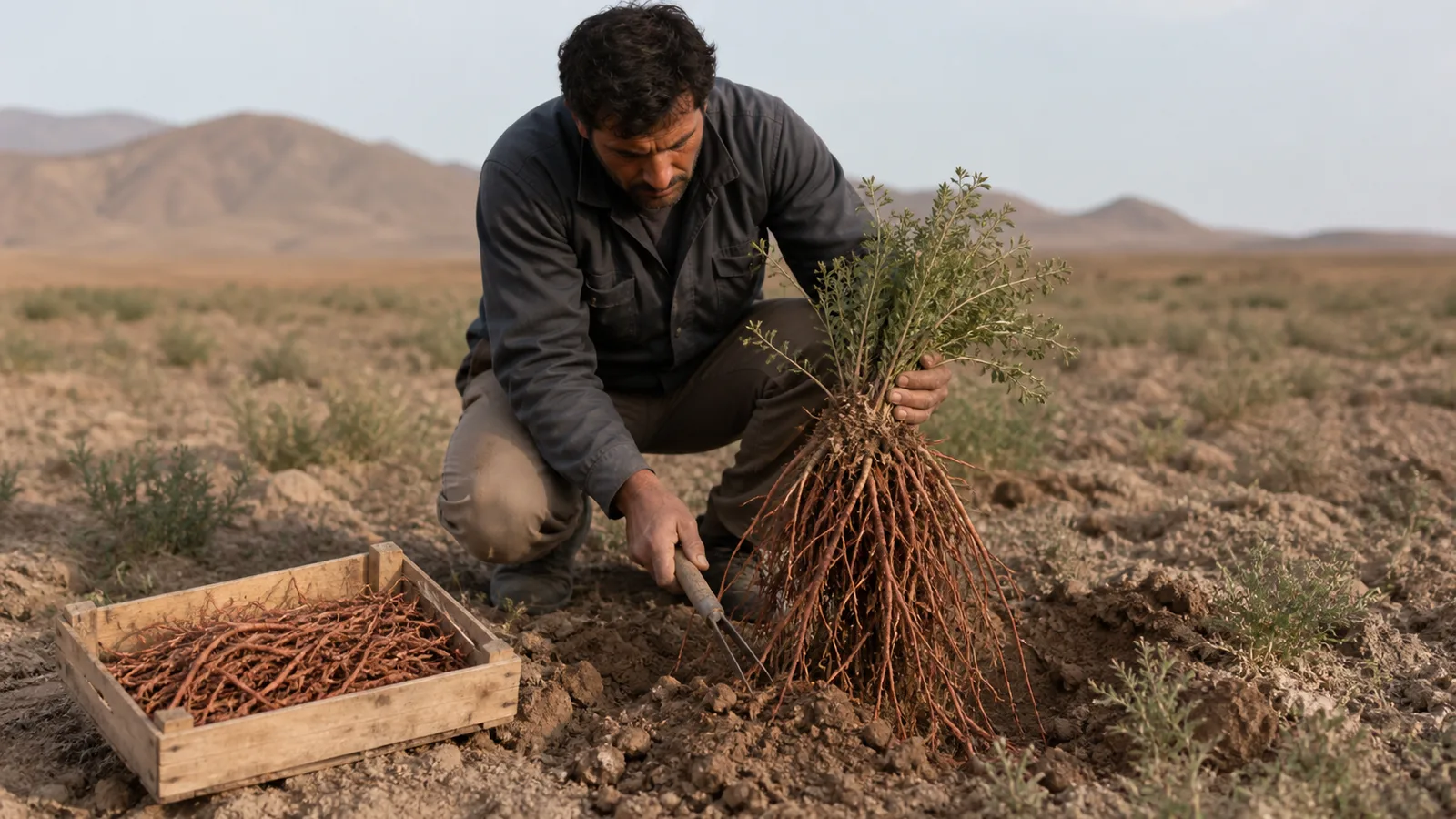
Calling more than one crop “red gold” creates understandable confusion. Saffron earns the nickname from its high-value red stigmas; in the desert communities described here, people also applied it to ronas because a salt-tolerant root crop could provide useful income and a durable red dye.
What is ronas, or common madder?
Common or dyer’s madder is Rubia tinctorum, a perennial in the Rubiaceae family. It grows above ground each season, while the dye-bearing root system develops below. “Rhubarb” appeared repeatedly in the former English version because of a translation error; rhubarb belongs to a different botanical family and is not the crop described by the places, uses or pigment in the report.
The FAO’s reference on natural colourants identifies the roots of Rubia tinctorum as a source of red textile dye. Its major pigments include alizarin and purpurin. Their shade changes with the mordant and process, which is one reason madder could produce reds, pinks, oranges, lilacs and browns rather than one fixed colour.
The Yazd production figures—and an unresolved mismatch
Farjam Fazel, identified in the archived account as an agriculture director in Yazd’s Agricultural Jihad Organization, said the province ranked first in Iran for this industrial crop. The report gives three figures: 423 hectares under cultivation, an annual harvest of 2,474 tonnes and a yield of 11,078 kilograms per hectare.
Those numbers cannot all describe the same harvested area and crop year. Multiplying 423 hectares by 11,078 kg per hectare gives about 4,686 tonnes, not 2,474. The source may have combined planted area with the smaller area mature enough to harvest, or figures from different years, but it does not say. We retain the reported numbers as a historical record without inventing a reconciliation.
They should not be treated as current production statistics. The article was published in 2021, and the underlying figures were already historical. A present-day market or farm plan needs a dated agricultural dataset.
Planting and harvesting a crop grown for its roots
Fazel’s schedule distinguished between starting madder from seed and establishing it from roots. The earlier translation placed seed sowing from mid-March to late April and root planting from November to March. In the Persian agricultural calendar, the reported seed window is more accurately understood as approximately late February through late April. Exact timing still depends on local weather, soil and irrigation.
Harvest was reported from roughly late August or September into early November, in the third or fourth year after planting. Workers lift the mature roots with special shovels. That long wait explains an important economic constraint: land and labour are committed well before the dye material is ready to sell.
Care during lifting matters. Broken roots may still contain pigment, but soil removal, drying and storage affect the material that a processor receives. The purpose is not to preserve a fresh vegetable; it is to prepare a stable dye-bearing root for a controlled industrial or craft process.
Why madder suited the Yazd desert
The report says ronas became known as desert “red gold” because it adapted to saline water and soil and offered favourable economic returns around Ardakan. Research from Yazd has likewise examined madder planting methods under saline conditions, confirming that salt management, root yield and water-use efficiency are real agronomic concerns for the crop.
Adaptation does not mean the plant grows without management or has guaranteed profitability. A multi-year root crop still faces irrigation cost, labour, market demand and the opportunity cost of keeping a field occupied. The original argument was that more attention to the industrial plant could support jobs and economic activity, not that every planting would be profitable.
Madder in carpets, textiles and natural colour
The strongest documented use is dyeing. Ground madder root has a long history in wool, fluff, carpet yarn and other textiles. The archived account also describes it in preparing carpet lacquer and in modifying or stabilising colours made from straw, pomegranate skin and walnut skin. In practice, the final shade and fastness depend on fibre, extraction, water chemistry and mordant.
The report additionally mentions food, pharmaceutical and cosmetic industries, colouring smoked fish, and painting walls in homes or workshops. Those are attributed historical or industrial-use statements, not instructions for household use. A raw root or homemade extract should not be assumed food-safe or skin-safe simply because madder is natural. Processors need the identity, composition, contaminants and regulatory status of the exact extract they intend to use.
Alizarin’s colour also explains madder’s decline and renewed niche interest. The FAO notes that synthetic alizarin displaced much natural madder after the nineteenth century. Natural dyes remain relevant to heritage textiles and some contemporary craft markets, but must compete on consistency, safety, price and colour performance.
Who bought Yazd madder?
Fazel said buyers of processed or ground madder in Yazd were mainly traders from Isfahan and Kashan, as well as Urmia, Kerman, Yazd and Shiraz. The archived report also named exports to more than ten countries and listed Germany, Italy, England, Turkey, India, Qatar, France and Pakistan.
The sentence preserves the markets named at the time; it does not provide a customs year, tonnage or value, and the eight listed countries do not by themselves substantiate “more than ten.” Current export activity should therefore be checked against dated customs records before the claim is reused commercially.
Ardakan and Bafgh as the remaining production centres
The report said Iranian madder cultivation had become almost entirely concentrated in Ardakan and Bafgh. It linked that continuity to the root pigment and to the long-standing demand of textile and handmade-industry owners for natural red dyes.
That concentration gives the crop cultural importance as well as economic risk. When knowledge, processing and buyers are clustered in only a few places, changes in labour cost or demand can weaken the entire chain. Preserving madder is therefore not just a matter of planting it; growers need practical harvesting technology, processors, quality specifications and buyers willing to pay for natural colour.
The real beginning of this red-gold harvest
This Yazd harvest begins with mature madder roots being lifted after three or four years in desert soil. It is a story about ronas, alizarin and natural dye—not a saffron harvest. Making that distinction restores the value of the report: a lesser-known Iranian crop, adapted to difficult conditions, connecting farms in Ardakan and Bafgh with carpet workshops and dye markets far beyond the province.

![Exporting Saffron to Turkey + Price Guide [Complete 0 to 100]](https://img.rowhanisaffron.com/20260827003933/saffron-export-turkey-quality-inspection.webp)



