


The report of red-gold cultivation across 57000 hectares of Khorasan Razavi farms is a historical snapshot of Iran’s saffron heartland, not a current acreage estimate.
The underlying news item was published in October 2012. It recorded a provincial program for saffron farms, corm quality, irrigation and processing alongside production, labor and export-value figures. Keeping that date visible is essential because the cultivated area and harvest changed in later seasons.
What the 57000 hectares represented
Engineer Ghodsi, then director of horticulture at the Khorasan Razavi Agricultural Jihad Organization, said that approximately 196 tonnes of saffron had been harvested from 57,000 hectares in the province. He described that volume as 76% of Iran’s total saffron production.
The original IANA report dates those figures to 23 Mehr 1391 in the Iranian calendar. They describe the crop at that point in time; they should not be copied into a present-day production profile without a new survey.
A provincial program for saffron production
Dr. Tabatabai, identified as head of the Khorasan Razavi Agricultural Jihad Organization, framed saffron as a strategic export crop capable of strengthening growers’ financial position. Against that background, he said the organization had allocated 10% of its asset-acquisition credits to a comprehensive saffron program.
The program described in the report covered several connected needs:
- developing and promoting model, or “ideal,” saffron farms;
- supporting farms that multiplied selected saffron corms;
- improving growers’ knowledge of mechanization;
- establishing terminals for corm distribution and sale;
- improving irrigation methods in saffron fields; and
- standardizing corm production.
These were not separate publicity projects. Corm condition influences establishment, irrigation affects flowering and plant health, and post-harvest handling determines how much quality remains after the crop leaves the field.
Why saffron corm movement was controlled
Tabatabai also described saffron corms as a valuable genetic reserve. He said the agricultural authority was working with law enforcement and the provincial anti-smuggling headquarters to prevent unauthorized transfers out of Khorasan Razavi and exports to neighboring countries.
Movement within the province was to follow the organization’s instructions. The policy statement should be read in its historical setting; it is not a current legal notice. Growers moving or buying planting material today need the rules now in force, together with reliable information on corm origin, size, health and disease risk.
Rain, frost and the production forecast
Ghodsi expected production to grow if newer research methods were applied and the favorable rainfall of the preceding year was not followed by early autumn frost or untimely rain. He linked the prospect of better grower income to both production and exporters’ support.
That was a conditional forecast, not the final harvest result. Saffron responds to the whole production cycle: corm quality, soil and drainage, irrigation timing, temperature around emergence, labor at flowering and drying after harvest. Favorable rain can help while poorly timed rain during flowering can complicate picking and drying.
What 220 worker-days per hectare meant
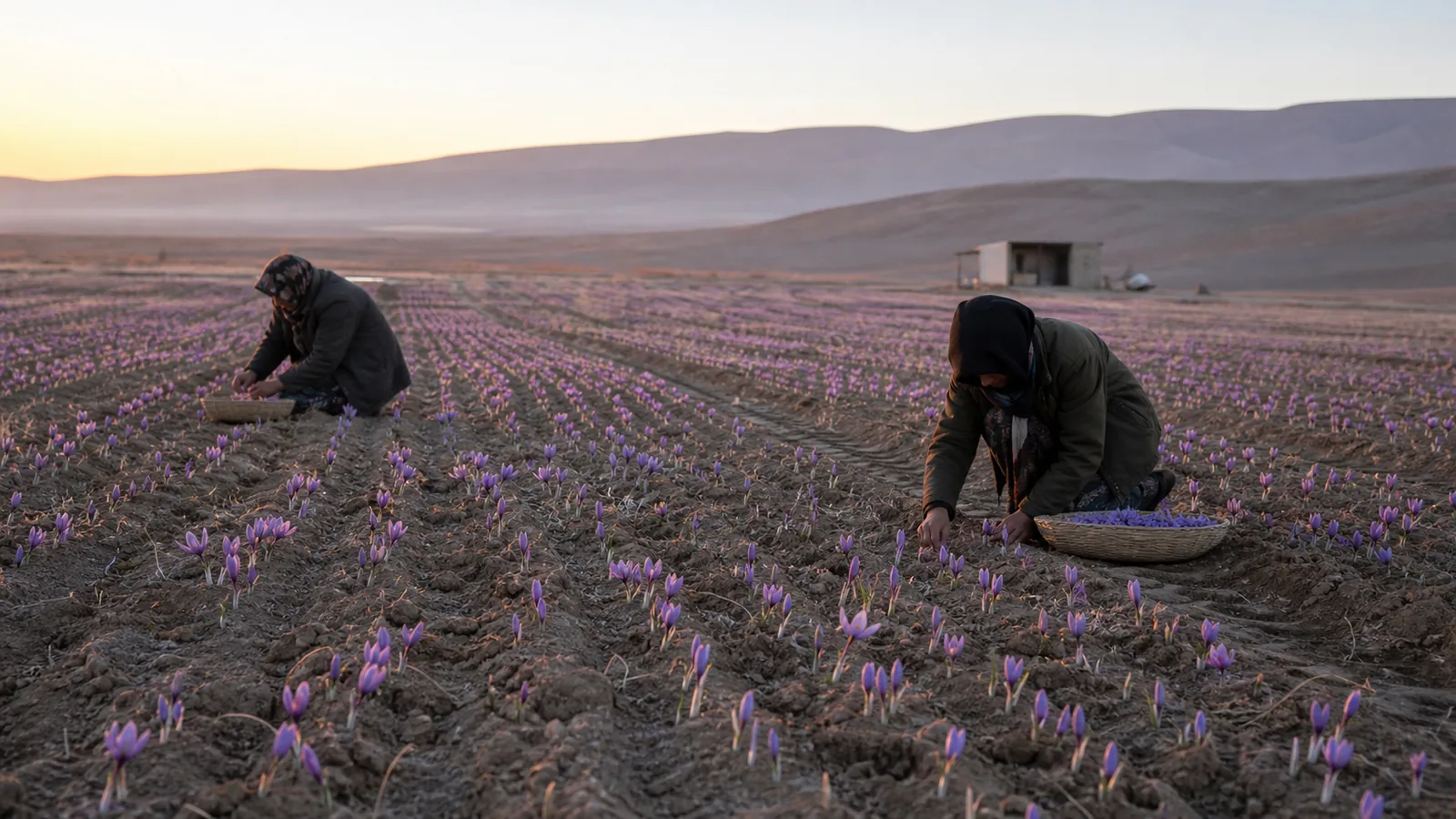
The report assigned 220 person-days of labor to each hectare of saffron. Across 57,000 hectares, that implies about 12.54 million worker-days. It then expressed the total as the equivalent of 62,700 permanent jobs in deprived parts of the province.
Those two measures should not be confused. Worker-days describe the amount of labor required, much of it concentrated around planting, field care, flower picking and stigma separation. A permanent-job equivalent converts that seasonal workload into a full-year measure; it does not mean that every hectare supports 220 people continuously.
The employment point remains central to saffron’s importance. Current FAO work describes cultivation as deeply rooted in Khorasan Razavi and South Khorasan and says it supports the livelihoods of hundreds of thousands of smallholders. FAO’s recent saffron value-chain program focuses on production practice, post-harvest handling, safety, traceability and modern marketing.
Comparing saffron with other provincial crops
For the 1390–91 crop year, Ghodsi said saffron generated 1.1 times the value of wheat in Khorasan Razavi, 5.7 times the value of sugar beet, 4.8 times cotton and 15.8 times alfalfa. The report also put the foreign-exchange value of red gold in 1390 at $409 million.
These are historical value comparisons, not yield comparisons. They depend on the area, volume and prices used in that year’s provincial calculations. The dollar figure likewise belongs to the stated Iranian year and should not be presented as a current export total.
The intended argument was that a high-value crop could use limited inputs productively while directing added value toward saffron growers and exporters. Whether that value reaches farmers depends on quality, bargaining conditions, processing, market access and the costs between field and buyer.
Results reported from the model farms
A saffron and medicinal-plants specialist quoted in the archived report discussed the research behind the “ideal farm” program. The work included a strategic plan, a national improvement and processing plan, several research projects, selected corms weighing more than eight grams and efforts to standardize planting material.
According to the reported comparisons, first-year yield on the model farms was 3.3 times that of traditional farms. Observations in the second and third years gave ratios of 2.8 and 2.3 respectively. The stated average for the first three years was 6.1 kilograms per hectare.
Those ratios are promising, but the article does not provide sample size, field locations, a control protocol or statistical uncertainty. They should be treated as program results reported by the organization, not as a guaranteed yield for every grower. Soil, corm density and health, irrigation, temperature, farm age and harvest practice can all change the outcome.
How to read this red-gold record today
The 57,000-hectare figure captures a stage in the expansion of Khorasan Razavi’s saffron economy. Its real value is not a timeless headline number. It is the connected picture behind it: public investment, corm quality, irrigation, research, seasonal labor, weather risk, processing and export income.
For current acreage or production, use a dated official agricultural release and keep the year attached to every figure. For farm decisions, local soil, water, corm-health and market evidence matter more than a provincial average from another season.

![Exporting Saffron to Turkey + Price Guide [Complete 0 to 100]](https://img.rowhanisaffron.com/20260827003933/saffron-export-turkey-quality-inspection.webp)



