


Ghainat, more commonly written as Qaenat, is a saffron-growing region of South Khorasan where Iran’s “red gold” belongs to both the landscape and everyday life.
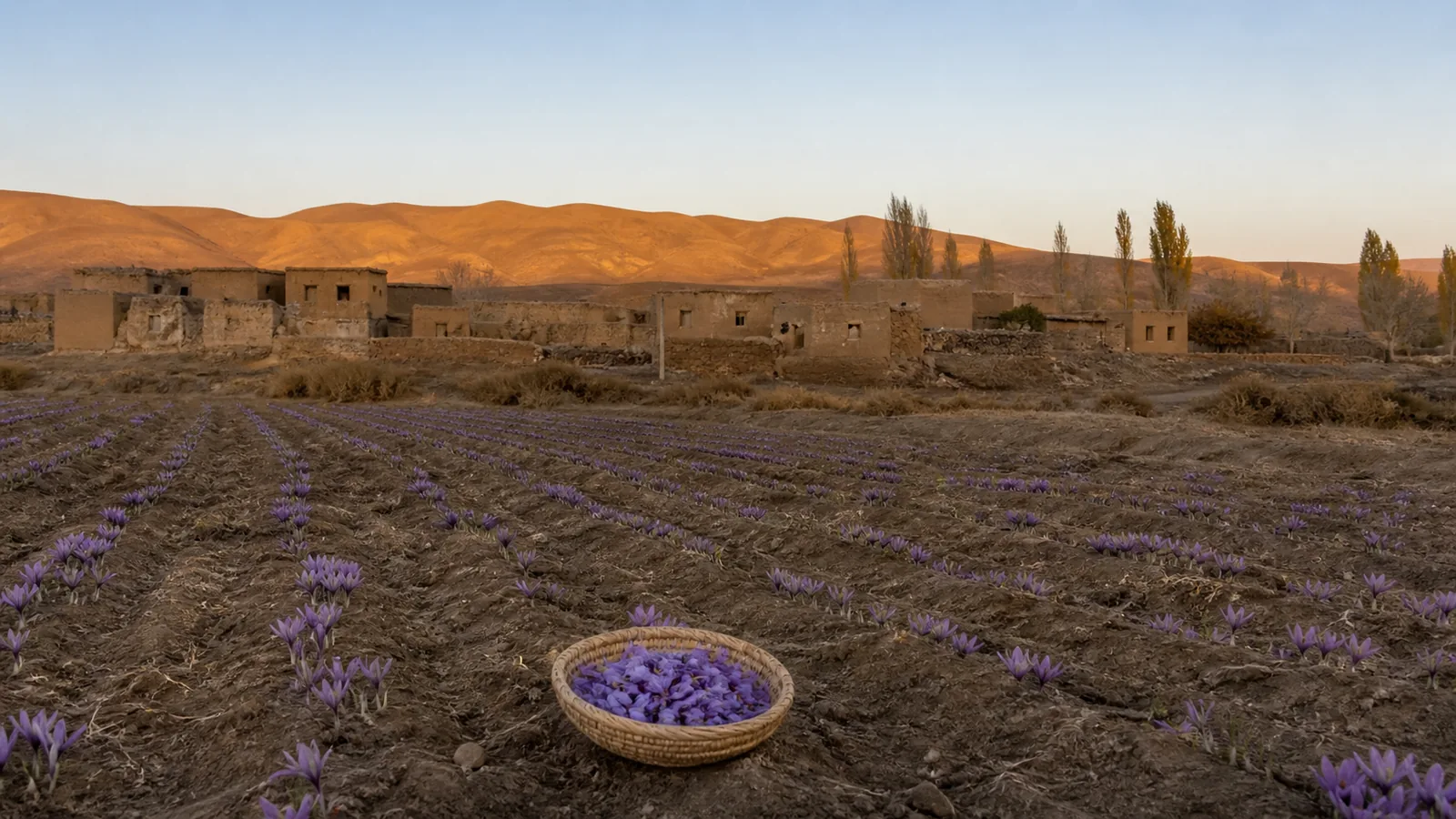
The spelling can be confusing. English sources use Ghainat, Ghaenat, Qaenat and Qayen, while Qaen is the principal city. They point to the same part of eastern Iran: a high, dry country of villages, plains and hills where saffron has long been an important crop. The Iranian tourism authority describes Qayen as Iran’s saffron capital and identifies saffron as one of its main souvenirs.
Where Ghainat sits in eastern Iran
Qaenat lies in the north of South Khorasan Province. Khaf and Gonabad are to the north, Ferdows and Sarayan to the west, and Birjand and Darmian to the south. Its eastern side reaches Iran’s border with Afghanistan. Qaen itself is roughly 100 kilometres from Birjand.
Cold winters, dry ground and the surrounding Ghohestan hills give this place a character quite unlike Iran’s greener regions. The district is not one single “red gold village.” Saffron fields are distributed across the city’s rural surroundings, so a journey may pass through working villages before reaching the crop itself. In autumn, purple flowers spread low across the soil and the red stigmas are separated by hand after picking.
The harvest is one reason November is a particularly meaningful time to visit. Spring is generally more comfortable for sightseeing, but the autumn flowering season shows why saffron and Qaen have become so closely associated. Field access should always be arranged respectfully; these are farms and livelihoods, not display gardens.
Why saffron fits this landscape
Saffron uses relatively little water compared with many crops, but that does not mean it grows without water or skilled care. Irrigation has to reach the corms at the right stage, flowers must be collected promptly, and the delicate stigmas need careful drying.
Across this wider part of Khorasan, underground qanats have helped communities move groundwater to settlements and fields. The connection is documented especially clearly in neighboring Gonabad, whose qanat-based saffron farming system is recognized by the FAO. That designation belongs to Gonabad rather than Qaenat, but it provides useful context for understanding why ancient water structures and saffron cultivation appear together in the region.
Qaen’s historic centre
Saffron may bring many visitors to Ghainat, yet the city’s built heritage tells a much longer story. Visit Iran names the Jame Mosque, the Tomb of Bozorgmehr Qaini, Kuh Castle and the historic houses among Qaen’s principal attractions.
Qaen Jame Mosque
The Jame Mosque stands in the centre of the city and is the best-known religious building in Qaen. Its surviving fabric reflects more than one building phase. The earlier heritage account describes a two-iwan arrangement, a tall western iwan, side prayer halls, domed spaces and an inscribed stone dated 796 AH. It also records evidence of Seljuk-period architecture beneath later work.
Those layers matter more than assigning the whole mosque to a single date. Repair, rebuilding and continued worship can leave several periods visible in one structure. The same account gives the mosque’s national registration number as 295.
The Tomb of Bozorgmehr Qaini
On the slopes of the Ghohestan range stands the tomb associated with Bozorgmehr Qaini, remembered as a mystic, political figure and poet. The official attraction record for the Tomb of Bozorgmehr places it above Qaen and describes a cross-shaped structure from the sixth and seventh centuries AH, built with stone, plaster, brick and waterproof mortar.
A large dome, four iwans, pointed vaults, muqarnas and plasterwork give the building its distinctive form. The precise identity of the person buried there is not settled in the official account, so the monument is best understood through its architecture and its place in local memory rather than a definitive biographical claim.
Ghaen Mountain Fortress, or Kuh Castle
About three kilometres south of Qaen, the mountain fortress occupies a difficult height above the plain. The stored local record describes a long stone-and-mortar complex divided between defensive and administrative areas, with later Seljuk and Ismaili associations built over older remains. Its position explains its function: the western and northern sides command broad views, while the mountain protects the other approaches.
The remains are extensive rather than a complete standing castle. Visitors should treat it as an archaeological mountain site, check current access conditions and avoid attempting steep sections without suitable footwear or local guidance.
Water, houses and museums
Ghaen Bazaar reservoir and Water Museum
The old bazaar reservoir, in the lane historically associated with Qaen’s market, was adapted as the city’s Water Museum. The earlier account records a stair of 27 steps leading down to a cylindrical tank about seven metres deep and seven metres across, with an estimated capacity of 300 cubic metres.
Displays were created around qanat digging, water storage, lighting underground channels and distributing water. Together with images of reservoirs, dams, mills and other waterworks, they show how an ancient water structure can explain the practical side of settlement in a dry region. The old text listed limited visiting hours, but those details may have changed and should be confirmed locally.
Qarni, Soltani, Qaini and Mousavi houses
Several historic houses survive in Qaen’s older quarters. Their courtyards, seasonal rooms and shaded iwans reflect the need to live comfortably through hot days and cold winters.
- Qarni House is described as a Qajar-period courtyard residence with separate summer and winter spaces, service rooms and plaster decoration.
- Soltani House belonged to a prominent local family. After restoration, it became an anthropology museum presenting customs, wedding traditions, local dance, farming, spinning, jajim weaving and the planting and harvest of saffron.
- Qaini House is associated in the earlier record with Zand-period design and a large arrangement of courtyards, entrance halls and summer and winter iwans.
- Mousavi House, beside the Qaini and Soltani houses, is described as an early Pahlavi residence with a central courtyard, one principal iwan and restrained plaster framing.
These buildings are worth reading as a group. One contains decorative work, another preserves domestic planning, and another now interprets local life. Together they make the city more than a list of isolated monuments.
Religious and community landmarks
The older survey also records Khezri Mosque and a combined mosque and Hosseinieh built in the early nineteenth century from clay and mud. Its two connected parts served different community gatherings while functioning as one complex.
On the eastern edge of Qaen, the shrine known as Prince Hussein occupies a small hill near traces of the old city moat. Archaeological remains reported beneath the later structure included masonry and brickwork attributed to the Seljuk period. The site’s religious meaning and its archaeological sequence should be treated as related but distinct forms of heritage.
The mausoleum of Abu Muhammad Hassan ibn Mansour, known as Abu al-Mafakher, adds another link to the region’s spiritual and intellectual history. He is remembered as a jurist, narrator, mathematician and political figure of the sixth century AH. The surviving monument described in the local record is a square, domed chamber whose corner supports make the transition to the roof.
Forts and saffron villages beyond Qaen
The wider district rewards a slower itinerary. Afriz village has an irregular fort with nine lookout towers, generally associated with the Safavid period. Bihud also has defensive remains on a mountain above the village, including walls, towers and a reservoir. Pottery and the layout have been used to associate parts of that site with the Seljuk period and Ismaili occupation.
These northern hills and village landscapes help explain why searches for a red gold hill or red gold village often lead to Qaenat. The attraction is not a single staged location. It is the meeting of working saffron country, old settlement routes and defensible high ground.
Afriz, Bihud and the smaller rural settlements should not be approached as open-air museums with guaranteed facilities. Ask locally before entering agricultural land or a ruin, and never climb unstable walls.
Caves in the Ghohestan landscape
Pahlavan Cave lies on the western slopes of the Shaskuh range, near Stand village. Its two openings differ sharply: the lower entrance is narrow, while the larger opening is on steep ground and may require mountaineering equipment. Inside, the earlier account notes stone-and-brick wall remains and pottery associated with use during the Islamic period, particularly the Seljuk era.
Varzeq Cave, west of Varzeq village, has a broader entrance and a stone-and-mortar storage pool fed by a small channel. As at Pahlavan, traces of walls and pottery suggest that people used the cave as shelter rather than regarding it only as a natural chamber.
Neither cave should be entered casually. Conditions can change, archaeological material should remain undisturbed, and a local guide with the right equipment is the sensible choice.
How to understand the land of Iranian red gold
Ghainat makes most sense when saffron and heritage are seen together. The crop explains the autumn rhythm, the villages and much of the region’s modern identity. Qanats and reservoirs explain how people managed scarce water. Houses, mosques, tombs, forts and caves show how they built, worshipped and found protection across different periods.
A useful visit does not require racing through every named site. Begin with Qaen’s mosque, historic houses and water heritage; view the Bozorgmehr tomb and mountain fortress in their landscape; then arrange any village, field or cave visit with current local advice. That approach respects both the living saffron economy and the fragile record around it.

![Exporting Saffron to Turkey + Price Guide [Complete 0 to 100]](https://img.rowhanisaffron.com/20260827003933/saffron-export-turkey-quality-inspection.webp)



