


A supportive purchase of saffron can stop a sudden price collapse, but it can also move the problem into a warehouse. If farmers wait too long for payment, or a large public stock returns to the market without a clear plan, emergency support may create a second price shock instead of lasting stability.
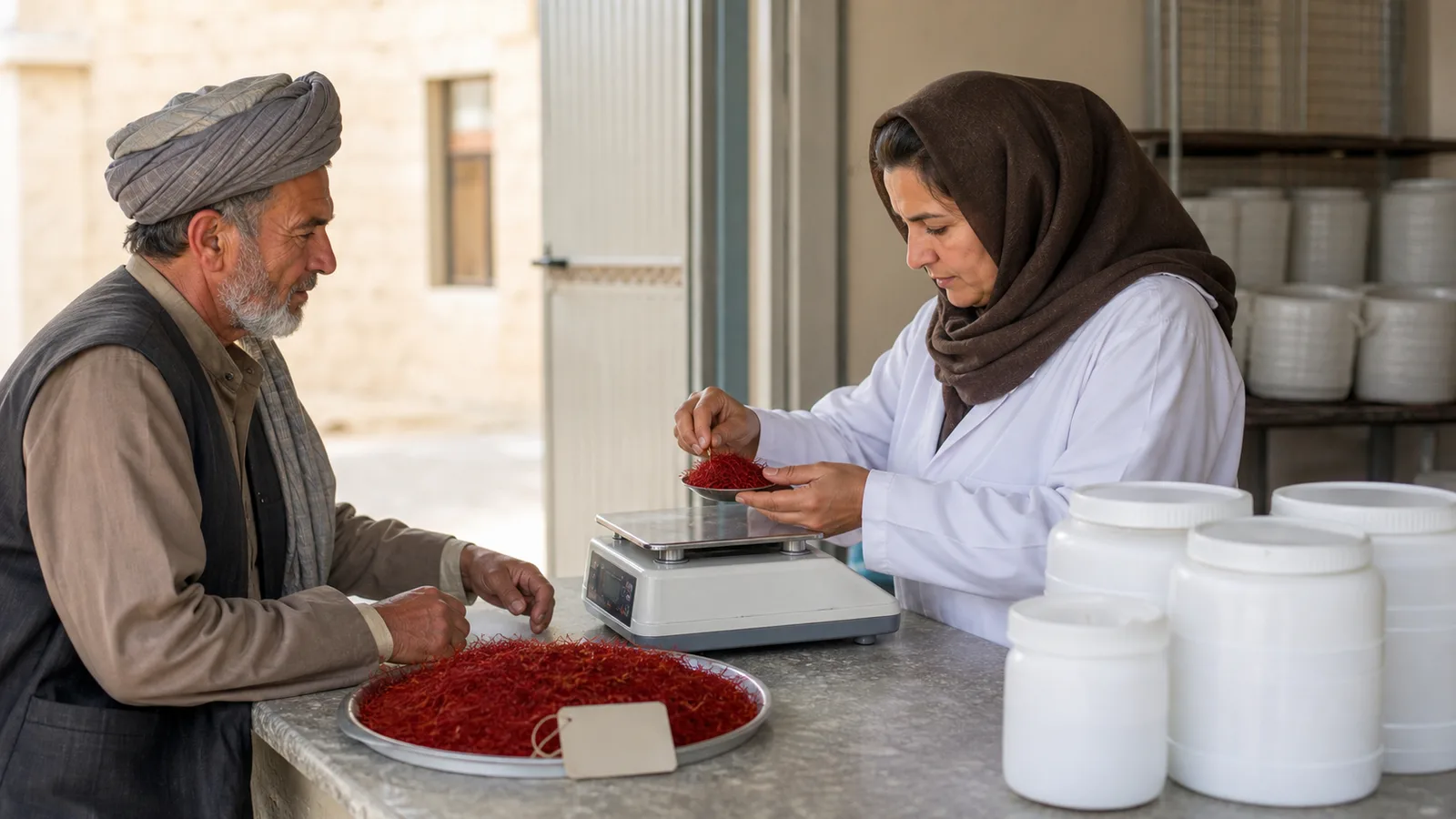
That was the concern raised by National Saffron Council member Ali Hosseini in an archived report about Iran’s government purchase programme. A separate North Khorasan account shows why the policy also appealed to growers: it created a buyer during a difficult season, introduced grade-based prices and helped establish a provincial quality laboratory. Read together, the reports show a policy with immediate benefits and real long-term risks.
What is a supportive purchase of saffron?
In this programme, the Rural Cooperative Organization bought dried saffron from growers under announced conditions rather than leaving every farmer to accept the day’s private-market price. The immediate purpose was price support and a reliable outlet at harvest, when many growers need cash and a large volume reaches the market at once.
Support is not the same as an ordinary commercial purchase. The public buyer must appraise quality, accept or reject lots, store the accepted saffron, pay farmers and eventually decide how the stock will be sold. A delay or weak decision at any one of those stages affects the rest of the market.
The national figures behind the criticism
Hosseini said the organization had taken 72 tonnes and 117 kilograms of saffron into its warehouses from 1,036 farmers. He credited the programme with temporarily preventing a price decline, but said delayed claims had put growers under financial pressure.
The report stated that 3,136 billion rials had been settled since purchases began in November, representing 46% of the relevant claims in North and South Khorasan. Because the archived translation does not include the underlying payment ledger or a clean number format, the amount should be treated as the report’s stated figure. The 46% share is the clearer measure: at that point, more than half of the recorded claims remained unsettled.
Hosseini said some farmers would rather have accepted a lower cash price than waited for the higher programme payment. That is not proof that every participating farmer regretted the decision, but it identifies a basic design problem. A purchase price only protects income when the payment date is reliable enough for the grower’s expenses.
North Khorasan: what happened to the delivered lots
Ramezani, then director general of the North Khorasan Rural Cooperative, reported 1,030 kilograms delivered for supportive purchase. The old headline incorrectly called the accepted quantity “765 tons.” The surrounding figures, including kilogram-level payments, make clear that the intended unit was kilograms.
The report nevertheless contains totals that do not reconcile:
- it says 276 kilograms were returned and 765 kilograms were purchased, although 1,030 minus 276 equals 754;
- it says payment had been made for 290 kilograms and remained due for 505 kilograms, a combined 795 kilograms; and
- it does not explain whether the figures came from different reporting dates, adjustments or a transcription error.
Those values should not be forced into a tidy total without the original ledger. What can safely be retained is the operational picture: some lots were rejected because a farmer did not accept the offered price or because the saffron did not meet the required standard, while many accepted lots still awaited payment.
Four price levels and a new quality laboratory
North Khorasan used four purchase prices based on appraisal. Ramezani said most local saffron qualified for the highest reported level, 10.5 million tomans per kilogram. This is a historical programme price, not a current quotation and not a promise of what any lot would receive today.
The programme’s most durable reported benefit was infrastructure. Ramezani said it led to a saffron quality laboratory for the province, then being equipped, and that future harvest training would help growers protect quality. The article does not establish when the laboratory became operational, what tests it obtained accreditation for or how many farmers later received training, so those remain announced outcomes rather than verified current services.
The direction aligns with current value-chain work. FAO’s programme in Iran brings together farmers, processors, cooperatives, traders and experts to improve production, post-harvest handling, safety, traceability and marketing. A lab is useful when it is part of that complete chain: representative samples, documented methods, clear grades, traceable lots and results buyers can understand.
Why stored saffron can become a market risk
A public purchase reduces the volume offered during harvest. It does not remove that saffron from existence. Unless stock is allocated for a defined purpose, it remains future supply.
Hosseini worried that releasing 72-plus tonnes into already weak conditions could depress prices and harm production. That is a risk scenario, not evidence that the release occurred or caused a measured loss. The outcome depends on timing, volume, quality, transparency and whether the sale meets new demand or merely competes with the next crop.
Storage also has to preserve what the programme bought. The Codex saffron standard CXS 351-2022 covers quality classes, contaminants, hygiene, packaging, labelling and analytical methods. A stock policy therefore needs more than a tonnage total. It needs lot-level grade, test results, packaging, storage conditions, age and a planned release route.
The COVID-era export warning
The national account was written during the coronavirus disruption. Hosseini said saffron exports had slowed as routes closed and argued that Iran was not prepared for crises affecting agricultural markets, whether disease or flood.
His proposed “export anchors” is better understood as overseas distribution or market bases on several continents, not literal anchorages. The aim was to maintain local inventory, customer relationships and fulfilment when exporters could not move normally from Iran.
That concept can reduce dependence on one route, but only if each hub has lawful import arrangements, traceable inventory, realistic demand and controlled storage. Sending stock abroad without those conditions would move the warehouse risk rather than solve it.
What a safer purchase programme would disclose
The two reports point to a practical checklist for future support:
- publish eligibility, grade definitions, sample methods and prices before delivery;
- give each grower a receipt showing accepted weight, grade, price and a firm payment date;
- report accepted, rejected, paid and unpaid kilograms from the same cut-off date;
- keep public stock in traceable lots with current quality records;
- publish the purpose, timing and method of any release before it reaches the market; and
- measure success through payment time, farmer net return, quality and realised sales, not only kilograms purchased.
A supportive purchase of saffron is neither automatically harmful nor automatically successful. In North Khorasan it offered a buyer, differentiated quality and helped justify laboratory capacity. Across the wider programme, delayed payment and a large stored volume created legitimate concern. Support works best when it gives farmers prompt certainty and gives the market equally clear information about what happens next.

![Exporting Saffron to Turkey + Price Guide [Complete 0 to 100]](https://img.rowhanisaffron.com/20260827003933/saffron-export-turkey-quality-inspection.webp)



