


North Khorasan was described as Iran’s third-largest saffron-producing province in a November 2020 statement by Abdullah Yousefi, then head of the provincial Agricultural Jihad Organization. This article preserves that dated production snapshot; its figures should not be read as current statistics.
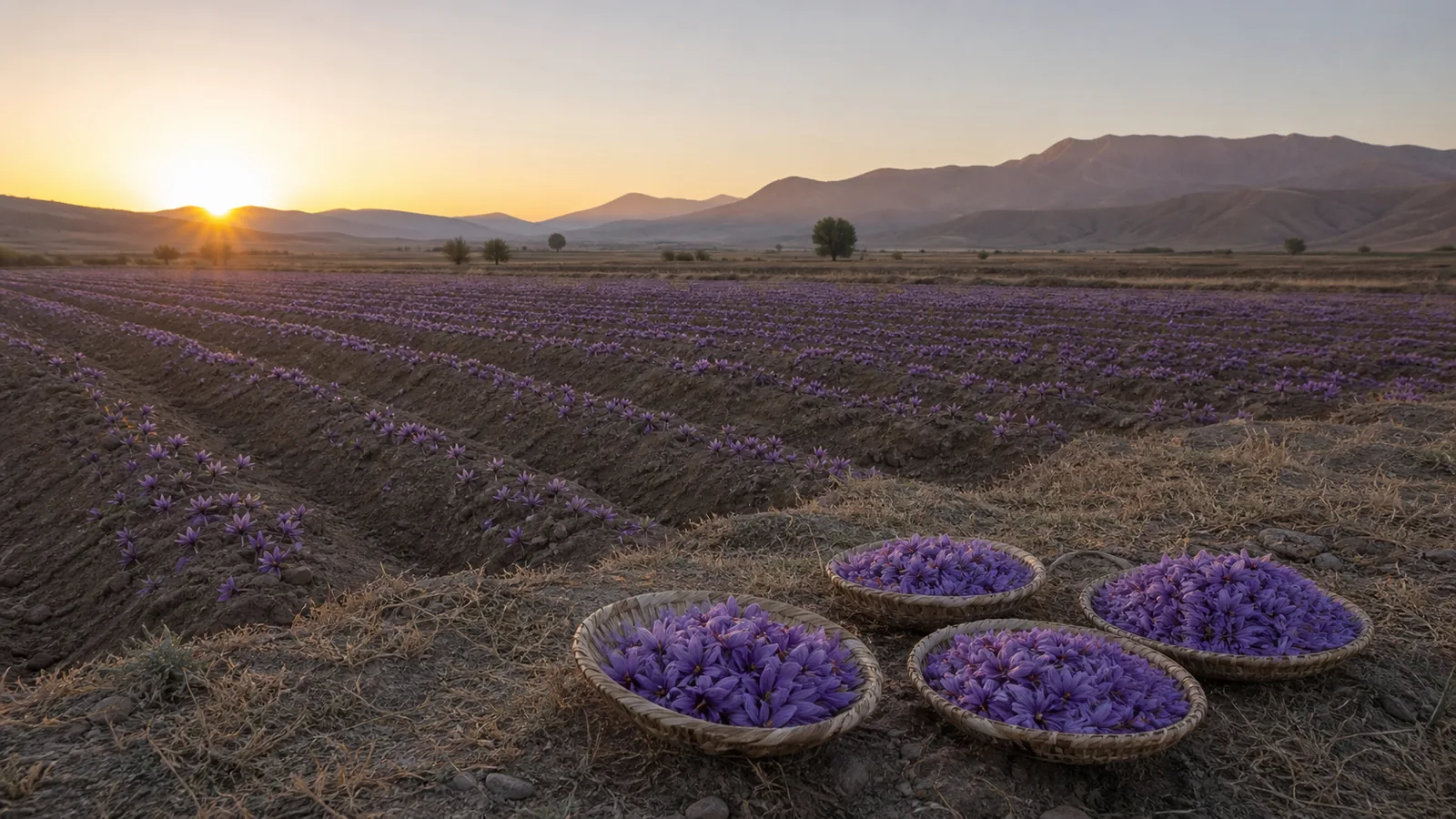
North Khorasan’s reported saffron production in 2020
Yousefi reported 3,997 hectares under saffron cultivation and annual production of about 20 tonnes. He also cited an average yield of 6 kg per hectare. Those three rounded figures do not reconcile exactly—3,997 hectares at 6 kg would imply almost 24 tonnes—so they are best retained as separate estimates from the original statement rather than combined into a new calculation.
The crop was reported in all eight counties of North Khorasan. Faruj held the leading position, with 2,453 hectares and approximately 14 tonnes of annual production. Shirvan and Esfarayen ranked second and third within the province.
Why saffron mattered to the province
The statement valued North Khorasan’s saffron output at 1.8 trillion rials and said it accounted for 17% of the province’s total horticultural production value. These are historical, nominal figures from the 2020 report; inflation and changes in cultivated area mean they cannot be used as a present-day valuation.
Saffron also fitted the province’s agricultural conditions. North Khorasan includes arid and semi-arid areas where drought and pressure on water resources have shaped planting decisions. Saffron needs irrigation at a different point in the agricultural calendar from many other crops, which can reduce direct competition for water during peak demand. Low water demand, however, does not mean no water requirement or automatic suitability for every field; soil, drainage, corm health and local climate still matter.
Employment and the local value chain
Yousefi said a hectare of saffron supported one direct job and a much larger amount of indirect or seasonal work through planting, field care, flower picking and stigma separation. The English source rendered the latter figure as 180–200 “jobs” per hectare, but that wording is ambiguous and may refer to seasonal labour inputs or workdays. It should not be treated as 180–200 permanent positions without the underlying methodology.
At the time, the province had five saffron processing and packaging units with a combined annual capacity reported as 3.4 tonnes. That capacity was much smaller than the stated crop, which helps explain the article’s emphasis on processing, packaging and post-harvest investment. When saffron leaves a producing area in bulk, more of the sorting, branding and retail value can be captured elsewhere.
Advantages identified in the provincial plan
The 2020 statement presented several reasons for expanding saffron cultivation:
- adaptation to dry and semi-dry conditions;
- irrigation timing that differs from many competing crops;
- potential replacement of some high-water-demand orchards or fields where agronomically suitable;
- the possibility of mechanising parts of planting and field management;
- relatively manageable crop maintenance outside the labour-intensive harvest;
- existing processing and packaging businesses; and
- export potential for properly handled saffron.
The organisation’s proposed support included technical advice during planting, crop care and harvest; transfer of production knowledge; development of the saffron value chain; access to inputs and cultivation tools; finance; crop insurance; and support-purchase programmes.
Problems that could limit growth
The same statement did not treat expansion as risk-free. It identified the lack of mechanised harvesting, uneven technical knowledge, pest and disease pressure during rapid growth, volatile markets, limited export planning, bulk sales and insufficient processing as constraints.
These concerns are connected. Expanding the planted area without enough healthy corms, field advice, workers and drying capacity can weaken quality. Increasing production without reliable buyers or transparent grading can also expose farmers to price shocks. Yousefi therefore called for affordable finance for new technology, more research, investment incentives for post-harvest industries, stronger producer organisations, better insurance and support for organic production where certification requirements could be met.
North Khorasan in Iran’s saffron sector
The original report also stated that Iran accounted for 90% of the world’s saffron-growing area and 89% of production. Global-share estimates vary by year and source, so those percentages belong to the report’s period rather than serving as permanent figures.
What the 2020 snapshot shows clearly is North Khorasan’s role beyond field production. Faruj, Shirvan and Esfarayen were part of a growing provincial cluster, while processing capacity, labour availability, market access and technical support determined how much of the crop’s value stayed locally. The title’s “third largest” claim is therefore preserved as an attributed historical ranking, not presented as an undated fact.

![Exporting Saffron to Turkey + Price Guide [Complete 0 to 100]](https://img.rowhanisaffron.com/20260827003933/saffron-export-turkey-quality-inspection.webp)



