


In a 2020 assessment of Khorasan Razavi agriculture, provincial officials argued that Iran’s strength in saffron cultivation was not being matched by processing, product development, packaging and branding. Their central concern was simple: selling a valuable crop mainly as a raw ingredient leaves much of its eventual value elsewhere.
What “conversion industries” means here
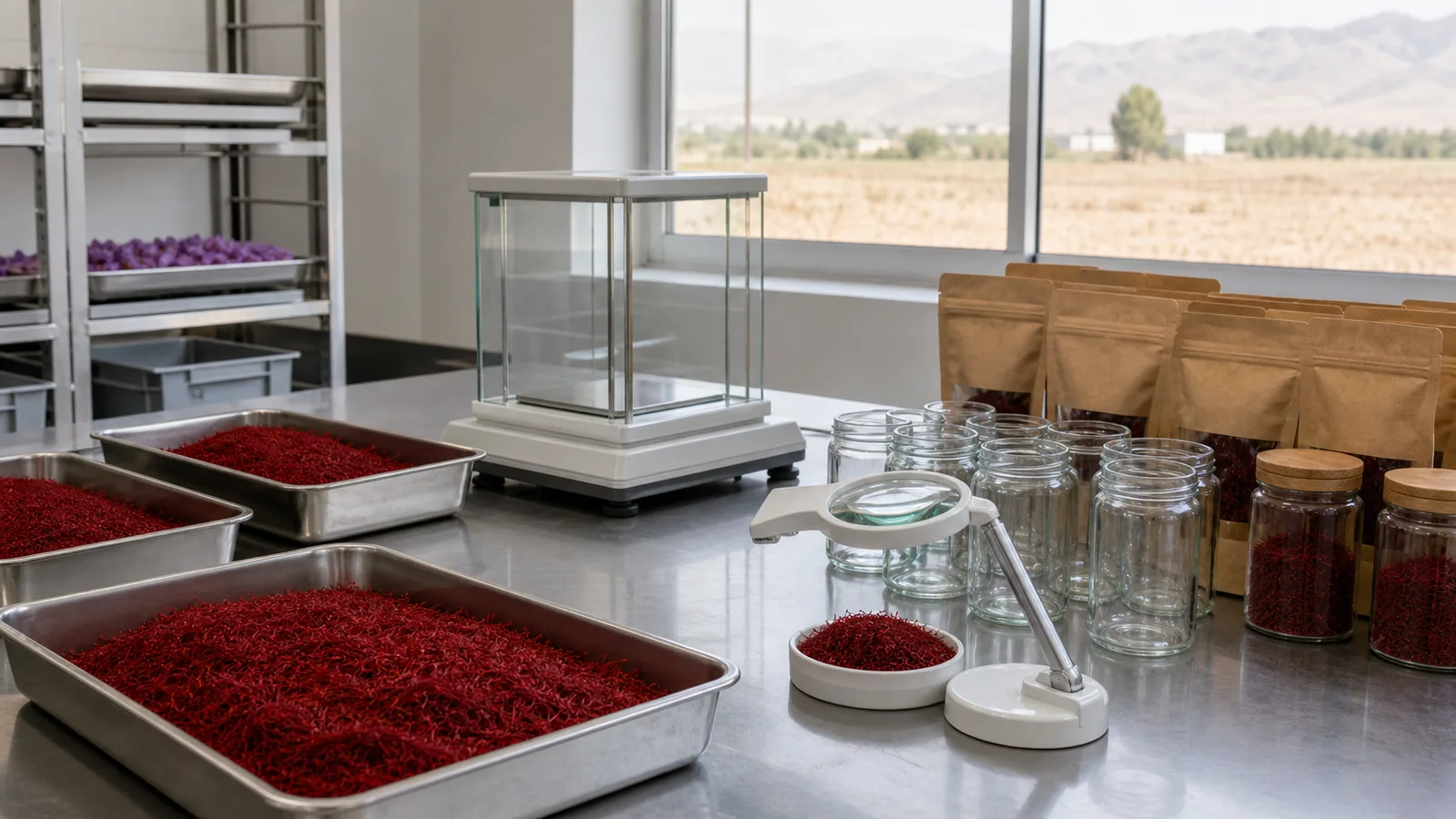
The phrase in the original report is a literal translation of a term used for agricultural processing and complementary industries. In practical terms, it covers the work between harvest and the final market: cleaning, grading, drying, quality control, packaging, formulation, storage, transport and the manufacture of products that use saffron.
This article preserves the officials’ dated figures and proposals. They describe the sector at the time of publication and should not be treated as current production, population or market-share data.
Khorasan Razavi’s agricultural base
The report described agriculture as accounting for 40% of the province’s gross domestic product and cited roughly one million hectares of irrigated and rain-fed crops and orchards, producing about eight million tonnes a year. It ranked Khorasan Razavi first in Iran for cumin and red meat, second for eggs, third for milk and fourth for chicken meat. It also listed 15.8 million livestock units and more than 1.4 million tonnes of livestock and poultry products.
For horticultural crops, the province was ranked first in saffron, second in pistachios, third in pomegranates and fourth in grapes. A population figure of 6,434,501 people in 2,450,916 households was quoted, including approximately 1.733 million rural residents.
Water was the agricultural constraint
Mohammad Reza Orani, then head of the provincial Agricultural Jihad Organization, said more than 98% of Khorasan Razavi’s agricultural output depended on groundwater and only 2% of cultivation was rain-fed. In an arid and semi-arid province with depleted aquifers, he argued that cropping systems had to change.
The statement cited 67,000 hectares of vegetables and summer crops, about 50,000 hectares of which were described as vegetables and similar field crops. It claimed that their output was equivalent to production from 5,000 hectares of greenhouse cultivation, while a hectare of greenhouse production could yield ten times as much as irrigated open-field cultivation and support ten direct and indirect jobs.
Greenhouse area was reported at 374 hectares, compared with about 118 hectares in 2013, with a further annual target of 225 hectares. These figures explain why water efficiency and controlled cultivation sat beside saffron processing in the province’s development debate.
Why agricultural processing matters
Processing can extend the useful life of crops harvested in a short season, reduce waste, create rural work and connect agriculture with manufacturing and export. It does not automatically guarantee food security or higher farmer income, but adequate drying, storage, grading and packaging can protect quality and widen the range of buyers.
Alireza Bustani, then head of the Khorasan Razavi Transformation Industries Association, argued that processing could also reduce seasonal unemployment and rural migration. He said factories often received crops that failed standards because of fertilizer use, pesticide practices or poor durability, making better communication with growers essential.
Bustani described much of the province’s processing equipment as outdated. As an example of export opportunity, he pointed to Russia’s reported annual import of 160,000 tonnes of tomato paste. He also stated that 70% of Iran’s conversion industries were located in Khorasan Razavi, that their output was twice provincial consumption and that 90% of owners were private-sector businesses. These are attributed claims from the period, not independently verified current shares.
The saffron value gap
The report said Khorasan Razavi produced most of Iran’s saffron and put Iran’s share of global production at about 95%, yet estimated the country’s share of the global market’s value at only 4%. Production share and market-value share are different measures, and both vary by year, source and the way re-exports are counted. The comparison nevertheless captured the officials’ concern: a producer can lead in volume while capturing a much smaller share of branded retail value.
Hashem Naghibi, then director of horticulture at the provincial organisation, said more than 120 saffron packaging units operated in Khorasan Razavi but mostly packed saffron in raw form. Processing beyond tea and a limited range of drinks was described as minimal. He called for new beverages, flavour products, essential oils and pack sizes designed for different uses, provided that quality, safety and labeling requirements were met.
Naghibi reported more than 86,000 hectares of saffron, over 300 tonnes of output and 144,000 saffron farmers in the province. He said one hectare generated about 200 workdays and one permanent job opportunity. For the preceding year, the report gave 310 tonnes harvested from 86,400 hectares, with about 250 tonnes exported for $355 million.
Mechanisation and post-harvest quality
Mechanisation was another weakness identified in the saffron chain. Naghibi said there was still no satisfactory machine for separating stigmas from saffron flowers and that research had not yet delivered the desired results across planting, field care, harvest and classification.
He divided production costs into roughly 20–25% for planting, 35% for harvesting and 40% for flower separation and drying. He estimated that mechanisation across these stages could reduce total costs by 60–70%. Because those percentages came from an official interview rather than a published cost study in the article, they are best read as the speaker’s estimates.
The same section stressed hygienic handling during and after harvest. That point is fundamental regardless of machinery: flowers deteriorate quickly, and contamination or poor drying can reduce colour, aroma, safety and export acceptance.
Finance for agricultural machinery
Seyed Saeed Sajjadi, head of mechanised technologies in the provincial organisation, said annual mechanisation finance had been 60 billion rials before 2013 and that a cumulative 4.17 trillion rials had been paid from 2013 onward. The report described this as a 70-fold increase, although comparing an annual amount with a multi-year cumulative total does not establish a like-for-like annual increase.
Sajjadi reported that the province’s mechanisation level reached 1.86 horsepower per hectare, up from 1.2, and that mechanised harvesting of irrigated wheat rose from about 30% to 63%, with a target of 67%. These wheat figures were used to show the broader direction of agricultural investment rather than the mechanisation rate of saffron itself.
Raw sales beyond saffron
Najafgholi Salehi, a former head of the provincial organisation, described raw sales as a wider problem. He cited 363,000 farmers, eight million tonnes of annual horticultural, crop and livestock output, 2.138 million hectares of potentially agricultural land and 1.2 million cultivated hectares across 83 crops—900,000 hectares of field agriculture and 300,000 hectares of orchards.
Salehi argued that processing medicinal plants and other crops locally could retain more value, but investment in transport was also necessary. Without reliable domestic and export logistics, losses and delays can place more pressure on land and water rather than relieving it.
What the 2020 report was really asking for
The argument was not simply for more factories. It was for a connected saffron system: better production advice, hygienic harvest and drying, accurate grading, modern equipment, credible packaging, product development, market research, transport and recognizable Iranian brands.
That distinction matters. Turning saffron into more products is useful only when the products meet real demand and retain traceable quality. The unresolved lesson in the report is that production leadership by itself does not guarantee pricing power, export resilience or recognition in the final market.

![Exporting Saffron to Turkey + Price Guide [Complete 0 to 100]](https://img.rowhanisaffron.com/20260827003933/saffron-export-turkey-quality-inspection.webp)



