


Standardizing saffron onions and harvested flowers was identified as a priority for Iranian saffron when Alireza Kouchaki discussed gaps in corm trade, flower handling and production statistics.
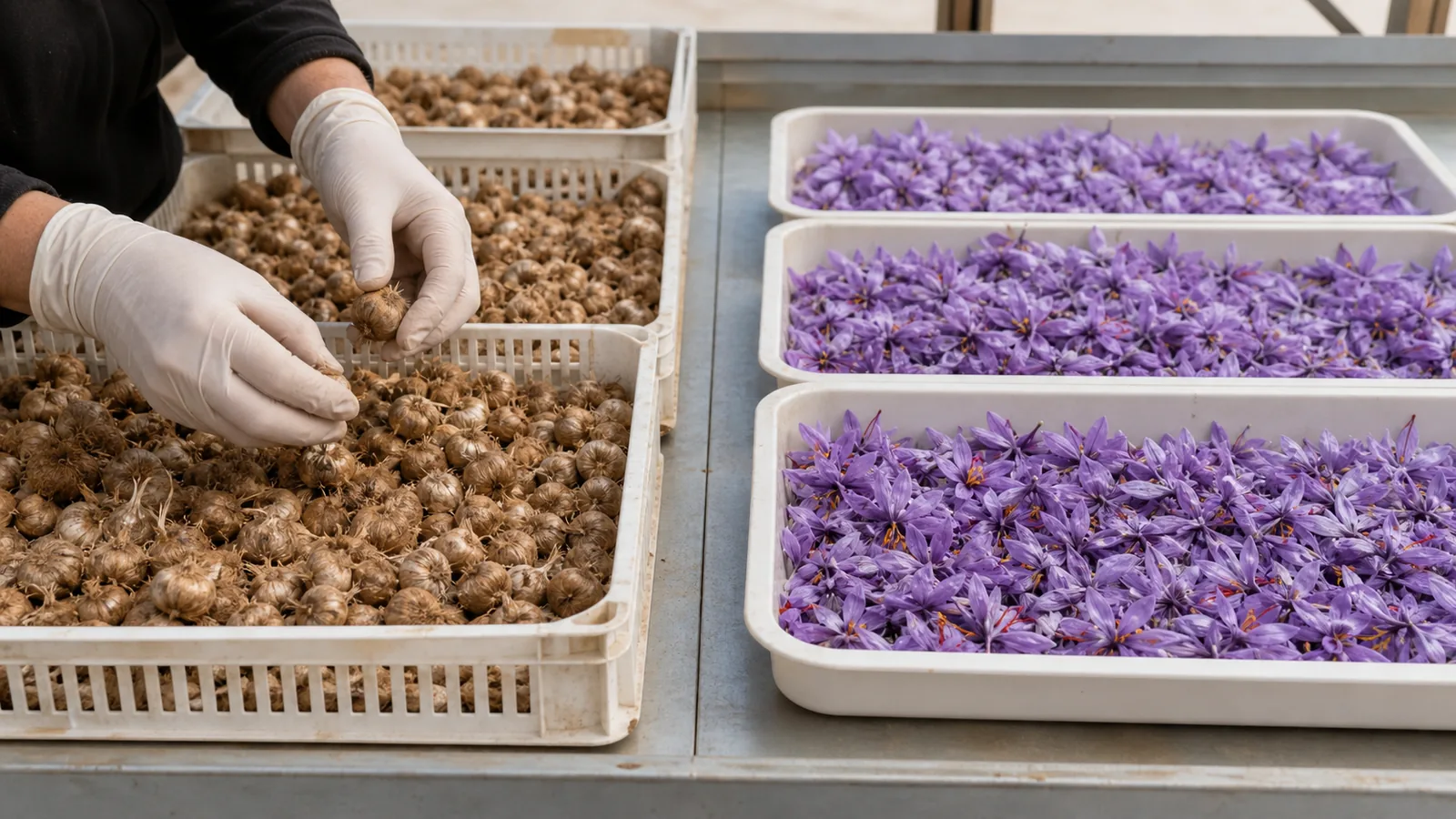
In saffron farming, the part often called an onion or bulb is technically a corm. Kouchaki’s concern was that corms were being bought and sold loose without a consistent standard, while freshly harvested flowers were transported in bulk in vans.
Why saffron onion standardization matters
Kouchaki, a professor in the Department of Agriculture at Ferdowsi University’s Faculty of Agriculture, presented the two issues together: the planting material entering a field and the flowers leaving it after harvest.
According to his remarks, unstandardized saffron onions made it difficult to bring order to trade at the beginning of the production cycle. A grower buying corms in bulk needs meaningful information about the lot rather than an undifferentiated load with no shared specifications.
His first proposed priority was therefore to organize these transactions. The statement did not set out a finished grading standard, but it clearly identified consistency and traceability as missing parts of the system.
The problem with bulk flower handling
The second concern was the treatment of harvested saffron flowers. Kouchaki said flowers were being piled loosely into vans. That approach makes the condition and handling history of a load harder to control during the short period between picking and stigma separation.
He treated flower handling as part of the same standardization problem as corm sales. In both cases, organization depends on agreed practices, identifiable lots and a process that can be checked rather than informal bulk movement alone.
Remarks from the Iranian saffron roundtable
Kouchaki made the comments during a roundtable called “Iranian Saffron in the World Arena” at Ferdowsi University’s Faculty of Agriculture.
He also referred to the fifth International Saffron Symposium in Morocco. According to the figures quoted in the report, about 74 people from 15 countries took part, and Iran had the largest delegation with 25 participants.
The remarks predated the next symposium, which he said was due to be held in Iran in 2018. Its planned theme was saffron and health, and he expected pharmacy and medical faculties to be involved.
Iran’s scale and saffron cultivation elsewhere
Kouchaki used the Morocco meeting to emphasize the exceptional scale and visibility of Iran’s saffron fields. The original wording suggested that saffron was not cultivated elsewhere, but that statement is too broad when read literally.
Saffron is cultivated in a number of countries. An updated peer-reviewed review of saffron production lists Iran, India, Spain, Italy, Morocco and Greece among the principal producers, along with newer cultivation areas. Iran’s importance lies in the scale of its production, not in being the only country where the crop grows.
Conflicting production statistics
Kouchaki described saffron as the world’s most expensive spice and a crop associated with particular growing regions. He then turned to a less flattering problem: the statistics used to describe Iran’s own industry did not agree.
He said different estimates of cultivated area had been mentioned even at the fifth symposium. The report also recorded a Ministry of Agricultural Jihad figure of 350 tonnes of saffron produced in the preceding year. Because the remarks were made before the planned 2018 event, that number is historical and should not be treated as a current production total.
Why a shared system was the central argument
Kouchaki’s criticism went beyond one disputed number. He argued that progress required order, a common system and consistent accounting. Without those foundations, separate organizations and individuals could continue making decisions from different data.
Seen in that context, saffron onion and flower standardization were not isolated technical details. They were practical starting points for a production chain in which planting material, harvested flowers and national statistics could be described in a consistent way.
The two priorities in practical terms
- Saffron corms: move beyond anonymous bulk buying and selling toward defined, identifiable lots.
- Harvested flowers: replace uncontrolled loose transport with handling practices that can be managed and checked.
- Production records: use consistent methods so cultivated-area and output figures can be compared.
- Joint decisions: bring researchers, growers and authorities into a shared system rather than relying on fragmented estimates.
The report remains useful as a record of how an Iranian agricultural researcher framed the industry’s problems. Its symposium dates and production figure are historical, but its core distinction is still clear: quality cannot be separated from the way corms, flowers and information move through the saffron supply chain.

![Exporting Saffron to Turkey + Price Guide [Complete 0 to 100]](https://img.rowhanisaffron.com/20260827003933/saffron-export-turkey-quality-inspection.webp)



